Cart
0
TL;DR: Choosing LED strip lights comes down to three decisions: length (measure the run first, since most kits are sold in fixed lengths like 5m or 15m and can be cut to fit but not extended without a connector), colour temperature or RGB (warm white for cosy spaces, RGB or colour-changing for accent and mood lighting), and control type (a basic remote is fine for a single room, while a WiFi or app-controlled strip is worth it if you want scheduling or voice control). Always check the strip is rated for its location — kitchens and bathrooms need a higher IP (ingress protection) rating than a bedroom or living room.
LED strip lights have gone from a niche accent product to one of the easiest ways to change how a room feels, whether that's under-cabinet task lighting in a kitchen, a soft glow behind a TV, or colour-changing lighting for a home office or games room. The catch is that "LED strip light" covers a huge range of products, and picking the wrong one usually means either running short partway through a wall, or ending up with a colour that doesn't suit the room. Here's how to narrow it down before you buy.
Step 1: Measure the run before you look at anything else
LED strip kits are sold in fixed lengths, most commonly 5m, and multi-pack or long-run kits stretching to 15m or more. Measure the actual path the strip will follow — not just the straight-line distance — including any corners, since strips need a small amount of extra length to turn a corner cleanly rather than kink.
Most strips can be cut shorter at marked cut points (look for a printed scissor icon along the strip), so buying slightly longer than you need and trimming the excess is safer than buying short and discovering you're 40cm off the end of the cabinet. Extending a strip beyond its supplied length usually requires a separate connector and, for longer total runs, a second power injection point — worth checking before you commit to one continuous run around an entire room.
Step 2: Decide between fixed colour, warm/cool white, and RGB
- Fixed warm white (around 2700K–3000K) suits everyday living spaces — under kitchen cabinets, along a hallway, behind a bed frame — where you want light that reads as cosy rather than clinical.
- Cool white (4000K–6000K) is better suited to task-focused areas like a garage, workshop, or study nook, where clarity matters more than ambience.
- RGB or RGBW strips let you change colour and, on RGBW models, still access a true white setting separately from the colour modes. These are the right choice for accent lighting — behind a TV, along a shelf, or in a games room — where the point is mood rather than practical illumination.
If you're unsure, a colour-temperature-adjustable white strip (sometimes sold as "CCT" or "tunable white") is a reasonable middle ground: it skips the RGB colour features but lets you shift between warm and cool white depending on the time of day.
Step 3: Work out how much control you actually want
- Basic remote control covers on/off, brightness, and colour selection for a single strip or room. This is enough for most single-space installs and is the cheapest option.
- App or WiFi control (compatible with Alexa or Google Assistant on most current kits) adds scheduling, voice control, and syncing multiple strips together. It's worth the extra cost if you want the lights to turn on automatically at dusk, or if you're already running a broader smart-home setup and want one app for everything.
- Music-reactive modes, found on some app-controlled strips, sync colour changes to sound — a genuinely useful feature for a media room or entertaining space, and one that's hard to add after the fact if you buy a basic remote-only kit.
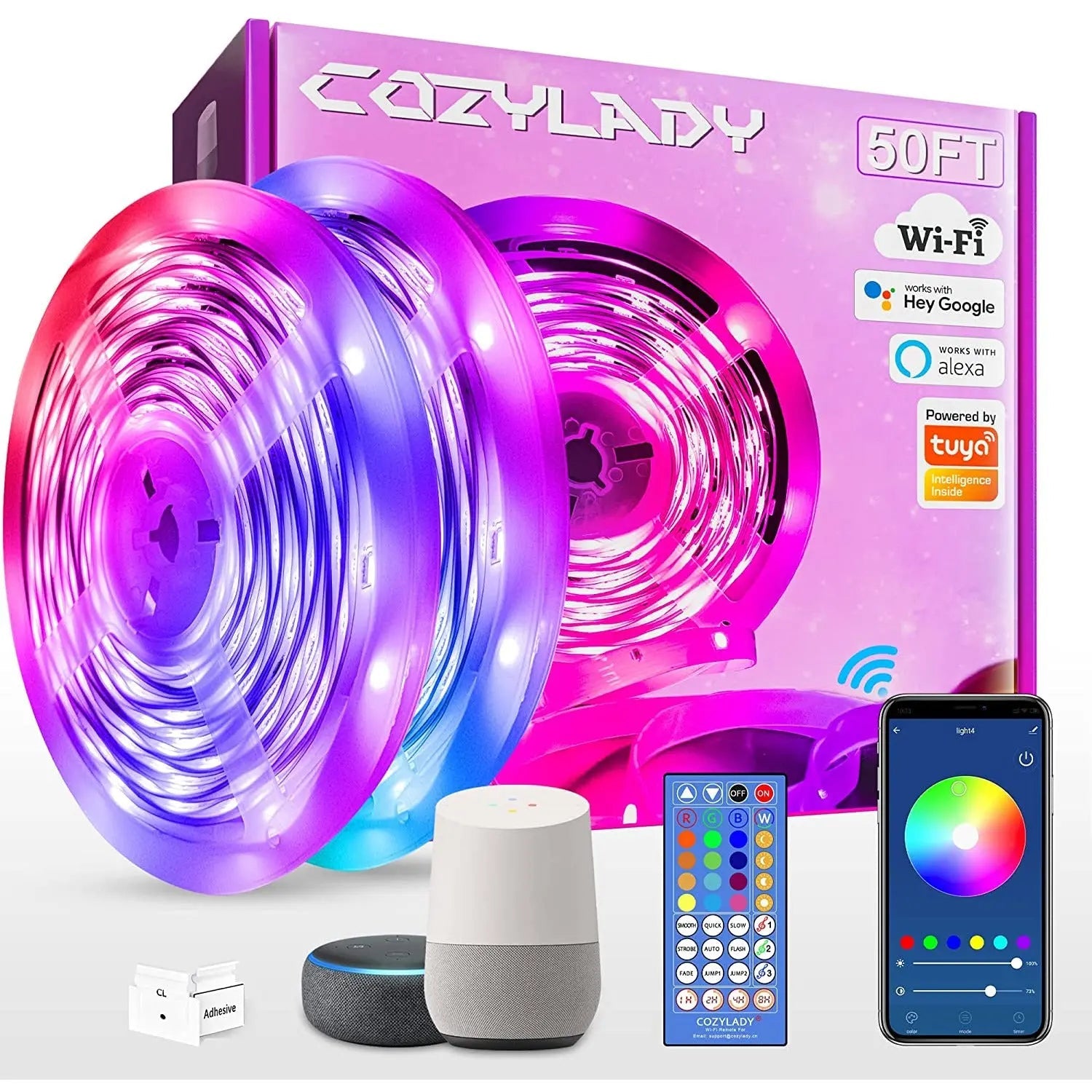
The 15m WiFi LED Strip Lights with Alexa and Music Sync cover this end of the spectrum in one kit — a long enough run for most full-room installs, with app control and voice-assistant compatibility included rather than needing to buy a separate smart hub.
Extending or joining strips without losing brightness
If a single kit doesn't cover the full run, or you need to join two strips at a corner without buying a whole new length, LED strip connectors let you extend or angle a run without soldering. Match the connector's pin count (commonly 4-pin for single-colour RGB strips) to your strip type before buying, since a mismatched connector won't seat properly and can cause flickering at the join.
LED strip light comparison at a glance
| Use case | Recommended type | Control |
|---|---|---|
| Under kitchen cabinets | Warm white, IP65+ rated | Basic remote or app |
| Behind a TV or shelf | RGB or RGBW | Remote or app, colour-changing |
| Bathroom mirror or vanity | Warm/cool white, higher IP rating for moisture | Wall switch or basic remote |
| Games room or media space | RGB, music-reactive if available | App with voice-assistant sync |
| Hallway or stairs | Warm white, motion-activated where possible | Basic remote |
Common LED strip light mistakes
- Not measuring corners into the total length, resulting in strips running short by the last 30–50cm of a run.
- Choosing cool white for a living or bedroom space, which can make a room feel clinical rather than relaxed — reserve cool white for task areas.
- Ignoring IP rating in kitchens and bathrooms, where steam and splashes need a strip rated for damp conditions, not a standard indoor-only strip.
- Buying a basic remote kit, then wanting scheduling later — if there's any chance you'll want automation, it's cheaper to buy app-controlled from the start than to replace the whole strip.
Frequently asked questions
Can I cut LED strip lights to a shorter length?
Yes, most LED strips can be cut at marked cut points along the strip (usually shown with a small scissor icon), but only at those points — cutting elsewhere can damage the circuit for that whole segment.
What colour temperature is best for a bedroom?
Warm white, generally in the 2700K–3000K range, reads as relaxing rather than clinical and suits most bedroom lighting needs better than cool white.
Do I need a special LED strip for a kitchen or bathroom?
Yes — look for a higher IP (ingress protection) rating for areas exposed to steam, splashes, or humidity, rather than a standard indoor-only strip.
Can I join two different LED strip lights together?
You can join or extend compatible strips using a connector matched to the strip's pin count and voltage, but mixing different brands or strip types isn't guaranteed to work reliably.
Is WiFi LED strip lighting worth the extra cost over a basic remote kit?
If you want scheduling, voice control, or to sync lighting with a broader smart-home setup, yes. For a single room with no automation needs, a basic remote-controlled strip does the same core job for less.