Cart
0
TL;DR: A ceiling rose is a mounting plate that covers the wiring point where a pendant or chandelier hangs down from the ceiling — you need one whenever you want a fixture that drops on a cable or chain. A flush mount (or semi-flush mount) light is a self-contained fixture that sits directly against, or very close to, the ceiling with no drop at all. If your ceiling is under about 2.4m, or the room is a hallway, wardrobe or stairwell where headroom matters, a flush mount is almost always the safer, more comfortable choice.
These two terms get mixed up constantly because people usually start from "I want a light for this ceiling" rather than "I want a rose" or "I want a flush mount." But they solve different problems, and picking the wrong one means either a fixture that hangs too low to walk under, or a plain flush light in a room that really wanted the drama of a hanging pendant.
What a ceiling rose actually is
A ceiling rose is the round plate — plain, ribbed or ornately detailed depending on the style — that sits flush against the ceiling and conceals the electrical junction where the cable for a pendant light or chandelier connects. It is not a light fixture on its own. It is the hardware that lets a hanging fixture attach neatly, rather than leaving bare wiring exposed at the ceiling.
Because a ceiling rose is designed around a hanging fixture, choosing one only makes sense if the room can accommodate the drop. A pendant on a rose typically hangs anywhere from 15cm to well over a metre below the ceiling, depending on the cable length and the style of fixture, which is exactly why rose-and-pendant combinations suit higher-ceilinged rooms best — see our guide on how high to hang a chandelier over a dining table for the specific drop numbers.
What a flush mount (or semi-flush mount) light is
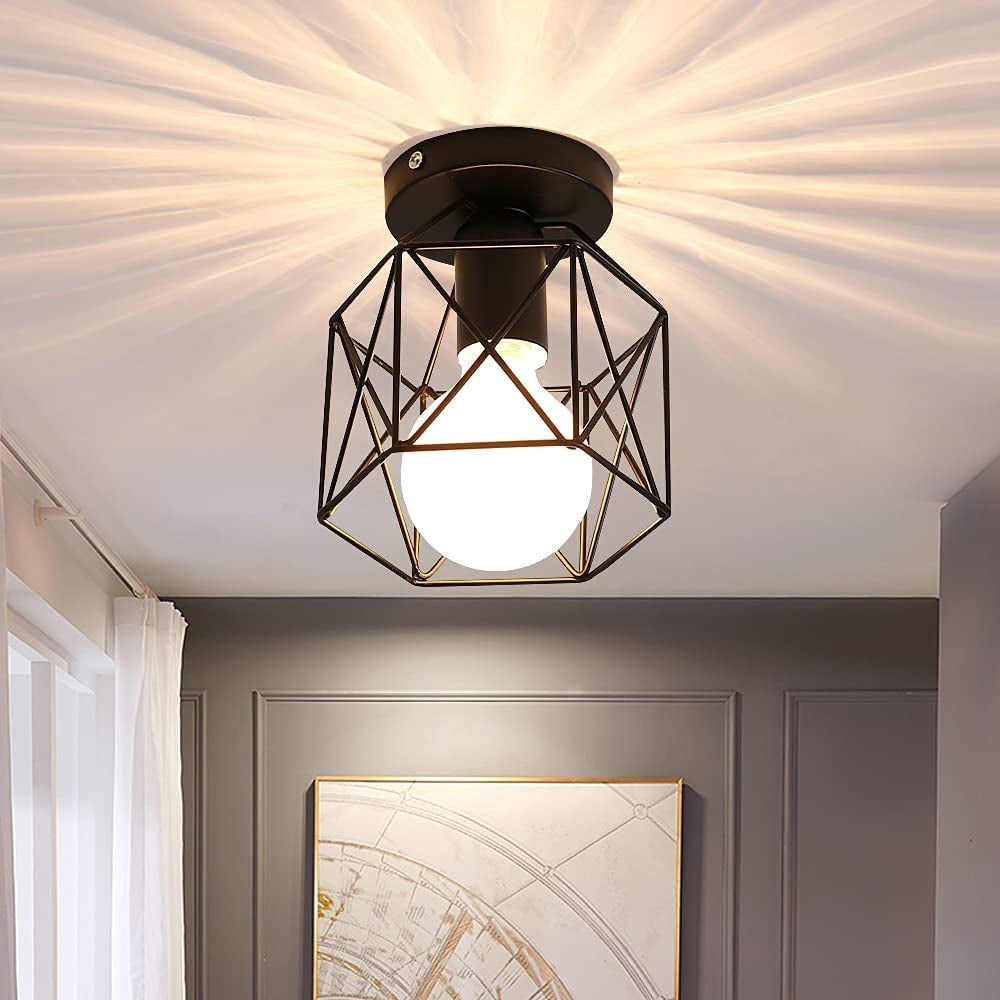
A flush mount light is a complete fixture that installs directly against the ceiling surface, with no rose and no drop. A semi-flush mount sits just a few centimetres proud of the ceiling — enough to house the globe and diffuser — but still nowhere near the range of a pendant.
Flush and semi-flush fixtures exist specifically to solve the low-headroom problem: hallways, wardrobes, stairwells, and rooms with a standard 2.4m Australian ceiling all benefit from a fixture that does not eat into usable head height. A black metal semi-flush mount ceiling light, for example, is built around exactly this brief — enough drop to diffuse the light properly without hanging low enough to bump into.
Ceiling rose vs flush mount: the direct comparison
| Ceiling rose (+ pendant) | Flush mount | Semi-flush mount | |
|---|---|---|---|
| Drop below ceiling | 15cm to 100cm+ | Near zero | A few cm |
| Best ceiling height | 2.7m and above | Any height, especially under 2.4m | 2.4m and above |
| Best rooms | Dining table, entry statement, living room | Wardrobes, stairwells, low hallways | Bedrooms, hallways, kitchens |
| Visual effect | Sculptural, a focal point | Understated, functional | A middle ground — some presence, minimal drop |
| Typical use case | A single fixture as a design centrepiece | Even, general-purpose room lighting | General lighting with a touch more style than a bare flush disc |
How to decide for your room
Start with your ceiling height, not the look you want. A standard Australian ceiling sits at 2.4m. Below that, a hanging pendant on a rose will often sit at head height for a taller person, which is uncomfortable in a walkway and genuinely unsafe in a wardrobe or under-stair space. Reserve rose-and-pendant combinations for rooms at 2.7m or higher, or for a raised section of an open-plan ceiling.
Think about foot traffic. Hallways, entries you walk through rather than stand in, and stairwells are flush or semi-flush territory almost by default — you do not want a fixture anyone has to duck under on the way past.
Match the fixture to the room's job. A dining table or a living room centrepiece benefits from the visual weight a pendant on a rose provides — see our guide on warm white vs cool white light for choosing the right colour temperature once you've settled on the fixture type. A wardrobe, laundry or stairwell just needs even, functional light with nothing to bump into, which is where a compact option like this crystal semi-flush mount ceiling light earns its keep — a little more presence than a plain disc, with virtually no drop.
Check what is already in the ceiling. If a rose and wiring are already installed from a previous pendant, replacing like-for-like with another rose-mounted fixture is usually the simpler job. Converting a rose point to a flush mount, or vice versa, is a bigger change to the fitting and should be planned with your electrician rather than assumed to be a straight swap.
Installation note
Both ceiling roses and flush mount fixtures connect to your home's hardwired electrical circuit, so in Australia this connection must be carried out by a licensed electrician. You can choose the fixture type, finish and position yourself — the electrician handles the wiring and the actual mounting to the ceiling point.
Frequently asked questions
Can I put a flush mount light where a ceiling rose used to be?
Generally yes, since both connect to the same ceiling wiring point, but the physical fitting differs — have a licensed electrician confirm the swap before you buy, especially if the existing rose is a decorative period feature you want to keep.
Is a semi-flush mount the same as a flush mount?
No. A true flush mount sits almost flat against the ceiling with no visible drop, while a semi-flush mount sits a small distance proud of the ceiling — usually just enough to house the fixture body and diffuse the light more softly.
What ceiling height do I need for a pendant on a ceiling rose?
Aim for at least 2.7m if you want a pendant with a meaningful drop. Below that, the fixture can sit uncomfortably close to head height, particularly in a walkway rather than a seating area.
Do wardrobes and stairwells need special lighting?
They benefit most from flush or semi-flush fixtures specifically because there is no room to spare for a drop — a hanging pendant in a wardrobe or over a staircase becomes a hazard rather than a feature.
Can I install a ceiling light myself?
No. Ceiling roses and flush mount fixtures both connect to hardwired electrical circuits, so the connection must be completed by a licensed electrician in Australia. You can plan the fixture and position yourself, then have your electrician complete the installation.