Cart
0
TL;DR: Knowing how to choose a ceiling fan comes down to four decisions: match the blade diameter to your room size, favour a DC motor for quieter and more efficient running, pick a reversible motor so the fan earns its keep in both summer and winter, and decide whether you want an integrated light with remote or app control. Once you've chosen the fixture, a licensed electrician handles the hardwired installation.
A good ceiling fan is one of the simplest ways to take the edge off an Australian summer without leaning on air conditioning all day. But "just buy a fan" gets complicated fast once you're faced with blade sizes, AC versus DC motors, reversible settings and light-kit options side by side in a store or online listing. This guide walks through each decision in order, from sizing the fan to the room, through motor type and features, to what happens on installation day. By the end, you should be able to shortlist a fan with confidence rather than guessing.
What Size Ceiling Fan Do You Need? Room Size vs Blade Diameter
Fan size is the first and most important choice, because an undersized fan in a large room will move very little air, while an oversized fan in a small room can feel overpowering and look out of proportion. The rule of thumb is to measure the room in square metres, then match that to a blade diameter (also called blade span or sweep).
| Room size | Recommended blade diameter | Typical rooms |
|---|---|---|
| Up to around 10m² | 650mm–1200mm, including compact low-profile fans | Home office, small bedroom, study nook |
| 10–17m² | 1200mm–1320mm | Standard bedroom, dining nook |
| 17–25m² | 1320mm–1400mm | Living room, open-plan zones |
| 25m² and above | 1400mm+, or two fans working together | Large living/dining areas, alfresco spaces |
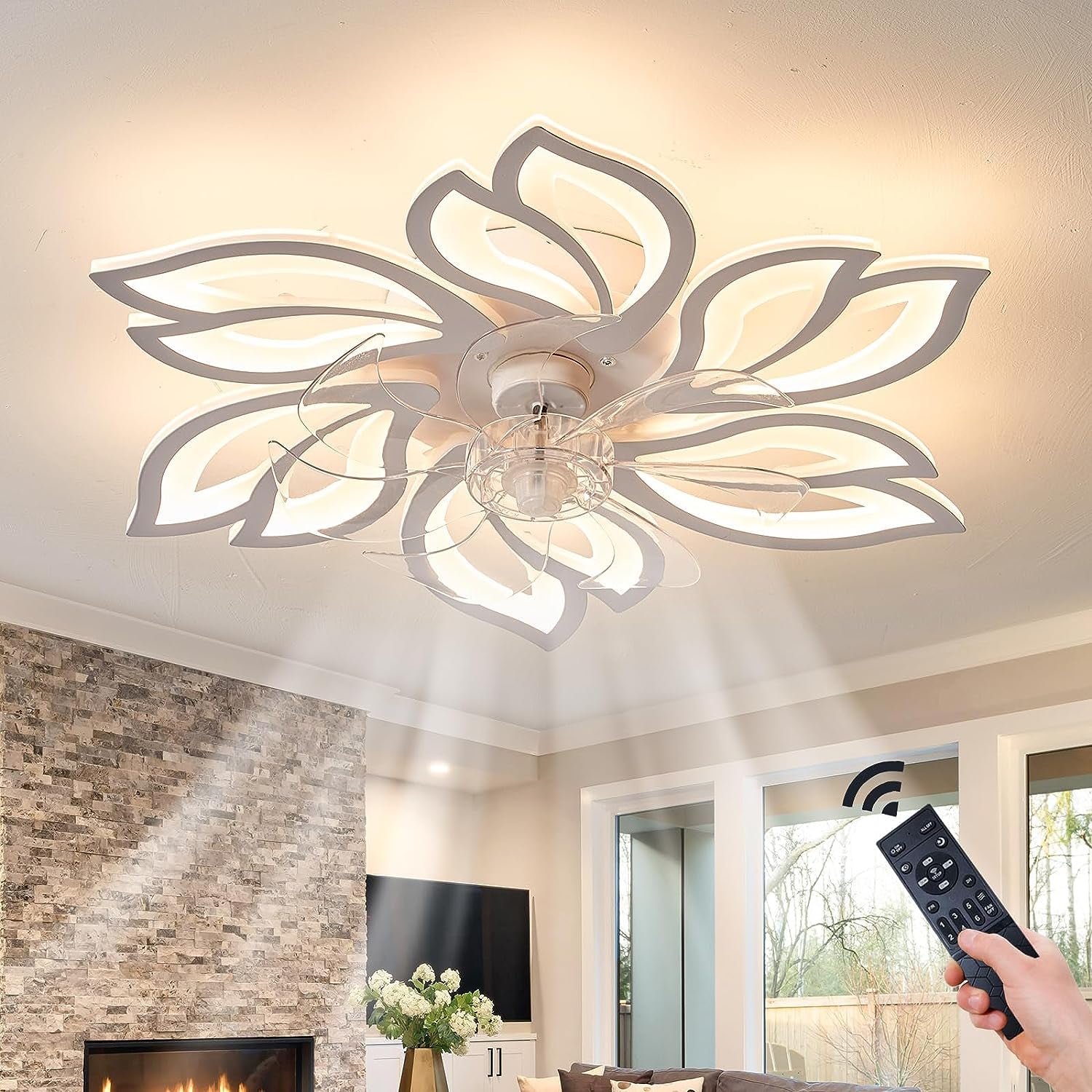
For a smaller room or a home office with limited ceiling clearance, a compact option like the Modern Low Profile Ceiling Fan with Light, Remote/App Control, 65cm sits close to the ceiling while still delivering six wind speeds, which suits rooms where a standard-drop fan would sit too low. For a larger bedroom, dining area or living space, a fan closer to 1320mm, such as the Black Ceiling Fan with LED Light Kit, DC Motor, 52 inch, Reversible Blades, covers more floor area per rotation. As a general guide, also leave at least 2.1m of clearance between the blades and the floor, and around 300mm between the blade tips and any wall, for both comfort and safety.
DC vs AC Motors: Which Is More Energy Efficient?
Ceiling fans are built around one of two motor types, and the difference matters more than most buyers expect. AC (alternating current) motors are the older, more traditional design. They're generally cheaper to buy, but they run less efficiently, tend to be noisier at higher speeds, and usually offer only three or four fixed speed settings.
DC (direct current) motors use a more efficient design that draws meaningfully less power for the same airflow, which adds up over the months a fan runs through an Australian summer. DC motors also tend to run quieter, start more smoothly, and typically offer six or more speed settings for finer control, from a barely-there breeze overnight to full airflow on a hot afternoon. If energy efficiency and quiet operation are priorities, a DC motor fan like the 52 inch model linked above is worth the closer look, since it pairs the larger blade span suited to bigger rooms with the lower running cost of DC.
Reversible Motors: One Fan for Summer and Winter
A reversible motor lets you flip the direction the blades spin, which turns a single fan into a year-round fixture rather than a summer-only purchase. In summer mode, the blades typically spin counterclockwise (viewed from below), pushing air straight down to create a direct cooling breeze across the room.
In winter mode, reversing the blades to spin clockwise pulls cool air upward and gently redistributes the warm air that naturally collects near the ceiling, without creating the direct draught you'd feel in summer mode. Run on a low speed, this can help even out the temperature in a room that's already being heated, rather than replacing the heater outright. If you're focused on the cooler months as well, our guide on how to keep your house warm in winter in Australia covers the draught-proofing and heating side of that equation. Both products linked in this guide include reversible, multi-speed motors, so the reverse function is one less thing to check on the spec sheet.
Fan and Light Combo Units, Remote and App Control
Many Australian buyers now look for a ceiling fan with light built in, since it removes the need for a separate light fitting and keeps the ceiling looking tidy, particularly in bedrooms and home offices where ceiling space is at a premium. The low-profile fan linked above pairs a flush-mount design with a three-colour LED light kit, which lets you shift between warmer and cooler light depending on the time of day, and the 52 inch DC model pairs its larger blade span with its own integrated LED light kit.
Control options are worth comparing too. Remote control is the baseline most buyers expect, letting you adjust fan speed and light settings without reaching for a wall switch. App control goes a step further, allowing you to adjust settings from a phone, which is convenient for larger homes or for checking in on a room from elsewhere. Both fans in this guide include remote and app control alongside their light kits. If a globe in an integrated light kit ever needs replacing down the track, our light bulb fitting types guide explains how to identify the correct fitting before you buy a replacement.
Installation: Why You Need a Licensed Electrician
A ceiling fan isn't a plug-in appliance. It's hardwired directly into your home's electrical circuit and mounted to a ceiling structure that has to safely support a rotating load, which is a different job from screwing in a light fitting. In Australia, this wiring and mounting work must be carried out by a licensed electrician, in line with electrical safety requirements.
The good news is that this doesn't take the decision-making out of your hands. You can research the room, choose the right blade size, decide between an AC or DC motor, confirm the light and remote or app features you want, and select the fan itself. What your electrician handles is the part that carries real risk if it's done incorrectly: running or connecting the wiring, confirming the ceiling mount can bear the fan's weight and motion, and testing that everything is installed and earthed correctly. This guide is written to help with the buying decision; it isn't a substitute for a licensed electrician's assessment of your specific ceiling and circuit.
Frequently asked questions
What size ceiling fan do I need for my room?
Measure the room in square metres, then match it to blade diameter: roughly 650mm–1200mm for rooms up to 10m², 1200mm–1320mm for 10–17m², and 1320mm–1400mm or larger for rooms above 17m². Larger or open-plan spaces may need two fans.
Are DC motor ceiling fans worth the extra cost?
Generally yes, if running cost and noise matter to you. DC motors use less power for the same airflow, run quieter, and usually offer more speed settings than AC motors, which adds up over a full summer of regular use.
Can a ceiling fan replace air conditioning in summer?
A ceiling fan cools people by moving air across your skin rather than lowering the room's actual temperature, so it works differently to air conditioning. Many households use a fan on its own on milder days and pair it with air conditioning on the hottest ones, since a fan lets you feel comfortable at a higher thermostat setting.
Should I choose a ceiling fan with a light or a separate light fitting?
A combo unit is often simpler and keeps the ceiling tidier, especially in bedrooms and home offices, since it avoids fitting two separate ceiling points. A separate light gives more flexibility over light placement and style, so the right choice depends on the room and your ceiling layout.
Can I install a ceiling fan myself?
No. A ceiling fan is hardwired into your home's electrical circuit and needs to be securely mounted to safely carry a rotating load, so installation must be carried out by a licensed electrician in Australia. You can choose the fan and plan the room yourself, then have an electrician complete the wiring and mounting.