Cart
0
TL;DR: Light bulb fitting types explained simply: Australian homes mostly use E27 (standard screw), B22 (standard bayonet), their smaller cousins E14 and B15, and G9 (a small two-pin capsule fitting). Screw fittings twist in like a jar lid; bayonet fittings push in and give a quarter turn to lock. The quickest way to work out what globe fits your lamp is to check the base of your existing bulb, or look inside the lamp holder itself for the fitting shape.
Buying a replacement globe should be simple, until you're standing in front of a wall of boxes with codes like E27, B22, E14, B15 and G9 printed on them and no idea which one your lamp actually takes. It's a genuinely common hold-up, because Australian homes have a real mix of fittings depending on the age of the house, the style of the fixture, and whether it was designed locally or imported. This guide walks through the main fitting types, how to tell them apart, and how to identify what globe fits your lamp before you buy.
The main light fitting types used in Australia
Most fittings fall into two families: Edison screw (marked with an "E") and bayonet cap (marked with a "B"). The number after the letter is the approximate diameter of the base in millimetres. There's also G9, a small two-pin "capsule" fitting that doesn't screw or twist in at all.
| Fitting code | Common name | Typical use | Approx. diameter |
|---|---|---|---|
| E27 | Standard Edison screw (ES) | Pendant lights, floor lamps, table lamps, many modern fixtures | 27mm |
| B22 | Standard bayonet cap (BC) | Ceiling roses, batten holders, pendants in older Australian homes | 22mm |
| E14 | Small Edison screw (SES) | Chandeliers, wall sconces, decorative and feature fittings | 14mm |
| B15 | Small bayonet cap (SBC) | Smaller decorative fixtures, some chandeliers and wall lights | 15mm |
| G9 | Capsule/pin fitting | Feature lighting, some chandeliers, compact fittings | ~9mm pin spacing |
Both B22 and E27 are considered standard, full-size fittings, but the mechanism is different. B22 is a push-and-twist bayonet cap that's long been common in Australian and British-influenced housing stock, so a lot of older ceiling roses and batten holders are still bayonet. E27 is a screw-in fitting that's become increasingly common as more contemporary, design-led fixtures reach the Australian market. E14 and B15 are simply the smaller-diameter versions of the same two mechanisms, generally used where a slimmer bulb profile suits the fixture, such as candle-style chandelier arms.
E27 vs E14: what's the difference
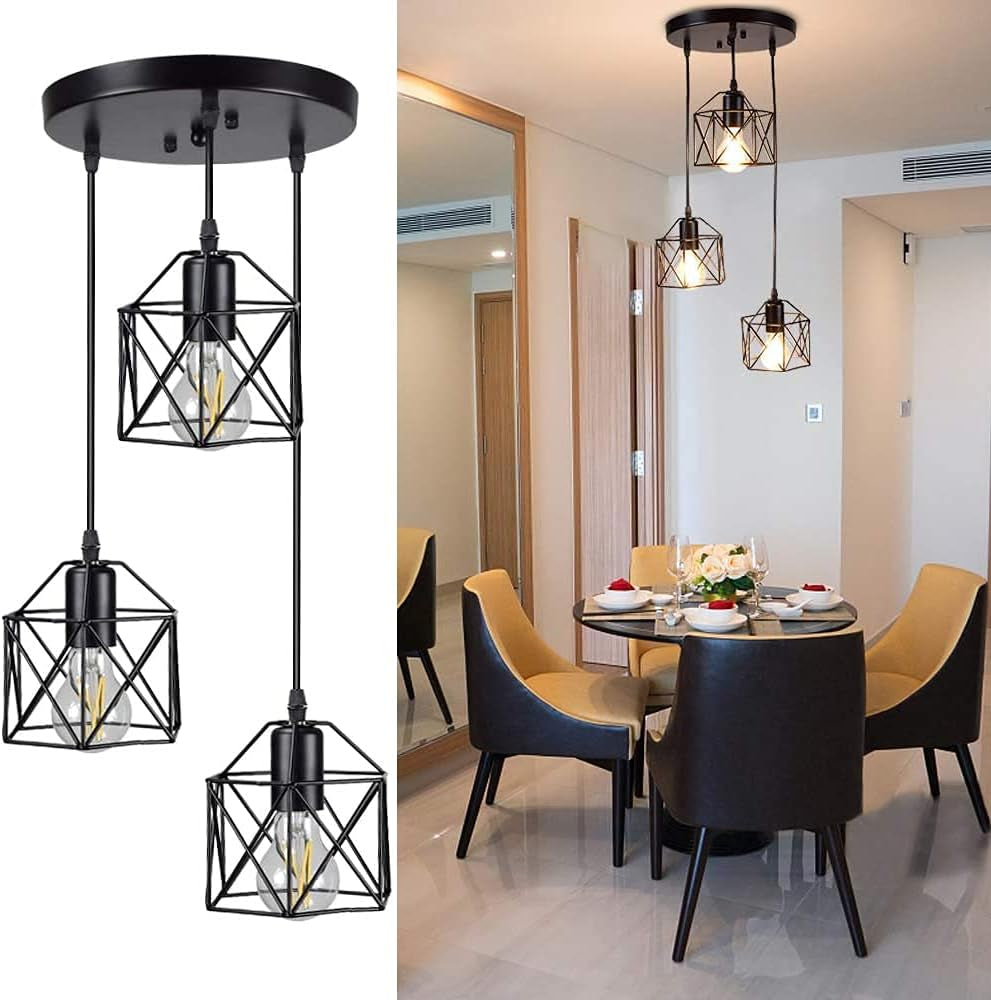
E27 and E14 both use the same Edison screw mechanism, a spiral metal thread that you twist clockwise to install, so the difference between E27 and E14 comes down to size rather than how they work. E27 is the full-size screw fitting at 27mm diameter, and it's what you'll find on most general-purpose fittings, including floor lamps and standard pendant lights. Our Vintage Pendant Light with a cage shade is a good example of an E27 fitting, taking three standard E27 globes across its three sockets.
E14 is the smaller version of the same thread, at 14mm diameter, and it's the fitting you'll typically see on chandeliers, wall sconces and other decorative fixtures where the design calls for a narrower "candle" style bulb. If you're shopping for a chandelier, checking the fitting first will save you a return trip. Our 6-Light Black Wagon Wheel Chandelier is a good example of a fixture built around E14 bulbs, and it's worth noting the listing itself recommends professional installation for the fixture, not the globe swap.
B22 vs E27 fitting: bayonet or screw?
The other question that trips people up is B22 vs E27, because these two mechanisms aren't interchangeable and look quite different once you know what to check. E27 screws in with a clockwise twist, the same way you'd screw a lid onto a jar. B22 is a bayonet fitting: you push the base straight up into the holder, then give it a quarter turn to lock two small pins into place, similar to how an older bayonet-style bike light might click into a bracket.
In practical terms, B22 has traditionally been the more common fitting for ceiling roses and batten holders in established Australian homes, since it's long been the local standard for hardwired fixtures. E27 shows up more often in newer, imported or design-focused fittings, particularly pendant lights, floor lamps and table lamps. Neither fitting is better than the other; they're just different mechanisms, so the only thing that matters when buying is matching the fitting your fixture actually has.
How to identify which fitting you have
Working out what globe fits your lamp doesn't need any special tools. A few simple checks will get you there:
- Check the base of your existing globe. Most bulbs have the fitting code printed or moulded onto the metal or plastic base, right near where it meets the fixture.
- Look at the lamp holder itself. If there's no globe in place, the fitting shape usually gives it away: a spiral thread means a screw fitting (E-series), while two small pins on either side mean a bayonet fitting (B-series).
- Measure the base. If the markings have worn off, measure the diameter of the base with a ruler or tape measure and compare it to the table above. E27 and B22 are both roughly 22–27mm, while E14, B15 and G9 are noticeably smaller.
- Check the product listing or manual. If you bought the fixture online or still have the box, the fitting type is almost always listed in the specifications, alongside things like maximum wattage.
- Take a photo before you buy. If you're at all unsure, a clear photo of the empty holder (or the old globe's base) makes it much easier to match against fitting codes at the shop or online.
Choosing the right globe for the job
Once you've confirmed the fitting, there are a few more decisions worth making before you check out. First, colour temperature: whether you want a warmer, cosier glow or a cooler, brighter light depends heavily on the room and how it's used, and it's worth reading our warm white vs cool white light guide before you decide, since getting this wrong is one of the most common lighting regrets. Second, check whether your fixture and switch support dimming if that matters to you, as not every LED globe is dimmable even within the same fitting type. Third, look at the wattage or lumen rating on the packaging so the new globe matches the brightness you're used to, particularly if you're swapping an old incandescent globe for an LED equivalent.
Fitting types by room and fixture
Different rooms tend to lean toward different fittings, largely because of the style of fixture that suits them. Floor lamps and table lamps in living rooms and bedrooms are very commonly E27, since it's the standard fitting for most freestanding lamp bases; if you're shopping for a new floor lamp as well, our guide on how to choose a floor lamp covers fitting and sizing together. Entryway and dining room chandeliers or pendants often use E14 or B15 across multiple arms, since the smaller bulb profile suits the decorative style. Ceiling battens and roses in older homes are frequently B22. Feature lighting and some compact fittings use G9. If you'd like to browse fixtures across all of these fitting types in one place, our lighting collection is a useful starting point.
When you need an electrician (and when you don't)
Swapping a globe for a new one of the same fitting is something almost anyone can do safely, provided the power is off and the fixture is designed for user-replaceable bulbs. That's the scope of this guide: identifying and buying the right globe. Changing the light fixture itself, or any wiring, junction box or ceiling rose connection, is a different job entirely. Any wiring or electrical installation work must be carried out by a licensed electrician, in line with Australian electrical safety requirements. If your existing fitting doesn't match the globe you want, the safer and simpler path is usually to choose a new fixture in the fitting you need, rather than attempting to alter the wiring yourself.
Frequently asked questions
What is the most common light fitting in Australian homes?
Both E27 (screw) and B22 (bayonet) are considered standard fittings in Australia. B22 is more common in ceiling roses and batten holders in older homes, while E27 is common in pendants, floor lamps and newer fixtures.
What's the difference between E27 and E14?
Both are Edison screw fittings that twist in clockwise. E27 is the full-size fitting at 27mm diameter, used in most general lamps and pendants. E14 is the smaller version at 14mm, typically used in chandeliers and decorative fittings.
Is B22 the same as E27?
No. B22 is a bayonet fitting that pushes in and locks with a quarter turn, while E27 is a screw fitting that twists in. They use different mechanisms and are not interchangeable.
How do I know what globe fits my lamp?
Check the base of your existing globe for a printed fitting code, look at the shape of the empty lamp holder, or measure the base diameter and compare it against standard fitting sizes like E27, E14, B22, B15 or G9.
Can I change a bayonet fitting to a screw fitting myself?
Changing the fitting itself involves altering the fixture or its wiring, which must be done by a licensed electrician. It's generally simpler to choose a globe or fixture that already matches the fitting you have.
Are G9 globes the same as E14?
No. G9 is a small two-pin capsule fitting that pushes straight into place, unlike E14, which is a screw fitting. They are not interchangeable.