Cart
0
TL;DR: To organise a kitchen drawer with dividers, empty the drawer completely, sort everything into groups by task, then fit an adjustable divider tray sized to your drawer's actual internal width rather than a fixed one. Give cutlery its own lane, keep everyday utensils flat and visible, and push anything you use less than weekly to the back or out entirely. Most drawer chaos comes down to items with no fixed home, not too little space.
If you have ever yanked open a kitchen drawer looking for the vegetable peeler and had to dig past three whisks, a corn holder and a mystery rubber band, you already know the problem. It is rarely that the drawer is too small. It is that nothing inside it has a designated spot, so every new item gets dropped wherever it lands. Dividers fix that by giving each category of item its own compartment, which is the difference between a drawer you can use with your eyes closed and one you have to search through every time.
Why kitchen drawers turn into chaos in the first place
A standard Australian cutlery drawer runs somewhere between 30 cm and 50 cm wide internally, though this varies a lot between older joinery and newer flat-pack cabinetry. Without a divider, that space behaves like one big bin: forks slide into the spoon section, the sharp knife ends up loose against the can opener, and the drawer only "works" for as long as you remember exactly where you last put things back.
Dividers solve this because they turn one open cavity into several small, fixed zones. Once a compartment is designated for teaspoons, teaspoons are the only thing that goes there, and your hand finds them without looking. It is a small change with an outsized effect on how a kitchen actually feels to cook in — see our guide to small kitchen storage ideas if drawers are just one of several problem zones in your kitchen.
How to organise a kitchen drawer with dividers, step by step
1. Empty the drawer completely. You cannot sort what you cannot see. Tip everything onto the bench so you are working with a clean slate, not shuffling items around a half-full drawer.
2. Measure the internal width, depth and height. Run a tape measure inside the drawer, not along the cabinet front — face frames and drawer runners eat into the usable space. Note the shallowest point too, since drawer boxes often taper slightly near the back.
3. Sort into groups by task, not by type. Rather than "all forks together" and "all spoons together," think in terms of how you actually cook: everyday cutlery, prep tools (peelers, can openers, measuring spoons), serving pieces, and the odds and ends that do not fit anywhere else.
4. Cull before you divide. Anything duplicated, broken, or unused for the past six months does not earn a compartment. A drawer organised around fewer, better-chosen items stays tidy far longer than one stuffed to capacity.
5. Choose a divider sized to your drawer, not the other way around. A fixed-width tray only works if your drawer happens to match its dimensions exactly. An expandable divider that adjusts across a width range is far more forgiving, since Australian drawer widths are inconsistent even within the same kitchen.
6. Assign each compartment before you load it. Decide "this section is spoons, this one is serving cutlery" before you start filling, so the layout is intentional rather than whatever falls into place.
7. Lay flat items on their side, not standing up. Spatulas, whisks and tongs stored flat in a wide, shallow compartment are easier to see at a glance and will not tip and jam the drawer runner.
Kitchen drawer organiser ideas for every type of drawer
Not every drawer needs the same solution. A few kitchen drawer organiser ideas depending on what the drawer is actually for:
- The cutlery drawer — usually the busiest drawer in the kitchen and the best candidate for an adjustable, multi-compartment tray with dedicated lanes for forks, knives, spoons and teaspoons.
- The utensil drawer — wider, shallower compartments suit this better than narrow cutlery slots, since spatulas, tongs and ladles need room to lie flat rather than stand upright.
- The knife drawer — knives stored loose in a drawer are a real safety hazard. A dedicated in-drawer knife block keeps blades separated and edges protected, and frees up bench space compared to a countertop block.
- The "junk" drawer — every kitchen has one. A modular tray system made of small trays that clip together on all sides lets you build a custom layout for oddly-shaped items like rubber bands, chip clips and spare batteries, and you can rearrange it as the contents change.
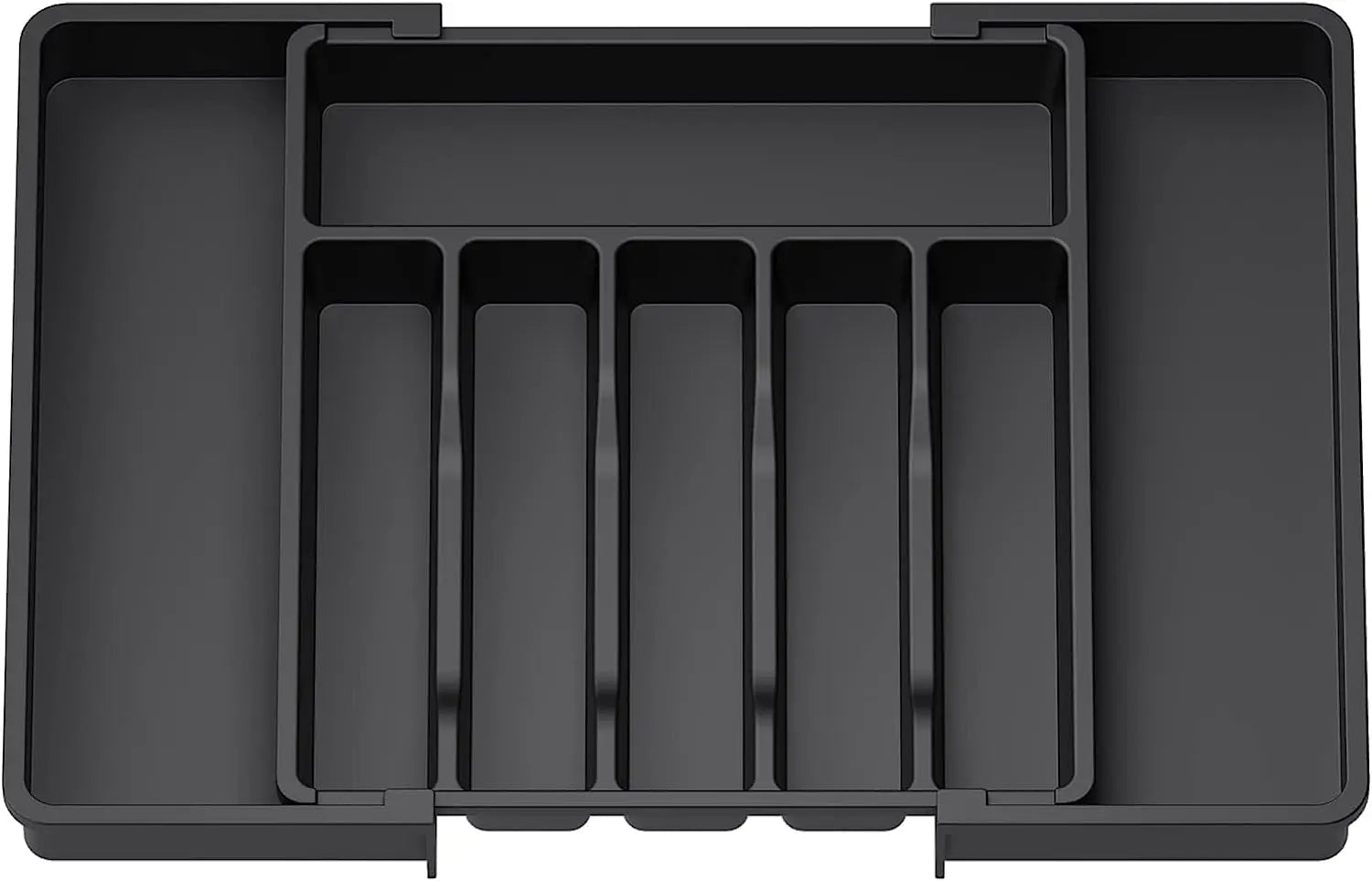
For the cutlery drawer specifically, our Expandable Cutlery Drawer Organiser is built around exactly this problem: two side panels slide out so one tray adjusts from 33 cm up to roughly 57 cm, which covers most standard Australian drawer widths without needing an exact custom fit.
Cutlery drawer organisation: getting the compartments right
The number and size of compartments matters more than most people expect. Too few and you are back to piling different items together; too many tiny slots and oversized serving spoons will not fit anywhere.
| Divider type | Material | Compartments | Adjusts to fit? |
|---|---|---|---|
| Expandable plastic cutlery tray | BPA-free PP | 8, across 3 sizes | Yes — 33 cm to 57 cm wide |
| Expandable bamboo tray | Moisture-resistant bamboo | 6 main + 2 extra when expanded | Yes — 37 cm to 49 cm wide |
| Modular clip-together trays | Plastic | 10 individual trays, arranged as needed | Yes — trays clip together in any order |
| In-drawer knife block | Hardwood | Slotted for up to 11 knives | No — fixed footprint |
As a rough guide for a cutlery drawer specifically:
- Allow one compartment each for dinner forks, dinner knives, dessert spoons and teaspoons at minimum.
- Add a wider compartment for serving pieces (ladles, large spoons) rather than trying to squeeze them into a narrow slot designed for teaspoons.
- If the drawer also holds odd tools like a pizza cutter or bottle opener, give them one shared "miscellaneous" compartment rather than letting them drift into the cutlery lanes.
- Check the material's care instructions before you buy — some expandable trays are rinse-clean only and are not dishwasher safe, which matters if you want to run divider trays through with the rest of the washing up occasionally.
The best way to organise kitchen drawers when space is tight
Small kitchens and older homes often have shallower or narrower drawers, which makes the "buy any organiser" approach fail fast. The best way to organise kitchen drawers when you are working with limited depth or width comes down to three habits:
Measure before you buy, every time. It is tempting to grab whatever divider tray is in front of you, but a tray even a centimetre too wide will not sit flat, and one too narrow leaves an awkward gap where things slide underneath.
Favour adjustable over fixed wherever the drawer is non-standard. Older Australian homes especially tend to have drawer widths that do not match modern flat-pack sizing, so a tray that expands to fit is far more likely to actually work than a rigid one.
Stack function vertically where the drawer is deep enough. A shallow tray sitting on top of a second layer of less-used tools makes use of a deep drawer's full height, rather than wasting the bottom half as empty space under one flat tray.
If your storage challenge extends well beyond the kitchen, our guide to organising a linen cupboard walks through the same measure-first, sort-by-task approach applied to a completely different space in the home.
Keeping the drawer organised once it is done
The system only holds if putting things away is as easy as taking them out. A few habits that make it stick:
- Return items to their assigned compartment immediately after washing up, rather than letting a "sort later" pile build on the bench.
- Do a two-minute reset once a month — pull anything that has drifted into the wrong compartment back to where it belongs.
- Resist the urge to add "just one more" item to an already full compartment. If it does not fit, that is a signal to cull, not to squeeze it in.
- If you are shopping for dividers for more than one drawer, browse the wider kitchen and dining collection so you can compare options for cutlery, utensils and knives side by side before you measure and buy.
A well-organised drawer is not about owning more storage products — it is about giving every item exactly one home and making it easier to put things back than to leave them out.
Frequently asked questions
How many compartments does a cutlery drawer need?
Most households do well with six to eight compartments: one each for forks, knives, dessert spoons and teaspoons, plus at least one wider section for serving pieces and one for miscellaneous small tools.
Should I choose a fixed or expandable drawer divider?
An expandable divider is generally more forgiving, since it adjusts to your drawer's actual width rather than requiring an exact match. A fixed tray only works well if you have measured precisely first.
What is the standard depth for a kitchen drawer divider?
Most cutlery trays sit around 5 cm deep, which suits standard cutlery drawers. Deeper drawers can often fit a divider tray plus a second layer of less-used tools underneath.
Are plastic drawer organisers dishwasher safe?
Not always — check the specific product's care instructions before buying. Many expandable plastic and bamboo trays are designed to be rinsed by hand rather than run through a dishwasher.
Can I use dividers in a junk drawer, or just the cutlery drawer?
Dividers work in any drawer, including the junk drawer. A modular set of small trays that clip together lets you build an irregular layout suited to odd-shaped items like batteries, rubber bands and takeaway menus.
How do I fit a divider to an oddly sized or older drawer?
Measure the narrowest internal width first, then choose an expandable tray with an adjustment range that covers it. Older Australian homes often have non-standard drawer widths, so adjustable is usually the safer choice over a fixed-size tray.