Cart
0
TL;DR: The most effective small kitchen storage ideas work zone by zone: sort drawers with adjustable dividers, clear the benchtop by moving daily items to caddies and rails, use the dead space under the sink and on empty walls, and give the pantry vertical tiers. In a compact Australian kitchen you are not short on stuff, you are short on organised space. Start with one zone, finish it completely, then move to the next.
A small kitchen is not a design flaw. Plenty of Australian apartments, townhouses and older cottages come with a galley or single-run kitchen of around 6 to 10 square metres. The problem is rarely the footprint. It is that every surface ends up doing three jobs at once, and the things you reach for daily are buried behind the things you use twice a year.
The fix is to break "the kitchen" into five zones: drawers, benchtop, under-sink, walls and vertical space, and the pantry. Each zone has its own rules. Work through them in order and you reclaim usable space without knocking out a single cupboard.
How should I organise kitchen drawers in a small kitchen?
Drawers are where clutter hides in plain sight. A single deep drawer of loose cutlery, utensils and odd gadgets can waste up to a third of its volume simply because nothing has a fixed position.
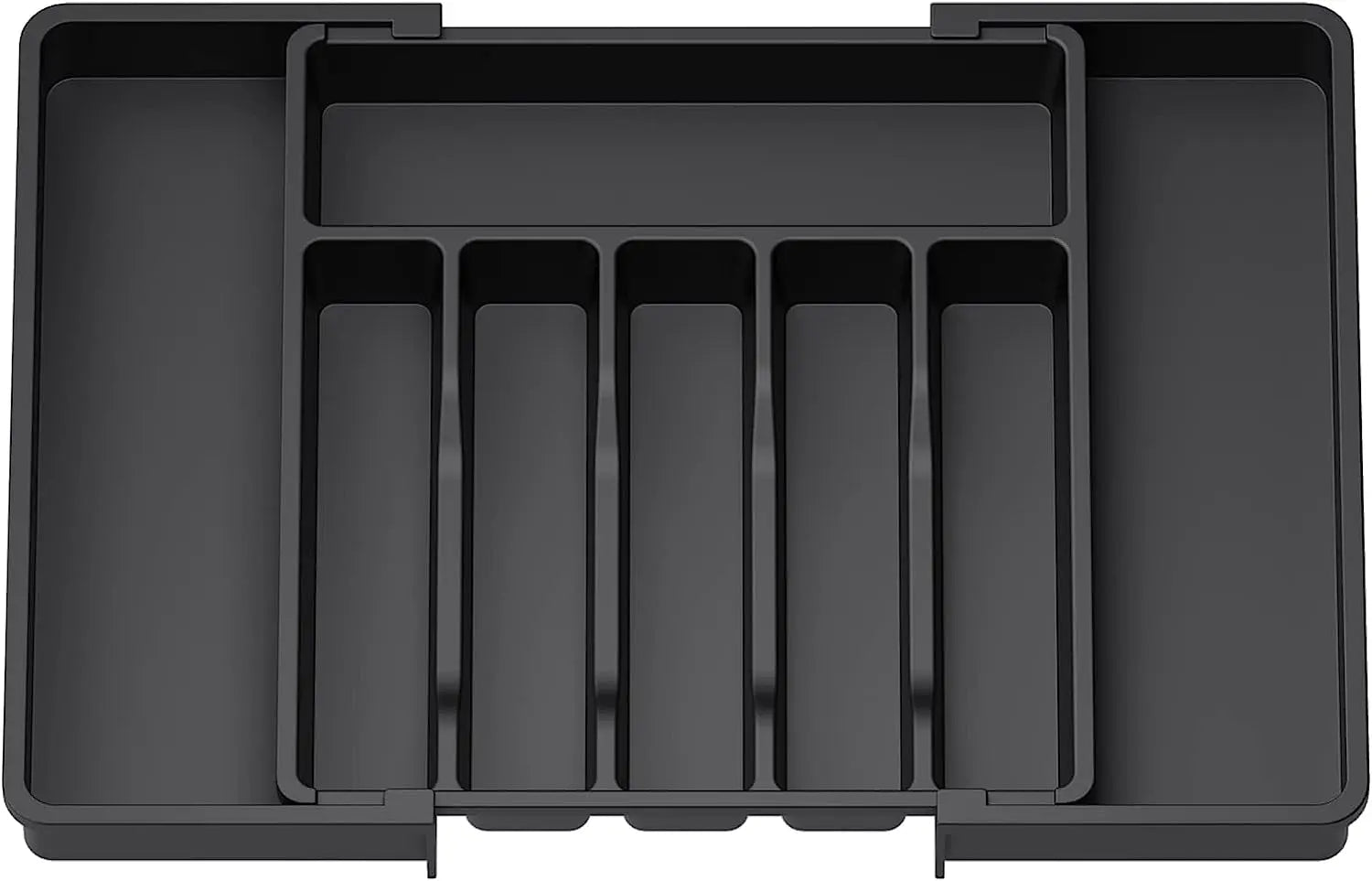
Start with an adjustable divider. A standard Australian cutlery drawer is roughly 40 to 45 cm wide internally, but widths vary a lot between joinery. An expandable organiser that slides from about 33 cm out to 55 cm means one tray fits the drawer you actually have, rather than the drawer a fixed tray was designed for. Aim for five to eight compartments so forks, knives, spoons and serving pieces each get a lane.
Separate the "every day" from the "sometimes". Keep the front two-thirds of your main drawer for daily cutlery and cooking tools. Push seldom-used items, such as pastry cutters, corn holders and cake candles, to a small labelled box at the back or into a different drawer entirely.
Store utensils on their side, not standing up. Laying spatulas and whisks flat in a wide, shallow compartment lets you see everything at a glance and stops the drawer jamming when a handle tips up.
Drawer quick wins
- Group by task: prep tools, serving tools and baking tools each get their own zone.
- Use non-slip liner so trays and dividers do not slide when the drawer opens.
- Keep sharp knives in a slotted section or a bench block, never loose among other tools.
How do I clear a cluttered kitchen benchtop?
Benchtop is the most valuable real estate in a small kitchen because it is your only real work surface. The goal is simple: nothing lives on the bench unless you use it most days.
Apply the "daily use" test. The kettle and the thing you make coffee in probably earn their spot. The blender you use on Sundays does not. Move occasional appliances into a cupboard and give the freed-up bench back to food prep.
Corral the small stuff into a caddy. Sponges, dish brush, hand soap and a dishcloth create most of the visual mess around a sink. A free-standing or wall-mounted sink caddy with a drainage tray gathers all of it into one tidy footprint and lets water run off instead of pooling on the bench.
Use the windowsill and the wall, not the bench. Herbs, a small utensil crock and frequently used oils can live on a narrow sill or a rail so the working surface stays clear. A chopping board that sits across the sink, or a roll-up drying mat, turns the sink into temporary bench space when you need it and disappears when you do not.
What can I do with the space under my kitchen sink?
Under-sink is the most wasted zone in almost every small kitchen. The plumbing makes it awkward, so people give up and pile bottles on the floor of the cupboard.
Work around the pipes, not against them. Use a two-tier pull-out or a U-shaped shelf that steps over the trap, so you get a second level of storage in the space the pipe would otherwise waste.
Contain the cleaning bottles. A single tote or caddy with a handle holds spray bottles upright and lifts straight out when you are cleaning, instead of you kneeling and reaching to the back.
Hang what you can. A tension rod run across the width of the cupboard becomes a rail for spray bottles hung by their trigger, freeing the floor for bin bags, bulk refills and a compact bin. Let a bench caddy handle the daily brushes and sponges, so this cupboard only stores refills and heavier gear.
How do I use vertical and wall space in a compact kitchen?
When the floor and benches are full, the answer is up. Walls, the sides of cabinets, and the backs of doors are usually completely empty in a small kitchen.
Mount a rail for long-handled tools. Brooms, mops and dustpans dumped in a corner take up floor space and fall over. A wall-mounted stainless steel broom organiser holds three or four long-handled tools off the ground, which matters most in a galley kitchen where every centimetre of floor is a walkway.
Hang, do not stack. A rail with S-hooks along a spare wall or splashback keeps ladles, measuring cups, tea towels and oven mitts visible and within reach, and it frees a whole drawer.
Use the inside of cupboard doors. Adhesive or over-door racks turn a flat door into storage for lids, wraps, foil and chopping boards stood on their edge.
Add a free-standing rack for the overflow. In a kitchen that doubles as a laundry or opens to a bathroom, a slim four-tier free-standing rack holds tea towels, aprons and cloths without drilling into tiled or rented walls, and it moves wherever you need it.
How can I fit more into a small pantry?
A small pantry or a single tall cupboard fails when it is one deep shelf per level. Half the depth becomes a black hole where tins go to be forgotten.
Go vertical inside the shelf. A stepped tin riser lets you see three rows of cans at once. Stacking shelves double the usable height of a tall gap between shelf and shelf above.
Decant and label. Clear canisters for flour, rice, pasta and cereal stack neatly, stop half-open packets tipping over, and tell you at a glance when you are running low. Square containers waste less space than round ones.
Bring the back forward. A lazy Susan in a corner or a shallow pull-out basket means the items at the back are one spin or one pull away, not a full unpack.
Small kitchen storage: zone-by-zone cheat sheet
| Kitchen zone | Storage solution | What it holds |
|---|---|---|
| Drawers | Expandable divider tray (approx. 33–55 cm) | Cutlery, cooking utensils, gadgets |
| Benchtop | Sink caddy with drainage tray | Sponge, brush, soap, dishcloth |
| Under-sink | Two-tier pull-out + tension rod | Spray bottles, refills, bin bags |
| Walls / vertical | Wall-mounted rail + S-hooks | Brooms, mops, ladles, tea towels |
| Free-standing overflow | Slim multi-tier rack | Tea towels, aprons, cloths |
| Pantry | Tin risers, canisters, lazy Susan | Tins, dry goods, condiments |
The order of operations matters more than the products
The single most common mistake is buying a boot-load of organisers and trying to fix the whole kitchen in an afternoon. You end up with organisers that do not fit and a bigger mess than you started with.
Instead: measure first, buy for one zone, and finish that zone completely before you touch the next. A drawer that is genuinely sorted stays sorted, because everything now has an obvious home to return to. Momentum from one finished zone is what carries you through the rest.
Ready to sort your kitchen zone by zone?
If you want to start with the wins that show fastest, these Pattan Australia pieces map straight onto the zones above:
- Drawers: the Expandable Cutlery Drawer Organiser adjusts to fit the drawer you actually have.
- Benchtop and under-sink: the Kitchen Sink Caddy with Drainage Tray gathers sponges, soap and cloths into one tidy footprint.
- Walls and vertical space: the Stainless Steel Broom Organiser lifts long-handled tools off a tight floor.
- Free-standing overflow: the 4-Tier Free-Standing Towel Rack suits renters who cannot mount to the wall.
Browse the full range at Pattan Australia and pick the one zone that is bothering you most today.
Frequently asked questions
What is the first thing to do when organising a small kitchen? Measure your drawers and cupboards, then start with a single zone rather than the whole room. Finishing one drawer or cupboard completely gives you a working template and the momentum to keep going.
How do I store pots and pans in a small kitchen? Store them on their side in a vertical divider or lid rack so you can pull one out without unstacking the lot. Hang frequently used pans on a wall rail to free up cupboard depth entirely.
Where should small appliances go in a compact kitchen? Only the appliance you use most days earns a permanent benchtop spot. Move the rest into a lower cupboard or a labelled bin and lift them out when needed, keeping your work surface clear.
How can renters add kitchen storage without drilling? Use free-standing racks, tension rods, over-door hooks and adhesive rails that leave no marks. A portable multi-tier rack and a sink caddy add real capacity without touching the walls.
Do I need matching containers to stay organised? No. Consistency helps things stack and stay visible, but function matters more than looks. Square containers save more space than round ones, and clear ones let you see stock levels at a glance.