Cart
0
TL;DR: Outdoor motion sensor lights use a passive infrared (PIR) sensor to detect movement and switch on automatically, giving you instant light at the driveway, front entry or a dark side path without touching a switch. For most Australian homes, a solar-powered PIR light is the simplest option because it needs no wiring and no electrician — just a spot that gets a few hours of daily sun. Look for a wide detection angle, an IP65 waterproof rating, and a dedicated security mode that keeps the light off until movement is detected so the battery lasts through the night.
Dark corners, side gates and long driveways are usually where a property loses visibility after sunset, and that is exactly where a well-placed motion sensor light earns its keep. Unlike decorative string lights, which are about atmosphere and are covered in our guide on how to choose outdoor string lights, motion sensor lights are purely functional. They light your path, deter unwanted visitors and help you see who has arrived at the door. This guide walks through how PIR sensors work, why solar is the easiest upgrade for most Australian properties, what the different lighting modes actually do, how waterproofing ratings hold up to local weather, and where to position lights for the best coverage.
How Do PIR Motion Sensor Lights Actually Work?
PIR stands for passive infrared. The sensor doesn't send out a signal to "ping" its surroundings — instead, it passively reads the infrared heat given off by warm objects, such as a person, a pet or a car, and compares that reading against the background temperature of the area. When something warm moves across its field of view, the change in infrared level triggers the light to switch on.
Detection range and angle vary between products, but a typical garden or driveway unit covers somewhere around six to ten metres, with a detection angle commonly between 120 and 180 degrees depending on the lens design. A wider angle generally means fewer units are needed to cover an area like a driveway apron or courtyard. Most PIR lights also let you adjust sensitivity and the "stay on" time, so you can decide how long the light remains lit after movement stops — anywhere from around ten seconds up to a few minutes — and how close movement needs to be before it triggers.
Because PIR sensors respond to heat rather than light, they work just as reliably during a bright afternoon as they do overnight. Most outdoor units also include a separate light sensor (a photocell) that only allows the motion trigger to activate once ambient light has dropped below a set threshold, which is what stops the light firing uselessly in daylight and helps preserve battery on solar models.
Solar vs Mains-Powered: Why Solar Is the Easiest Upgrade for Most Homes
There are two broad ways to power an outdoor motion sensor light: hardwired into your home's mains electricity, or self-contained with a solar panel and rechargeable battery.
Mains-powered fixtures need a licensed electrician to run cable, which adds cost and lead time, but they are not dependent on sunlight and can output steady brightness even through a stretch of overcast weeks. They suit permanent architectural lighting where a cable run is straightforward, such as under an eave that's already wired.
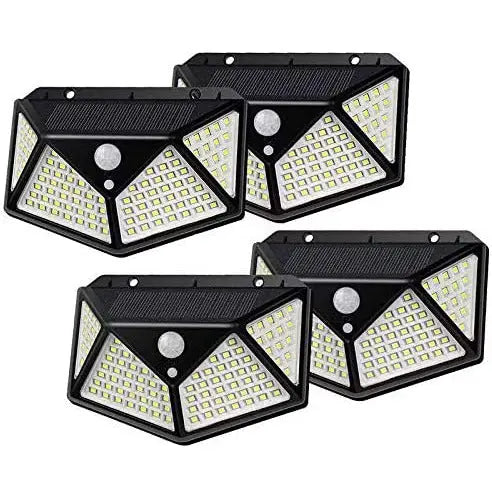
Solar PIR lights are the more practical choice for most driveways, side paths, fences and garden beds, because there's no wiring at all. You mount the unit, let the panel charge during the day, and it's ready to work that night — which also makes solar a good option for renters or anyone who wants a fast DIY install rather than a trade booking. The 100 LED Solar Motion Sensor Wall Light is a straightforward example, with four-sided coverage that suits a wall-mounted position near an entry or gate. For a wider spread across a driveway or open yard, the 800 Lumens Solar Motion Sensor Security Flood Light, 3 Adjustable Heads uses three independently adjustable heads to throw light across a wide 270-degree field, which is useful where one fixed sensor can't see around a corner or past a carport post.
Understanding the Different Lighting Modes
Most solar PIR lights offer a small set of operating modes, and picking the right one for each spot makes a real difference to both usefulness and battery life.
Security mode keeps the light completely off until the sensor detects motion, then jumps to full brightness for a set period before switching off again. This is the most battery-efficient mode and the one most people want for a driveway, side path or anywhere primarily used for security rather than everyday ambience.
Always-dim (low-glow) mode keeps the light on at a low, steady level from dusk until dawn, then brightens to full output when motion is detected. This gives a bit of gentle wayfinding light overnight — handy for a front path you walk regularly — while still reserving a brighter burst for when someone actually approaches.
Dusk-to-dawn mode runs the light continuously at a set brightness for the whole night, regardless of motion. It draws the most power of the three and is more common on mains-powered fixtures than solar ones, since a solar battery has to store enough charge to last until sunrise. A unit with selectable modes, like the three-mode wall light above, lets you match the setting to the season and to how much direct sun that particular spot receives.
Waterproofing and Weather Resistance: What IP65 Means for Australian Conditions
Outdoor fittings are rated using an IP (Ingress Protection) code, written as two digits. The first digit covers protection against solids like dust; the second covers protection against liquids. An IP65 rating means the fixture is fully dust-tight and protected against low-pressure water jets from any direction — enough to handle wind-driven rain, sprinkler overspray and the general damp of an Australian storm season.
For a light mounted under an eave or verandah with some cover, IP65 is generally a sound benchmark. For a completely exposed position — an open driveway pillar or a coastal property with salt-laden air — it's worth checking the specific listing for the liquid ingress figure and confirming the housing material is UV-stable, since constant harsh sun can degrade lower-quality plastics over time even if the seal itself holds up. The 800 Lumens Solar Motion Sensor Security Flood Light is IP65 rated, which covers the vast majority of driveway, porch and pathway positions around a typical home.
Where to Position Motion Sensor Lights for Best Coverage
Placement has more effect on how well a motion sensor light performs than almost any spec on the box. A few practical guidelines:
- Mount at roughly 2 to 2.4 metres. Too low and the detection zone is easily blocked by shrubs, bins or pets; too high and the sensor's angle starts pointing over the top of approaching people rather than across them.
- Angle the sensor across the path of movement, not head-on. PIR sensors are more sensitive to something crossing their field of view than something walking straight toward the lens, so a slight side angle at a driveway or gate usually gives faster, more reliable triggering.
- Prioritise entry points first. Front door and porch, side gates and walkways, the driveway entrance, and the garage or bin storage area are the highest-value spots, since these are where you most want advance warning of arrivals.
- Cover dark corners separately. Garden beds, side passages and anywhere light from the house doesn't reach are common blind spots worth a dedicated fixture rather than relying on spill from a porch light.
- Keep the sensor away from moving foliage. Trees and shrubs swaying in the wind are a common cause of false triggers, so aim the lens past rather than directly at anything that moves in a breeze.
- Protect the solar panel's sun exposure. If the light and panel are one unit, the mounting spot needs several hours of direct sun each day, not just a bright-looking corner — shaded eaves or overhanging trees will starve the battery even if the light itself is well positioned.
Security lighting also pairs naturally with the layers you use around an entertaining space — for ideas on building out a cosy, well-lit outdoor area beyond just the security basics, see our guide on setting up an outdoor entertaining area for the cooler months.
Frequently asked questions
How far can a solar motion sensor light detect movement?
Most solar PIR garden and driveway lights detect movement from around six to ten metres away, with a detection angle typically between 120 and 180 degrees. Exact range depends on the sensor's design, mounting height and the size of whatever is moving through its field.
Do solar motion sensor lights work well through Australian winters with less sun?
Yes, provided the panel gets a few hours of direct sun each day, though output may be slightly reduced on consistently overcast stretches. Choosing security mode over dusk-to-dawn mode helps the battery last longer when daily charging is lower.
What's the difference between security mode and dusk-to-dawn mode?
Security mode keeps the light off until motion is detected, then switches to full brightness briefly — the most battery-efficient option. Dusk-to-dawn mode stays lit continuously overnight regardless of movement, which uses far more stored charge.
Do I need an electrician to install a solar motion sensor light?
No. Solar motion sensor lights are self-contained with their own panel and battery, so they simply mount to a wall, post or fence with basic fixings. An electrician is only needed for hardwired, mains-powered fixtures.
What IP rating should I look for in an outdoor motion sensor light?
IP65 is a solid baseline for most driveway, porch and garden positions, covering dust and wind-driven rain. For fully exposed or coastal spots, check the listing closely and favour a housing described as UV-stable.