Cart
0
TL;DR: The short answer to how to organise a spice rack: pick a rack style that suits your kitchen's actual layout (a rotating turntable for a deep cupboard corner, a sliding drawer for a narrow gap, a pull-out rack for unused space under a shelf), sort spices in a way you'll genuinely keep up with, and store them away from heat, light and moisture so they don't lose flavour before you've used half the jar. Decanting into matching jars helps some kitchens and adds unnecessary effort in others — it depends on how many spices you actually use.
Spice storage tends to go wrong in one of two ways: everything gets crammed into a single cupboard shelf where the jars at the back are forgotten until they're a couple of years past their best, or a spice rack gets bought without much thought for the actual gap it needs to fit, so it ends up half-used and cluttered again within a month. Neither problem is really about willpower — it's about the rack not matching the space, or the sorting system being too fiddly to maintain on a Tuesday night mid-recipe. This guide runs through the rack types worth considering for different kitchen layouts, how to sort spices so you can actually find what you need, and the storage habits that keep them tasting like something rather than just sitting there for the look of it.
Which spice rack suits your kitchen space?
Not every spice rack works in every kitchen, and the biggest source of "why isn't this staying organised" is usually a mismatch between the rack style and the space it's living in. A few common situations and what tends to work best:
| Kitchen situation | Rack style | Why it fits |
|---|---|---|
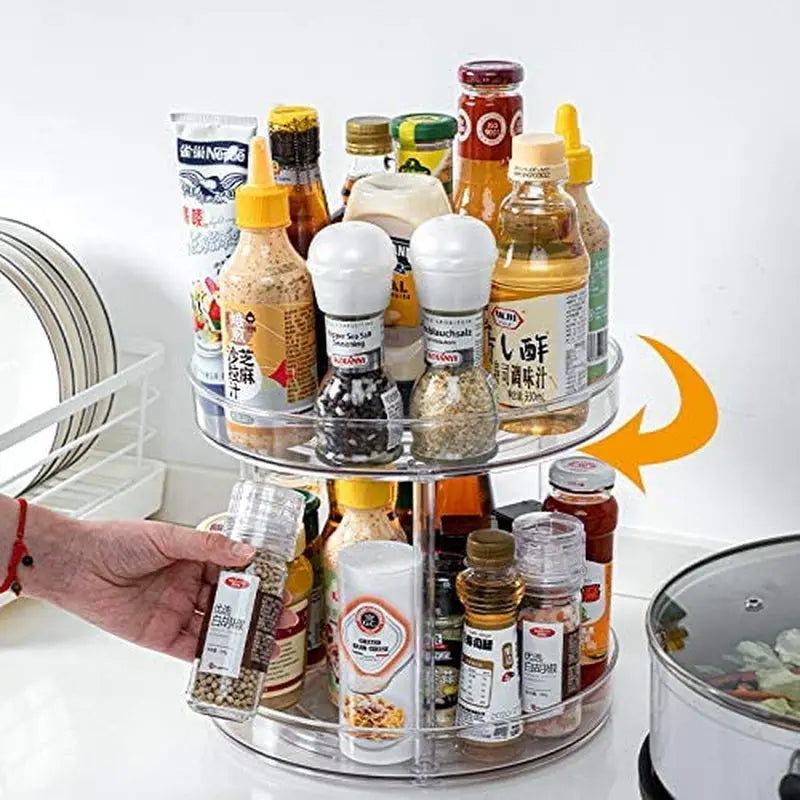
| Deep corner cupboard where jars get lost at the back | Rotating turntable | Spins the whole collection to the front — nothing gets forgotten in a blind corner |
| Narrow gap beside the stove, under the sink, or between cabinets | Sliding drawer basket | Pulls straight out for a clear view instead of reaching past jars in front |
| Unused vertical space below an existing shelf | Under-shelf pull-out rack | Uses air space that's otherwise wasted, without taking up any bench or shelf footprint |
For a deep corner cupboard, something like the 2 Tier Lazy Susan Rotating Spice Rack Turntable solves the classic "can't reach the back row" problem, since a quarter-turn brings any jar to the front instead of needing you to lean in and shuffle jars aside.
If the issue is a narrow gap rather than a deep one — under the sink, beside the stove, or in a slim cabinet — a 2-Tier Sliding Drawer Spice Rack Organiser pulls forward on its own tier rather than making you dig through a static shelf, which matters most in small kitchens where every cabinet is doing double duty.
For kitchens where the cupboards are already full but there's a gap of unused air below a shelf, an Under-Shelf Pull-Out Spice Rack Organiser claims that dead space without needing a new shelf or cupboard at all — a genuinely useful option for a spice rack for a small kitchen where every centimetre of existing storage is already spoken for.
Alphabetical, by cuisine, or by how often you use it?
There's no single correct sorting system — the one that survives is the one that matches how you actually cook, not the one that looks most impressive on day one.
- Alphabetical works well if you cook a wide range of cuisines and often reach for a specific spice by name — it's fast to scan and easy for anyone else in the household to follow without needing to know your system.
- By cuisine (a section for baking spices, one for Asian cooking, one for Mediterranean or Middle Eastern staples) suits households that cook in batches around a few consistent styles, since related spices end up within reach of each other for the one dish.
- By frequency of use — everyday spices like salt, pepper, cumin and paprika at the very front or eye level, occasional ones further back — tends to be the lowest-effort system to maintain, because it doesn't require remembering where anything "should" go, just how often it gets picked up.
For most households, a hybrid works best in practice: broad cuisine groupings for anything used occasionally, with the handful of everyday spices pulled out to the most accessible spot regardless of what category they technically belong to. If your spice rack lives in a drawer rather than a cupboard, the same logic applies to the rest of the drawer's contents — our guide to organising a kitchen drawer covers grouping loose items by how often they're used rather than by type alone.
Keep spices away from heat, light and moisture
Spices don't go "off" the way fresh food does, but they do lose potency — a jar of paprika that's spent months next to the stove or on a sunny windowsill will taste noticeably flatter than one stored properly, even well before any use-by date. Three things accelerate that loss:
- Heat speeds up the breakdown of the essential oils that give spices their flavour, which is why the shelf directly above or beside a stove is one of the worst spots for a spice rack, even though it's often the most convenient.
- Light, especially direct sunlight, fades both colour and flavour over time — spices stored in clear jars on an open shelf near a window will fade faster than the same spices kept in a cupboard or drawer.
- Moisture from steam (again, near the stove or dishwasher) causes clumping and can shorten shelf life significantly, particularly for ground spices and anything with salt in the blend.
A cupboard, drawer, or pantry shelf that's away from the stove and out of direct light is the best way to store spices for keeping them tasting like something. It's part of why a rack in a corner cupboard or a pull-out under an existing shelf tends to outperform an open rack mounted right beside the cooktop — the most visually convenient spot is often the worst one for actual flavour retention. This is the same reasoning behind zoning a wider pantry by temperature and light exposure, which our pantry organisation guide covers in more depth for cupboards that store more than just spices.
Decanting into uniform jars vs keeping original packaging
Whether to decant comes down to how many spices you go through and how much shelf space you're trying to make consistent, rather than being a strict rule either way.
Decanting into matching jars makes sense if you have a large collection, want everything to sit neatly on a turntable or in a drawer without odd-shaped packets tipping over, and are willing to label each jar clearly so nothing becomes a mystery powder six months later. It also tends to protect spices better, since most purpose-made jars seal more tightly than a folded-over paper packet.
Keeping original packaging is the lower-effort option and makes sense for spices you use rarely, or ones you buy in bulk bags that are awkward to decant cleanly. It also keeps any packet instructions or use-by information visible without needing to write it onto a new label yourself.
A practical middle ground: decant the everyday spices you reach for constantly — the ones that benefit most from a consistent, easy-to-grab jar — and leave less-frequent or oddly packaged ones in their original packaging, tucked further back or lower down in the rack.
A simple spice rack setup routine
- Take every spice out and check it. Smell and look at anything that's been sitting a while — if the colour has faded or there's barely any scent, it's not doing much for a dish anymore and is worth replacing rather than keeping out of habit.
- Measure the space before choosing a rack. A deep corner needs a turntable, a narrow gap needs a sliding drawer, and unused space under a shelf needs a pull-out rack — measuring first avoids buying something that doesn't actually fit.
- Decide on a sorting system you'll keep up with. Alphabetical, by cuisine, or by frequency of use — pick whichever matches how you actually cook, not the one that looks best photographed.
- Decant selectively. Move the everyday spices into matching jars if that suits your kitchen; leave rarely used ones in their original packaging if decanting everything feels like more effort than it's worth.
- Position the rack away from heat and light. Even a great rack underperforms if it's mounted right beside the stove or on a sunlit shelf.
- Do a quick check every few months. A fast scan to toss anything that's lost its scent keeps the whole system honest, rather than letting faded spices sit there indefinitely.
Frequently asked questions
What is the best way to store spices in a small Australian kitchen?
The best way to store spices in a small kitchen is to use vertical or pull-out storage that claims otherwise wasted space — a sliding drawer for a narrow gap or an under-shelf rack for unused air below a shelf — rather than a large standalone rack that eats into limited bench or cupboard room.
Should I organise my spice rack alphabetically or by cuisine?
Either works — alphabetical is faster to scan if you cook a wide range of dishes, while grouping by cuisine suits households that cook in a few consistent styles. Pick whichever you'll actually keep up with, since an abandoned system is worse than a simple one.
How long do spices actually stay fresh once opened?
There's no fixed rule, but ground spices lose potency faster than whole ones, and heat, light and moisture all speed that up. If a spice looks faded or barely smells like anything, it's past being useful in a dish even if it's not technically spoiled.
Do I need to decant every spice into a new jar?
No — decanting suits everyday spices you use constantly and want sitting neatly in a rack, but rarely used or bulk-packaged spices are often fine left in their original packaging to save the effort.
What are some easy spice rack ideas for renters or small kitchens?
A rotating turntable for a cupboard corner, a sliding drawer for a narrow gap, or an under-shelf pull-out rack are all straightforward, low-commitment options that don't require any permanent fittings, which suits rental kitchens as well as small ones.