Cart
0
TL;DR: Choosing a clothes drying rack starts with one number: how many metres of hanging line you need. A standard household load takes roughly 10 m to 15 m of line to dry properly without items overlapping. From there it is a format question. A wall-mounted retractable rack takes up no floor space and folds flat when it is not in use, which makes it the right answer for a laundry, a balcony or a bathroom. A floor-standing folding rack gives you the most line for the money and can be moved to follow the sun. A retractable clothesline suits a narrow space where even a folded wall unit would be in the way. Whatever the format, check the load rating, check the material against your climate, and if you are renting, look for a no-drill mounting option.
If you have already sorted out the kitchen side of drying, our guide on how to choose a dish drying rack covers that entirely separate problem. This guide is about laundry — clothes, towels and sheets — which is a different set of constraints entirely, driven by line length rather than bench space.
Drying clothes without a dryer is standard practice in most Australian households, and it works well for most of the year. The problem months are June through August, when a wet week means washing accumulating faster than it dries, and when the outdoor line stops being reliable. A properly sized rack is what bridges that.
Start With Line Length, Not Rack Size
Manufacturers advertise racks by footprint, which is not the number that matters. What matters is total drying length — the combined length of all the rails.
A standard washing machine load needs roughly 10 m to 15 m of line. Below that you end up doubling items over each other, which is the single most common reason clothes take two days to dry instead of one. Overlapped fabric has no airflow between the layers, so the inner surfaces stay damp.
Sheets and towels change the maths. A queen sheet needs a long unbroken run or it will fold back on itself. Towels are thick and hold a lot of water, so they want space either side. If you regularly dry sheets and towels indoors, size up.
Work out your real weekly volume. Count the loads you do in a wet week, not an average one. A household doing five loads a week in winter with no dryer needs meaningfully more drying capacity than one doing two.
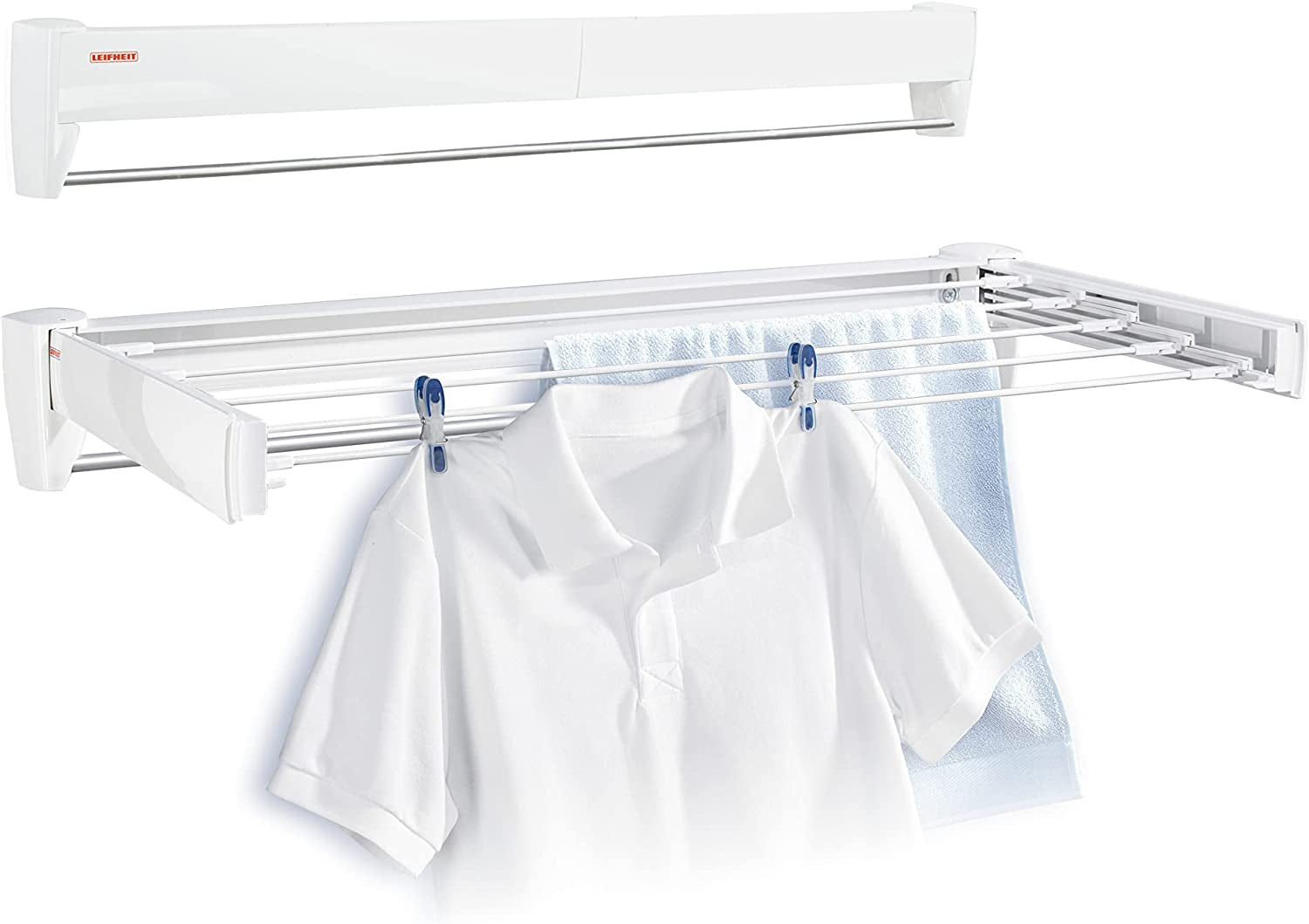
As a reference point, a wall-mounted unit like the Telegant Wall Dryer provides five expandable rails totalling 3.6 m of drying length plus a 60 cm aluminium towel bar, and folds flat against the wall when closed. That is a good supplementary capacity for a bathroom or small laundry, not a whole-household solution on its own.
The Four Formats
Wall-mounted retractable. Fixed to the wall, pulled out when needed, folded flat when not. This is the format that suits Australian laundries, balconies and bathrooms best, because it takes no floor space at all between loads. An Aluminium Wall-Mounted Retractable Clothes Drying Rack comes in black or silver and in two, three and four-segment versions, so you can size the drop to the wall you have. Aluminium is the right material choice here — it does not rust, which matters on a balcony or in a bathroom.
Retractable clothesline. A cassette on one wall and a hook on the other, with the line pulling across the space and retracting away completely when finished. The Retractable Stainless Steel Clothes Drying Rack comes in punch-fit and nail-free versions in black or white, which makes the nail-free variant worth knowing about if you rent. This format disappears more completely than any other, at the cost of being a single line rather than a rack.
Floor-standing folding. The most line per dollar and the only format you can move. A Folding 3-Tier Clothes Laundry Drying Rack measures 165 x 140 x 57 cm with six foldable shelves, two side wings with seven hanging holes, and four 360-degree castors, two of which lock. At around 5 kg it is light enough to move between the laundry, a sunny room and the deck as the day goes on. That mobility is the real advantage — being able to follow the sun or the airflow roughly halves drying time in a cold house.
Rotating and hanging racks. For small items — socks, underwear, tea towels — a compact hanging rack does a job the big racks do badly. A Spiral Clothes Hanger in stainless steel holds a number of small items in a small footprint and hangs from a rail or hook.
Format Comparison
| Format | Floor space when idle | Typical drying length | Moveable | Best suited to |
|---|---|---|---|---|
| Wall-mounted retractable | None | 3 m to 6 m per unit | No | Laundries, balconies, bathrooms |
| Retractable clothesline | None | Single long run | No | Narrow spaces, rentals (nail-free versions) |
| Floor-standing folding | Folds to a slim panel | 10 m to 20 m | Yes | Households with no dryer, whole-load drying |
| Hanging or rotating rack | None | Small items only | Yes | Socks, underwear, tea towels |
Material and Climate
Australian conditions are hard on laundry hardware in two specific ways, and the material choice is what decides whether a rack lasts.
Coastal salt air. Within a few kilometres of the coast, salt in the air will find any weakness in a finish. Powder-coated steel eventually chips, and once it chips it rusts, and once it rusts it stains everything hung on it. Aluminium and good-grade stainless steel are the materials that survive this. If you live near the beach, pay for the material rather than the extra rails.
Bathroom humidity. A rack in a bathroom sits in steam repeatedly, and the same rust logic applies. Aluminium is the safest choice for a permanent bathroom fixture.
Sunlight. Racks left permanently outdoors on a balcony face UV as well as rain. Plastic joints and coated finishes go brittle in Australian sun over a few summers. A metal-framed unit outlasts a plastic-jointed one substantially.
Load Rating and Stability
Wet washing is heavier than people assume. A load of wet towels can weigh more than 5 kg, and sheets more again.
Check the stated load rating and treat it as a real limit rather than a suggestion. On a wall-mounted unit the rating also depends on your fixings — a rack rated to hold 25 kg will not hold 25 kg if it is screwed into plasterboard with no anchor.
Wall fixings matter more than the rack. In most Australian homes, studs sit at 450 mm or 600 mm centres. Fixing into a stud is always better than fixing into plasterboard. Where you cannot reach a stud, use rated plasterboard anchors chosen comfortably above the loaded weight of the rack, not level with it. On brick or masonry, use the correct fixings for the substrate.
On a floor-standing rack, check the footprint and the castor locks. A tall three-tier rack loaded unevenly will tip, particularly on a hard floor. Load the bottom tier first and the top tier last, and lock the castors before you load it.
For renters, nail-free and adhesive-mount options exist but carry much lower ratings. They are fine for a few shirts and light items; they are not the answer for a full load of wet towels. In a rental, a floor-standing rack is usually the more honest solution than trying to make a wall mount work without drilling.
Drying Indoors Through an Australian Winter
Drying indoors works, but it introduces moisture into the house, and how you manage that determines whether it is a good idea or an annoying one.
- Ventilate the room the rack is in. Cracking a window even slightly, or running an exhaust fan, gives the moisture somewhere to go. A closed room with a full rack in it will develop condensation on the windows.
- Airflow beats heat. A rack in a cool room with air moving through it dries faster than a rack in a warm sealed room. A fan pointed at the rack on a low setting makes a substantial difference and costs very little to run.
- Space the items properly. This is where the line-length calculation pays off. Items with a gap between them dry in a fraction of the time of items pressed together.
- Move the rack to follow the light. The advantage of a rack on castors is that you can put it in the sunniest room in the morning and move it back in the afternoon.
- Turn heavy items halfway through. Towels and jeans dry unevenly; flipping them once roughly halves the total time.
Our guide on how to keep a house warm in winter in Australia covers the ventilation and condensation side of a cold house more broadly, and it is directly relevant if you dry indoors regularly.
Fitting It Into the Laundry
Where the rack lives matters as much as which rack you buy. A rack that has to be dragged out from behind a door will not get used.
The most practical position is usually directly above or beside the machine, on a wall that is otherwise dead space. A wall-mounted retractable unit above the machine turns unused vertical wall into drying capacity without taking anything away from the floor. Our guide on how to organise a small laundry room covers how to plan that wall, and our wardrobe organisation ideas guide covers what happens to everything once it is dry.
One note on installation: mounting a rack to a wall is standard household DIY. Anything involving a powered dryer, a new circuit or a new power point beside the machine is electrical work and must be carried out by a licensed electrician.
Ready to Size Yours Up?
Count the loads you do in a wet week, multiply by 10 m to 15 m of line, and check that number against the drying length of the rack you are considering — not its footprint. Then choose the format that fits the wall or floor space you actually have. Browse the full Pattan Australia range when you have those numbers.
Frequently asked questions
How many metres of drying line do I need?
Around 10 m to 15 m of hanging line handles one standard washing machine load without items overlapping. If you regularly dry sheets and towels indoors, size up, since both need more space around them and hold considerably more water than everyday clothing.
Are wall-mounted or floor-standing drying racks better?
They solve different problems. Wall-mounted retractable racks take up no floor space between loads, which suits laundries, balconies and bathrooms. Floor-standing folding racks give more total drying length and can be moved to follow the sun or airflow, which is a real advantage in a cold house.
What material should a clothes drying rack be?
Aluminium or good-grade stainless steel, particularly near the coast or in a bathroom. Powder-coated steel eventually chips and then rusts, and rust stains whatever is hanging on the rack. Metal frames also outlast plastic-jointed ones under Australian sun.
How do you dry clothes indoors in winter without dampness?
Ventilate the room by cracking a window or running an exhaust fan so the moisture has somewhere to go. Airflow matters more than heat, so a fan on a low setting pointed at the rack helps considerably. Space items with gaps between them rather than overlapping them.
Can you fit a wall-mounted drying rack in a rental?
Nail-free and adhesive-mount retractable clotheslines exist and suit rentals, but they carry much lower load ratings and are best kept to light items. For a full load of wet towels in a rental, a floor-standing folding rack is usually the more practical answer.
How much weight can a wall-mounted drying rack hold?
Check the stated rating, then check your fixings, because the fixing is usually the limit rather than the rack. Fixing into studs, typically at 450 mm or 600 mm centres in Australian homes, is always stronger than plasterboard. Where you cannot reach a stud, use anchors rated comfortably above the loaded weight.