Cart
0
TL;DR: The right reading light for bed is small, adjustable and warm-toned, so you can angle it straight onto the page instead of across the room. A clip-on book light suits anyone who reads with a partner already asleep, while a gooseneck bedside lamp suits a fixed reading spot. Either way, look for a soft amber colour temperature, at least two brightness levels, and a rechargeable battery that comfortably covers several nights of reading.
Sharing a bed with someone who goes to sleep earlier than you turns a simple habit like reading before bed into a small negotiation. Flick on the wrong light and you are met with a groan and a pillow over the face; read in the dark and you strain your eyes. The fix is not to give up reading, it is to choose a light built for exactly this problem. This guide walks through the design choices that actually matter, so you can organise your bedside setup around a light that works for you without disturbing the person next to you.
Clip-on book lights vs bedside lamps
The first decision is really about where the light needs to sit. A clip-on book light attaches directly to the page, the cover, or a headboard, so the beam moves with the book and stays pointed at the text rather than spreading across the room. That makes it the more forgiving option if you read propped up on different sides of the bed on different nights, or if you read in awkward positions once the lights are off.
A bedside desk lamp with a flexible arm, by contrast, lives on the nightstand and stays in one place. It suits people who always read sitting upright in the same spot, and it doubles as a general bedside light for finding your phone or a glass of water. The trade-off is that it needs a flat surface nearby and, unless it has a narrow, directional head, some of its glow will always reach past the page. If you are furnishing the nightstand itself rather than just the reading light, our guide to choosing a bedside table lamp covers height, shade and control choices in more detail.
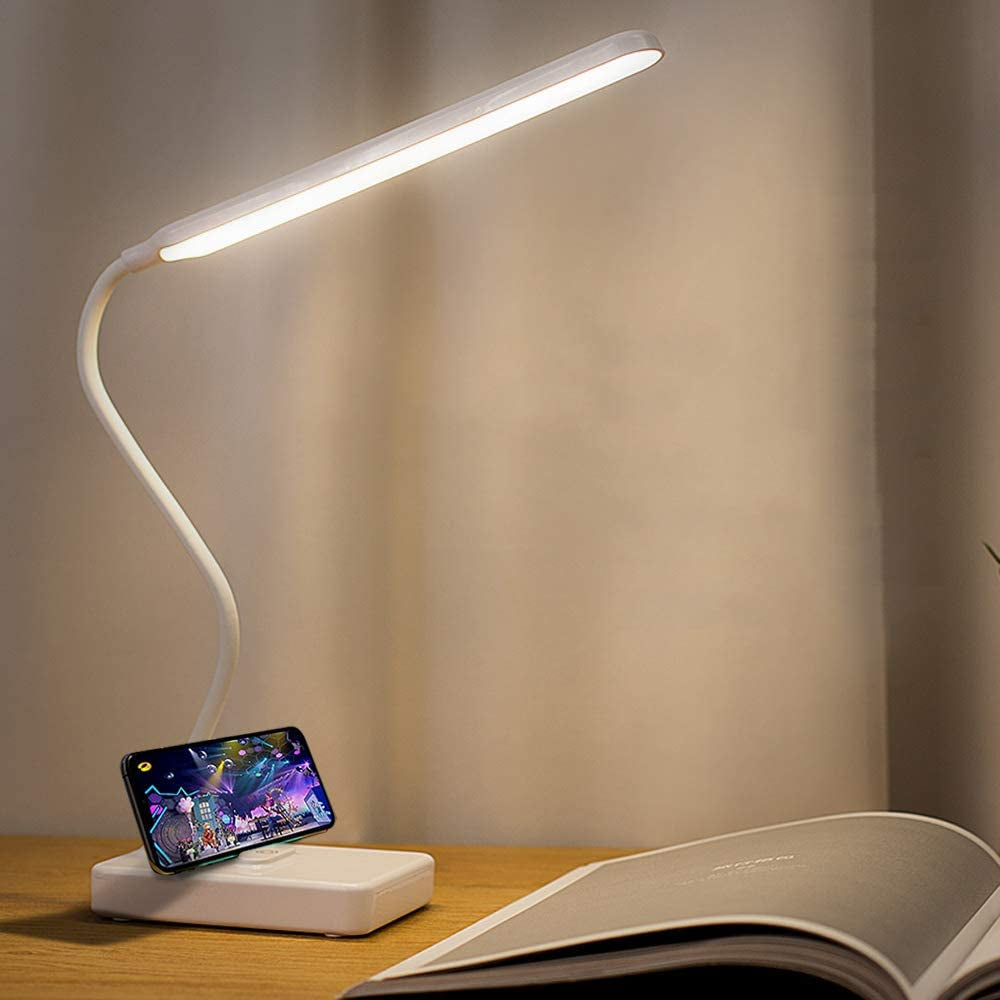
For reading in bed specifically, a light that clips to the book itself, such as the horizontal head book light for reading in bed, keeps the beam tight to the page and off your partner's side of the bed, which is the main advantage over a fixed lamp. If you would rather have a light that stays put on the nightstand and can also serve as your everyday bedside lamp, a compact cordless rechargeable bedside reading lamp with a gooseneck arm covers both jobs from one spot.
Brightness and colour temperature: why warm light matters most
Colour temperature is measured in kelvins, and it has more to do with disturbing a sleeping partner than raw brightness does. A cool white light, generally anything above around 4000K, reads as bluish-white and mimics daylight, which is exactly the wrong signal to send a bedroom at night. It also tends to scatter more visible light around the room, so even a modest cool-white beam feels more intrusive than a warmer one at the same brightness.
A warm or amber light, sitting roughly in the 2700-3000K range, feels softer to the eye and pools more tightly where it is aimed, rather than washing out the surrounding darkness. That combination, a gentler colour and a more contained beam, is why a warm reading light is far less likely to register as "the lights are on" to someone trying to sleep beside you.
Brightness still matters, but it should be adjustable rather than fixed. A single very bright setting forces a compromise between comfortable reading and disturbing your partner, whereas a light with several brightness levels lets you find the lowest setting that still lets you read comfortably, then dial up only if your eyes are tired or the text is small. Look for lights with at least three brightness steps and, ideally, a warm colour setting as a default rather than an afterthought. Our companion guide to warm white versus cool white light covers colour temperature in more depth if you want to apply the same thinking to the rest of the bedroom.
Rechargeable vs corded: what actually suits a shared bedroom
Corded reading lights are simple and never run flat, but the cord itself is often the problem in a shared bed. It has to reach a power point, it can trail across the nightstand or the doona, and unclipping or repositioning the light mid-read means dragging the cord with it, which is enough movement and noise to wake a light sleeper.
A rechargeable light removes the cord entirely once it is charged, which matters more for reading in bed than for almost any other household light. You can clip it, unclip it, angle it, or move it to the other side of the pillow without a single cable to manage, and there is no risk of pulling a lamp off the nightstand by catching a cord with your foot.
The trade-off is that rechargeable lights need to be charged before the battery runs low, and a light that dies mid-chapter is its own kind of frustration. In practice, this is a minor planning habit rather than a real downside, covered in more detail below. For most people reading in bed next to a partner, the freedom of movement a rechargeable light gives you outweighs the small extra step of remembering to charge it.
Adjustable design: directing light away from your partner
Whether you choose a clip-on book light or a bedside lamp, the physical design decides how well it keeps light off your partner's side of the bed. A flexible gooseneck arm or an adjustable head lets you angle the beam down onto the page at a steep angle, rather than letting it fan outward and upward into the room. That steep, close angle is what keeps the light contained to a small pool over the book rather than lighting up the ceiling or the wall behind the headboard.
A narrow beam angle helps for the same reason: light that is designed to spread wide, the way a general room light does, is harder to keep off a sleeping partner no matter how you position it. A light built specifically for reading, with a focused head and a rotating or bendable joint, gives you far more control than a fixed, wide-beam light ever will.
It is also worth testing the light's swivel range before you settle into bed for the night. A head that only tilts a little will limit which side of the bed you can comfortably read on, while a light with a full range of movement, or one that clips directly to the book, adapts to whichever position you end up reading in.
Battery life and charging habits for rechargeable reading lights
Battery life varies by brand and by brightness setting, so it is worth thinking in terms of nights of use rather than hours on a spec sheet. A light used on its lowest, warmest setting will comfortably outlast the same light run on its brightest mode, sometimes by several nights, because higher brightness draws more power from the same battery.
A simple habit solves almost all battery frustration: charge the light on a regular night, such as once a week, rather than waiting until it is flat. Many rechargeable reading lights charge via USB, so they can sit on the same cable you already use for your phone, and a full charge typically takes a couple of hours. Building that into an existing routine, like plugging it in while you brush your teeth, means the light is rarely the thing standing between you and your book.
If you read every night, look for a light with a genuinely long runtime on its lowest brightness setting, since that is the mode you are most likely to use next to a sleeping partner. A light that only lasts an hour or two on its dimmest setting will need frequent charging, which defeats some of the convenience of going cordless in the first place.
Frequently asked questions
What colour temperature is best for a reading light for bed?
A warm, amber tone around 2700-3000K is best for reading in bed. It is gentler on the eyes before sleep and less likely to register as bright, obvious light to a partner trying to sleep, compared with a cooler, bluer white.
Will a clip-on book light disturb a sleeping partner?
Generally no, because it clips directly to the page and directs the beam onto the book rather than out into the room. Choosing a warm colour setting and the lowest comfortable brightness reduces the chance of disturbance even further.
How long do rechargeable reading lights last on a single charge?
It depends on the brightness setting used, but most last several nights of typical reading on a low, warm setting and considerably less on the brightest mode. Charging once a week on a regular night avoids running flat mid-read.
Is a corded or rechargeable reading light better for bed?
Rechargeable is generally better for bed, since it removes the cord that would otherwise trail across the nightstand or need repositioning every time you move the light. Corded lights are still reliable if you have a power point close to hand and rarely reposition the light.
Can I use a reading light instead of a bedside lamp?
A dedicated reading light, particularly a clip-on style, is built to focus light on a page rather than light a room, so it is not a full replacement for a bedside lamp used for general tasks. A gooseneck reading lamp with adjustable brightness can cover both roles reasonably well from the one fixture.