Cart
0
TL;DR: Pots and pans stay tidiest stored vertically with dividers, not stacked flat in a pile — a stacked cabinet only works until you need the bottom pan, at which point everything above it has to come out first. The real trick is separating lids from the pans they belong to: a dedicated lid rack or wall-mounted holder solves more cabinet chaos than any pan organiser bought on its own.
Open a typical under-bench cabinet and the problem is rarely a lack of space — it is that pans, lids and baking trays are all fighting for the same flat stack, so getting to the one you actually need means unpacking half the cupboard first.
Why stacking pots and pans flat never really works
A flat stack forces you to remove everything on top just to reach the pan at the bottom, every single time. It also means mismatched lids rattling loose between pans, or worse, stacked lids sliding off the pile the moment the cabinet door opens.
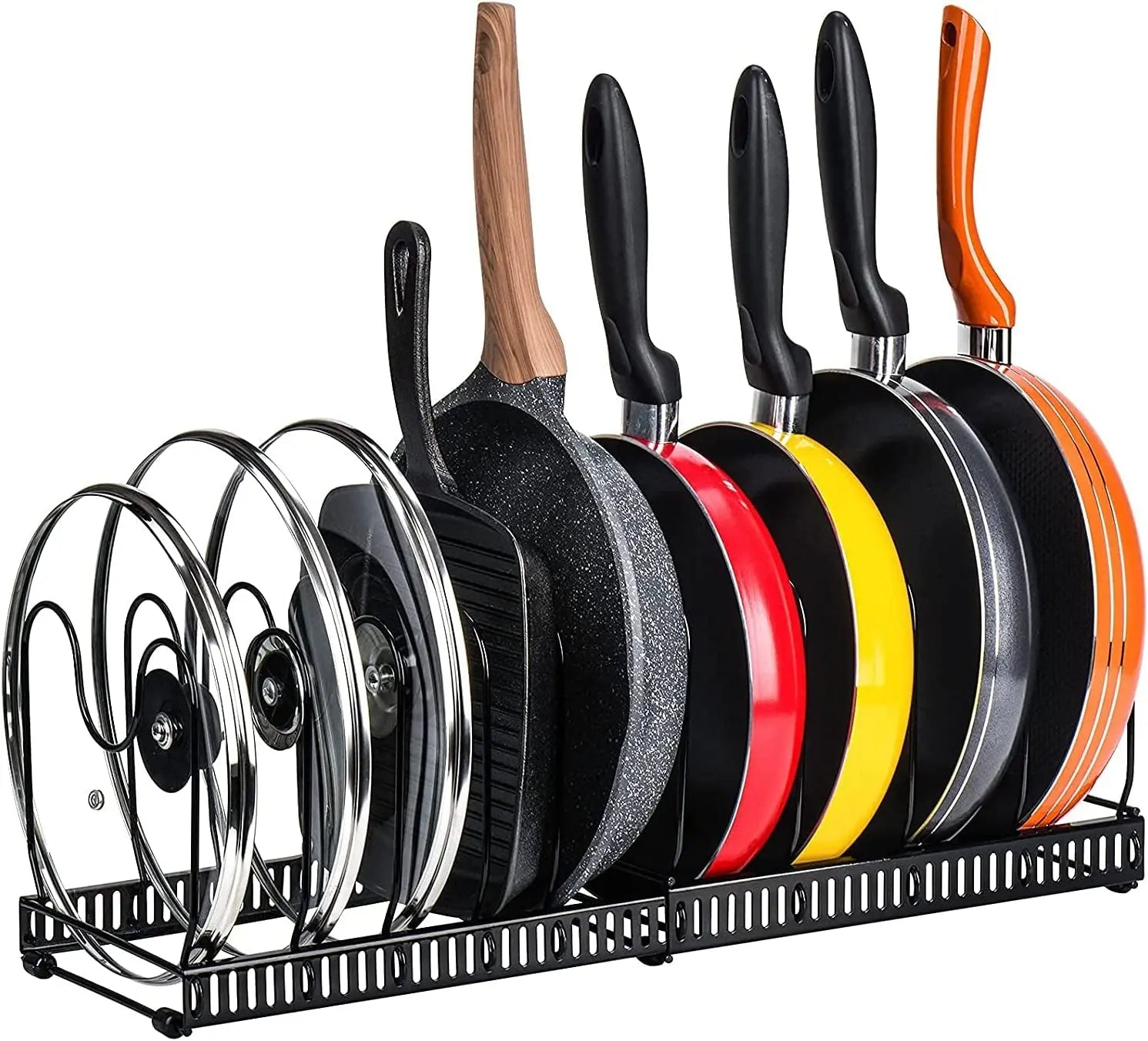
Vertical storage solves this by giving each pan its own slot, so you can slide one out without disturbing the rest. An expandable pans organiser rack with 10 adjustable compartments does exactly this — deep U-shaped dividers hold pans, pot lids, baking trays and even cutting boards upright and separated, and the rack itself expands to fit cabinets of different widths rather than needing an exact custom fit.
Solve the lid problem separately from the pan problem
Lids are almost always the actual source of cabinet chaos, not the pans themselves. A pan without its matching lid nearby just gets pushed to the back and forgotten, while a pile of loose lids takes up disproportionate space and rattles every time the cabinet is opened.
The simplest fix is a rack built specifically for lids rather than pans. A pot lid holder rack with 10 dividers and 4 hooks keeps lids upright and separated from the pans themselves, with hooks left over for oven mitts, tea towels or other kitchen odds and ends — so lids stop rattling loose or getting buried under whatever pan landed on top of them last.
Pot and pan storage ideas by kitchen type
| Kitchen situation | Best approach |
|---|---|
| Deep under-bench cabinet, plenty of pans | Expandable vertical rack with wide dividers for pans and baking trays |
| Narrow cabinet, tight on width | An organiser that separates into two smaller units rather than one fixed-width rack |
| Lids constantly going missing or rattling loose | A dedicated lid rack, or lid holders mounted to the inside of the cabinet door |
| Drawer storage instead of a cabinet | A drawer-specific expanding organiser designed to sit flat rather than stand upright |
| Heavy cast iron cookware | Heavy-duty racks rated for the extra weight, rather than lightweight plastic dividers |
For drawer storage instead of a cabinet
Not every kitchen stores pots and pans in a cupboard — some sit in a wide, shallow drawer instead, which needs a completely different approach to a vertical rack. A drawerstore expanding cookware organiser is built specifically for this: scratch-proof wire dividers insert anywhere along an adjustable frame, so pans, lids and baking tins sit flat and separated rather than sliding around loose in the drawer.
A simple approach to setting it up
- Take everything out of the cabinet first, the same way you would for organising a kitchen drawer — you cannot judge what will fit until the space is empty.
- Separate lids from pans before deciding on storage, since they usually need two different solutions, not one.
- Measure the cabinet's actual width and height, not just a guess, before buying an organiser — an expandable rack is far more forgiving of an odd-sized cabinet than a fixed one.
- Put your most-used pans at the front of the rack, and anything used only occasionally — like a stockpot or a roasting tray — towards the back or on a higher shelf.
- Reassess after a week of normal cooking. If a particular pan is still awkward to reach, it is usually a sign the layout needs one more adjustment, not that you need to buy more storage.
If your kitchen storage problem extends beyond pots and pans, our guide to small kitchen storage ideas covers the wider cabinet and pantry picture.
Frequently asked questions
What's the best way to store pot lids?
Separately from the pans themselves, either in a dedicated upright lid rack inside the cabinet or on a set of holders mounted to the inside of the cabinet door — both stop lids sliding loose or getting buried under pans.
Should pots and pans be stored flat or upright?
Upright, wherever cabinet height allows. Vertical dividers let you slide one pan out without disturbing the rest, while a flat stack means unpacking everything above the pan you actually need.
How do I organise pots and pans in a narrow cabinet?
Look for an organiser that can separate into two smaller units rather than one fixed-width rack, so you can fit each half into a narrower space or use them on either side of a divided cabinet.
Can I store pots and pans in a drawer instead of a cabinet?
Yes — a drawer-specific expanding cookware organiser with adjustable wire dividers is built for this, keeping pans, lids and baking trays flat and separated rather than sliding around loose.
Will a cookware rack hold heavy cast iron pans?
Check the specific weight rating before buying — some racks are built and rated for cast iron and other heavy cookware, while lighter plastic dividers are better suited to standard non-stick pans.