Cart
0
TL;DR: Choosing a bedside table starts with height, not looks. The top should sit within about 5 cm of the top of your mattress — level is ideal, slightly higher is better than lower. For width, measure the clear gap between the bed and the wall or wardrobe and subtract at least 10 cm so you can still walk past. Depth of 35 cm to 45 cm suits most bedrooms; anything deeper starts to crowd the room. After that it is a storage question: a drawer hides the clutter, an open shelf is cheaper and lighter visually, and a small cabinet suits anyone who wants things genuinely out of sight. In a tight bedroom, a narrow table of around 27 cm to 30 cm wide, or a wall-mounted shelf, does the job without blocking the walkway.
This guide is about the table itself — the piece of furniture. If what you are actually deciding is what to put on top of it, our separate guide on how to choose a bedside table lamp covers shade size, globe type and brightness, and it is worth reading after you have settled the table, because the table's height and top surface area determine which lamps will actually work.
A bedside table is a small piece of furniture that gets used more than almost anything else in the house. It holds a lamp, a glass of water, a phone, a book, reading glasses, and whatever else accumulates. Get the proportions wrong and it is a daily irritation: too low and you are reaching down for the light, too deep and you clip it every time you get out of bed, too small and everything ends up on the floor.
Height Is the Decision That Matters Most
Everything else is adjustable. Height is not.
Measure from the floor to the top of your mattress, not to the top of the bed frame and not to the top of the doona. That mattress-top measurement is your target. A bedside table whose surface sits level with the mattress top, or up to about 5 cm above it, puts everything within easy reach when you are lying down.
Australian bed heights vary more than people expect. A low platform bed might put the mattress top at 45 cm; a bed with a thick pillow-top mattress and a base can sit at 65 cm or more. That is a 20 cm spread, which is why a table that looked right in a showroom can look wrong at home.
If you have to choose between slightly too high and slightly too low, choose too high. Reaching up to a surface is easier than reaching down and feeling for it in the dark. A table more than about 10 cm below the mattress top means you are groping downward for a glass of water at 2 am, which is exactly the scenario a bedside table exists to prevent.
Check the drawer clearance too. On a table with a drawer, make sure the drawer front is not so high that you cannot see into the drawer while standing, and not so low that the bed frame fouls it when it opens.
Width and Depth: Measure the Gap, Not the Wall
The second measurement is the clear space beside the bed.
Measure the gap between the side of the bed and whatever bounds it — the wall, a wardrobe door, the edge of the room. Then subtract at least 10 cm for a walkway. If the gap between your bed and the wall is 60 cm, a table of 45 cm to 50 cm wide leaves you room to move. If it is 40 cm, you need something genuinely narrow.
Depth of 35 cm to 45 cm suits most bedrooms. That gives a usable surface for a lamp plus a book plus a glass without the table protruding past the bed line. A deeper table looks substantial but you will catch your leg on it.
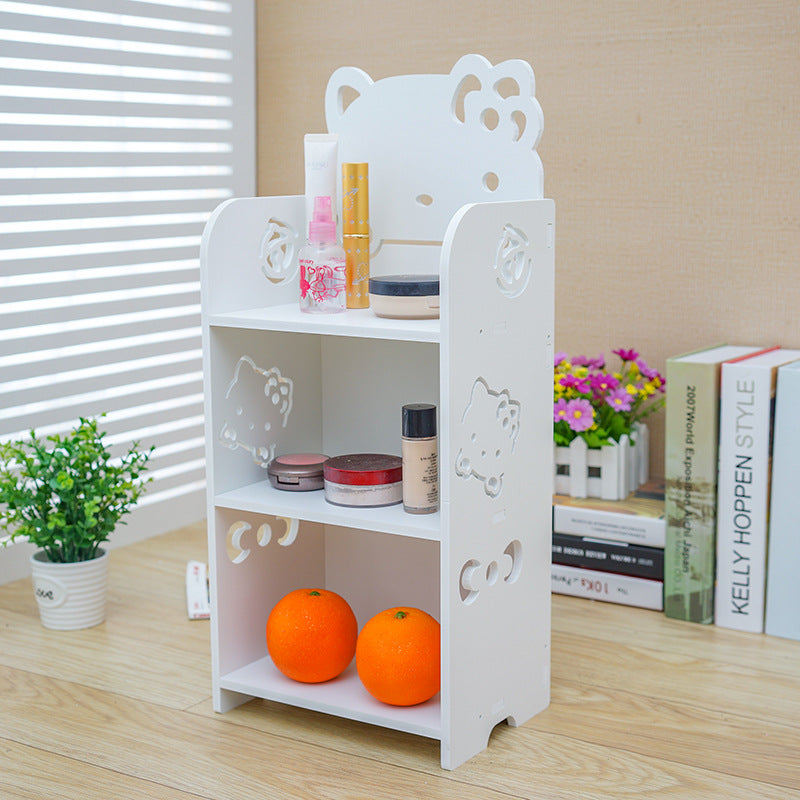
For a narrow gap, a slim tower-style piece is the answer. A Lace Carved Nightstand Storage Cabinet at 19 x 27 x 47.5 cm is an example of the type: a 27 cm footprint that still gives you enclosed storage, in a shape that suits a bedroom where a conventional table simply will not fit. Because it is short in height, it works best with a low platform bed rather than a high pillow-top.
In a very small bedroom, consider a Nordic Mini Side Table in solid wood, which is designed for exactly this constraint, or skip the floor-standing table altogether and use a wall-mounted shelf with a small lamp. A shelf frees the entire floor area and makes the room read as larger.
Bedside Table Sizing at a Glance
| Measurement | Guide | Why |
|---|---|---|
| Height | Within 5 cm of mattress top; slightly above is better than below | Everything stays in reach lying down |
| Width | Gap beside bed minus at least 10 cm | Leaves a walkway |
| Depth | 35 cm to 45 cm | Usable surface without protruding past the bed |
| Narrow bedroom | 27 cm to 30 cm wide, or a wall shelf | Keeps the walkway clear |
| Surface area needed | Lamp base plus roughly 20 cm x 15 cm clear | Room for a book, glass and phone |
Storage: Drawer, Shelf or Cabinet
The three formats solve different problems, and the right answer depends on what actually ends up beside your bed.
A single drawer is the standard for a reason. It swallows the small clutter — chargers, hand cream, earplugs, a spare phone cable — and keeps the visible surface clear. A Bedside Table with Drawer in black is a straightforward version of this: one drawer, a flat top, nothing to think about. This is the safe default if you are not sure.
Open shelving is lighter visually and works well in a small or dark room, because you can see through and under it. The trade-off is that whatever is on the shelf is on display, so it only stays tidy if you keep it tidy. It suits people who read — a stack of books on an open shelf looks intentional in a way that a stack of chargers does not.
A closed cabinet puts everything genuinely out of sight and gives you more volume than a drawer. It is the right choice if the bedside area is where medication, documents or anything you would rather not have visible lives.
A mix of drawer and open shelf is the most flexible arrangement: clutter in the drawer, books on the shelf. A Modern Minimalist Bedside Table, available in light green, matte black and simple white, is the sort of piece that suits a room where you want the table to disappear into the scheme rather than announce itself.
Matching Pairs, or Not
The convention is a matching pair either side of the bed, and it is a convention for a good reason: symmetry either side of a bed makes a room read as calm and resolved. If you have the space and the budget, a pair is the low-risk choice.
Two situations argue against it:
Asymmetric rooms. If one side of the bed is against a wall and the other opens into the room, a matching pair can look forced. Use a full-size table on the open side and something narrow or wall-mounted on the tight side.
Deliberately mismatched pairs. Two different tables of the same height, in the same finish family, read as considered rather than accidental. The rule that makes this work is that the heights must match. Different shapes at the same height look intentional; the same shape at different heights looks like a mistake.
Whatever you choose, keep the finish conversation limited. If the bed has black metal legs and the room has black window frames, a black table belongs. If the room runs to timber and linen, a natural timber finish will sit better than a painted one.
What Actually Goes On Top
Work backwards from what you use every night, because that sets the minimum surface area.
- A lamp takes the most space. Measure the lamp base before you buy the table, not after. A Vintage LED Nightstand Lamp with adjustable brightness has a small footprint, which frees up surface for everything else. If your reading habits are the real driver here, our guide on how to choose a reading light for bed covers the clip-on and wall-mounted options that take up no table space at all.
- Water. A carafe and glass set such as the Cow Carafe Set for Nightstand Use takes a compact footprint and stops the row of half-drunk glasses accumulating.
- A phone and charger. Decide now whether the cable runs over the back edge or through a hole in the table. Tables without cable management mean a cable draped across the top permanently.
- A book or two. This is what open shelving is for.
If you find you cannot fit all four, the table is too small — or the lamp is too big. Usually it is the lamp.
Power, Cables and Placement
Before you settle on a position, check where the power point is. A bedside table placed 1.5 m from the nearest outlet means an extension lead running along the skirting board, which is both untidy and a trip hazard in the dark.
If the room's power points are genuinely in the wrong place, adding or relocating an outlet is electrical work that must be done by a licensed electrician. The same applies to any wall-mounted bedside light that connects to fixed wiring. Plug-in lamps and rechargeable lamps need no trade involvement, which is why they are the practical answer in a rented home.
Making It Work in Winter
A bedside table earns its place most in the cooler months, when the bedroom becomes somewhere you actually spend the evening rather than just sleep. A surface for a book, a lamp at the right height and a drawer for the reading glasses turns the bed into a usable reading spot. Our guides on how to make your bedroom cosy in winter and the cushion size and layering guide cover the rest of that setup.
Ready to Measure Up?
Take three measurements before you shop: floor to mattress top, the clear gap beside the bed, and the footprint of the lamp you intend to use. Those three numbers eliminate most of the range and leave you choosing on style rather than guessing on fit. When you have them, browse the full Pattan Australia range.
Frequently asked questions
How high should a bedside table be?
The top should sit within about 5 cm of the top of your mattress. Measure from the floor to the mattress surface, not to the bed frame. If you have to compromise, choose slightly too high rather than too low, since reaching up is easier than feeling for something below the mattress line.
How wide should a bedside table be?
Measure the clear gap between the side of the bed and the wall or wardrobe, then subtract at least 10 cm for a walkway. A 60 cm gap suits a table of about 45 cm to 50 cm wide. In tighter spaces, look for a narrow tower-style piece around 27 cm to 30 cm wide.
What is a good depth for a bedside table?
Between 35 cm and 45 cm suits most bedrooms. That gives enough surface for a lamp, a book and a glass without the table sticking out past the line of the bed, which is what causes you to knock into it getting out of bed.
Do bedside tables have to match?
No. Two different tables of the same height, in the same finish family, read as deliberate. The rule that makes mismatched pairs work is matching height — different shapes at the same height look intentional, while the same shape at different heights looks like an error.
What is the best bedside table for a small bedroom?
A narrow tower-style cabinet of around 27 cm to 30 cm wide, or a wall-mounted shelf. A wall shelf frees the whole floor area beneath it and makes the room read as larger, and it pairs well with a clip-on or wall-mounted reading light rather than a table lamp.
Should a bedside table have a drawer or open shelves?
A drawer hides small clutter such as chargers and hand cream and keeps the top clear, which suits most people. Open shelves are lighter visually and suit readers, since a stack of books looks intentional on display. A table with both is the most flexible arrangement.