Cart
0
TL;DR: Choosing a garden watering timer comes down to how you want to control it and how much garden it has to cover. A mechanical dial timer screws onto the tap and runs for a set number of minutes with no batteries and no settings. A digital tap timer runs a repeating schedule and is the sensible default for most Australian backyards. A smart WiFi or ZigBee controller lets you adjust or skip a watering from your phone, which is the one that matters if you travel or if the weather changes faster than your schedule does. Whichever you pick, check three things before you buy: that it fits a standard Australian tap thread, that it carries a weatherproof rating suitable for sitting outside all year, and that you can replace the batteries without unscrewing the whole unit from the tap.
A watering timer is one of the few garden purchases that pays you back in time rather than in appearance. It takes the daily decision out of watering, it waters early in the morning when you are still asleep, and it stops the pattern where a garden gets drowned on Sunday and ignored until the following Saturday.
This guide covers the three types of timer, how to work out how much watering capacity you need, the fittings and ratings to check before you buy, and how to build a schedule that suits Australian conditions across the year.
The Three Types, and Who Each One Suits
Mechanical dial timers. You twist a dial to a number of minutes, the water runs, the dial winds down, the water stops. No batteries, no screen, nothing to configure. They are the right answer for someone who just wants to stop forgetting the hose is on, and for taps where a battery-powered unit would be inconvenient. The limitation is obvious: they do not repeat. Somebody has to twist the dial each time.
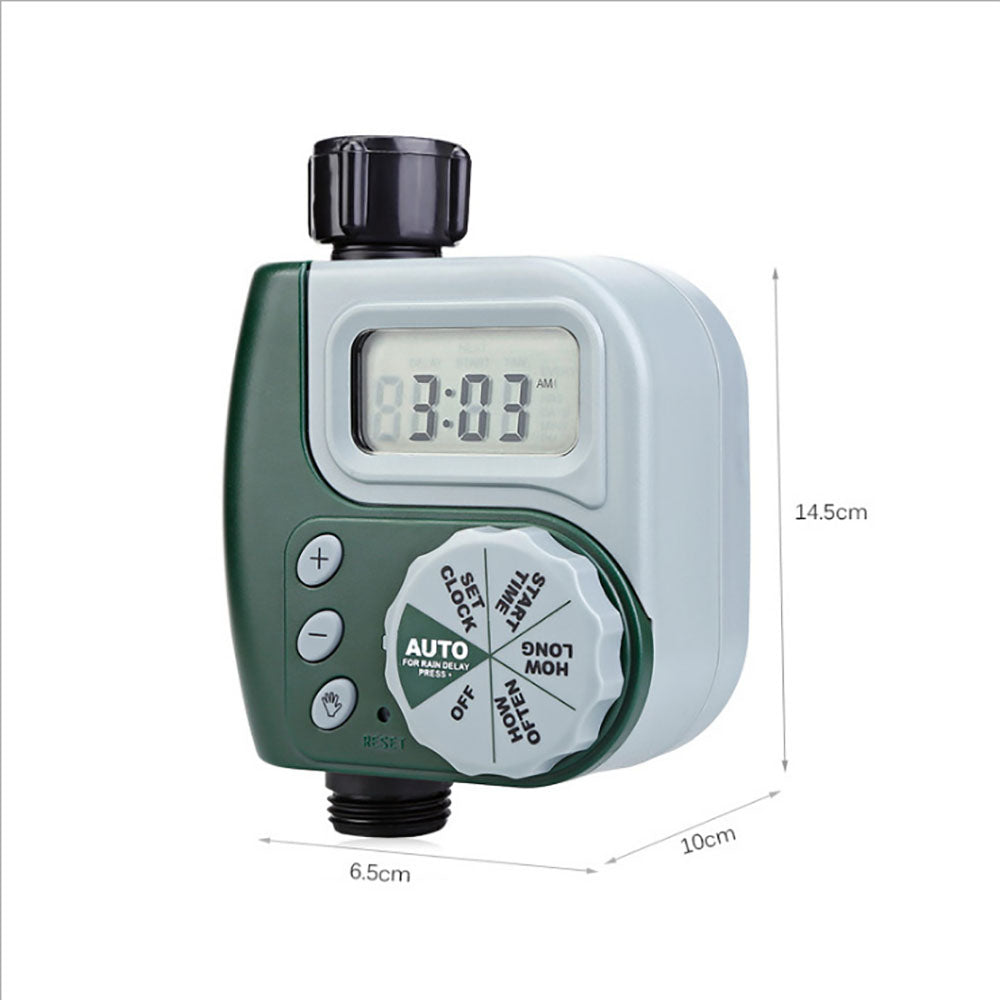
Digital tap timers. These are the workhorses. A battery-powered unit screws onto the tap, and you program a start time, a run duration, and a frequency — every day, every second day, twice a day. From then on it runs itself. Something like the Automatic Garden Watering Timer System, which is waterproof-rated and weighs around 430 g, sits in this category and is the type most Australian gardens are best served by. A compact unit such as the Smart Garden Mini Watering Controller, at around 410 g, does the same job for a balcony, a courtyard or a run of pots where a full-size controller would be overkill.
Smart WiFi and ZigBee controllers. These add remote control. You can change the schedule from your phone, skip a watering when rain is forecast, or check whether the garden was actually watered while you were away. The Smart WiFi Garden Irrigation Controller is built in POM with an IP67 waterproof rating and runs on four 1.5V alkaline batteries, and it connects through a WiFi or ZigBee gateway. This is the category worth paying attention to if you go away regularly, if your garden is out of sight of the house, or if you want to stop watering the moment a change comes through.
Timer Comparison
| Type | Repeats automatically | Needs batteries | Remote control | Best suited to |
|---|---|---|---|---|
| Mechanical dial | No | No | No | One tap, occasional use, no set-up appetite |
| Digital tap timer | Yes | Yes | No | Most suburban gardens and vegetable beds |
| Smart WiFi / ZigBee | Yes | Yes | Yes | Travellers, larger gardens, changeable weather |
Work Out What It Has to Cover
Before comparing models, work out how much garden the timer is actually serving. Three questions settle it.
How many separate areas need different amounts of water? A lawn, a vegetable bed and a row of pots have three genuinely different requirements. If you try to run all three off one outlet on one schedule, one of them will be wrong. Either accept the compromise, split into multiple timers on separate taps, or choose a multi-outlet controller.
How long is the run from the tap? Pressure drops over distance and through fittings. A 20 m hose run to a drip line at the back fence delivers noticeably less at the far end than at the tap. If the garden is a long way from the tap, an adjustable nozzle such as the Adjustable High Pressure Nozzle for Garden Watering gives you a way to concentrate flow where hand watering is still needed, alongside the timed line.
Is the tap shared? If the same tap fills a bucket, runs the car wash and feeds the garden, a timer that has to be unscrewed every time is going to be unscrewed and not put back. Look for a unit with a manual override or a bypass so the tap can still be used normally without disturbing the schedule.
The Practical Checks Before You Buy
These are the details that decide whether a timer is still working in two summers' time.
Tap thread. Standard Australian garden taps take a 3/4 inch BSP thread, and most timers are supplied to fit, sometimes with an adaptor for a 1 inch tap. Check your tap before ordering rather than after.
Weatherproof rating. A timer lives outdoors permanently and is exposed to sun, rain and dust. An IP-rated enclosure — IP67 means dust-tight and able to handle temporary immersion — is what you want on a unit that sits at ground level where it can be splashed or partly submerged in a downpour. UV exposure is the other half of the problem: cheap plastic housings go brittle in Australian sun. A dark, UV-stable housing lasts longer.
Battery type and access. Most digital and smart timers run on alkaline AA or AAA cells. What matters is whether you can open the battery compartment while the unit is still attached to the tap, and whether the schedule survives a battery change. A timer that forgets its programme every time the batteries go flat is a timer you will stop using.
Manual override. A physical button that runs the water now, without touching the programme, is genuinely useful. You will want it when you are planting something out or rinsing a path.
Frost. In cooler parts of Australia — the Southern Highlands, the Adelaide Hills, Tasmania, alpine areas — water left inside a timer over a hard frost can crack the housing. If you get real frosts, drain the line and take the timer off the tap over the coldest weeks.
Setting a Schedule That Suits Australian Conditions
The timer is only half the job. The schedule is what determines whether the garden actually thrives.
Water early in the morning. Between roughly 4 am and 8 am is the window where evaporation is lowest and the plant has the day ahead to use the water. Evening watering leaves foliage damp overnight, which encourages fungal problems in humid conditions.
Water deeply and less often, not lightly and daily. A long soak two or three times a week drives roots downward. A short daily sprinkle keeps roots near the surface where they dry out fastest. For established garden beds, aim for fewer, longer runs.
Adjust by season, not by habit. A summer schedule left running through a Melbourne or Hobart winter will waterlog a bed. As a rough starting point: cut back sharply through the cooler months, step up gradually through spring, and expect the heaviest demand from December to February. Pots dry out far faster than garden beds in every season and usually need their own schedule.
Skip when it rains. This is where a smart controller earns its place — you can cancel a cycle from your phone rather than watching the sprinklers run through a downpour. On a digital timer, use the rain-delay or off setting rather than reprogramming.
Check your local water restrictions. Water restrictions in Australia are set by state and regional water authorities, and both the rules and the permitted watering hours vary by location and can change with conditions. Check your own water authority's current rules before setting a schedule, and set your timer's start time to sit inside the permitted window.
Where the Timer Fits in the Wider Outdoor Setup
A watering timer is one of a small group of set-and-forget outdoor devices that quietly make a garden easier to live with. The others are lighting and power. If you are working on the outdoor space more broadly, our guide on how to choose outdoor string lights covers the equivalent decisions for lighting a garden or deck, and our guide on outdoor motion sensor lights covers detection range and placement around paths and side access.
Solar-powered garden pieces work on the same logic of leaving something outside to run itself. A Solar Light Watering Can with Hollow Projection Lamp, at 23 x 15 x 16 cm with a built-in rechargeable battery, is a decorative piece rather than a working one, but it belongs to the same category of garden hardware you install once and then leave alone.
One note on installation: a tap timer screws onto an existing garden tap and needs no trade involvement. Anything that requires plumbing changes, a new tap, or connection to a mains-powered irrigation controller is a different matter, and mains-powered controllers must be wired by a licensed electrician.
Ready to Set Yours Up?
Count how many separate watering zones you actually have, check your tap thread, and decide whether you need remote control or just a reliable repeating schedule. When you know those three things, browse the full Pattan Australia range and match a timer to your garden.
Frequently asked questions
What is the difference between a tap timer and an irrigation controller?
A tap timer screws directly onto a garden tap, runs on batteries and controls a single outlet. An irrigation controller manages one or more valves on a fixed irrigation system and is usually mains-powered or gateway-connected. For a typical suburban garden, a tap timer is the simpler and more practical option.
Do garden watering timers need batteries?
Mechanical dial timers do not. Digital and smart timers almost always do, typically alkaline AA or AAA cells. Check that the battery compartment can be reached while the timer is still on the tap, and that the programme is retained when batteries are changed.
What IP rating should an outdoor watering timer have?
Look for an IP-rated enclosure suited to permanent outdoor use. IP67 means dust-tight and able to withstand temporary immersion, which suits a unit sitting at ground level exposed to heavy rain and splashing. UV resistance in the housing matters just as much under Australian sun.
What time of day should a garden timer water?
Early morning, roughly between 4 am and 8 am, is the most efficient window because evaporation is lowest and the plants have the day ahead to use the water. Evening watering leaves foliage wet overnight, which encourages fungal problems in humid conditions.
How often should the timer run?
Fewer, longer runs beat short daily sprinkles because deep watering encourages roots to grow downward. Established garden beds generally do well on two or three longer cycles a week, adjusted down through winter and up through summer. Pots dry out much faster and usually need their own more frequent schedule.
Can I still use the tap normally with a timer attached?
Look for a timer with a manual override or a bypass outlet. That lets you run the tap for filling a bucket or washing the car without unscrewing the unit or disturbing the programmed schedule.