Cart
0
TL;DR: Knowing how to choose a chopping board comes down to four decisions: the material, the size, whether you need a juice groove, and how many boards you actually want. Timber and bamboo are kinder to knife edges and look good enough to carry to the table; plastic and stainless steel go in the dishwasher and are easier to keep on top of. For everyday cooking, a board of roughly 40 cm x 27 cm gives you room to work without swallowing the whole bench. Most Australian kitchens work best with two or three boards rather than one: a large timber board for vegetables and serving, a separate dedicated board for raw meat and seafood, and a small board for the quick jobs.
A chopping board is the single most-used surface in the kitchen and the one people put the least thought into. The result is a familiar pattern: one board that is slightly too small, slowly going grey, wobbling on the bench, and being used for raw chicken and salad leaves on the same night.
This guide covers the four material families and what each is genuinely good at, how to size a board to your bench and your knife, when a juice groove matters, and how to build a small set of boards that covers everything without cluttering the kitchen.
Start With Material: Four Families, Four Jobs
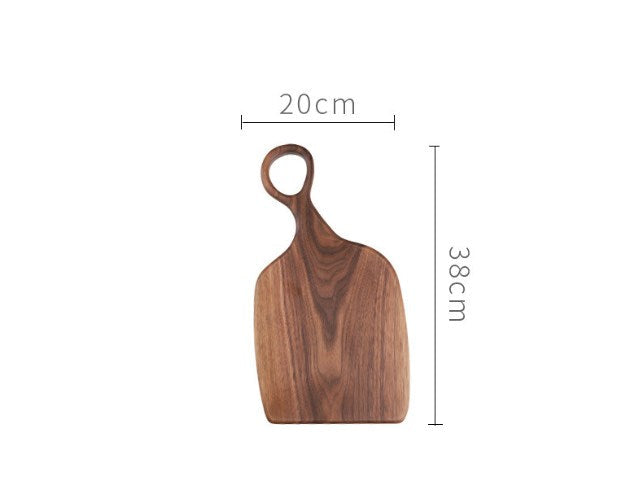
Hardwood (walnut, maple, acacia). Dense close-grain timbers are the standard for a reason. They are gentle on knife edges, they hold up to years of use, and light surface marks can be sanded out rather than being permanent. They are also the only category that genuinely doubles as a serving piece, which matters if you like putting cheese, bread or charcuterie straight onto the board. Something like the Solid Black Walnut Chopping and Serving Board fills that role — it comes in a small and a large, so you can use the small one for a wedge of cheese and the large one as the main prep board. The trade-off is maintenance: hardwood is hand-wash only, must be dried standing on edge, and wants oiling every so often.
Bamboo. Technically a grass, not a timber, and it behaves a little differently. Bamboo is lighter than hardwood, harder on the surface, and generally less thirsty, which is why it holds up well in humid parts of Australia. It is a good choice for a board that gets used constantly and needs to be light enough to lift one-handed. It is slightly less forgiving on a knife edge than walnut or maple, and it does not sand back as well, so deep cuts are permanent. Bamboo boards also work well as presentation pieces — a Bamboo Sushi Tray in 21 x 12 cm, 24 x 14 cm or 27 x 18 cm is really a small serving board with a tidy edge.
Plastic (HDPE or polypropylene). The practical choice for raw meat, chicken and seafood, because it goes through the dishwasher on a hot cycle. Plastic is cheap to replace, which matters more than it sounds: a plastic board with deep scoring should be retired rather than persevered with, and you should feel no attachment to it. It is the least attractive of the four and it dulls knives faster than timber.
Stainless steel and composite. Steel-topped and composite boards are the low-maintenance end of the range. They wipe clean, they do not absorb moisture, and they will not warp. A board like the Kitchen Chopping Board for Fruits and Vegetables, which pairs a stainless surface with a non-slip base and comes in a small and a large, suits fruit, vegetables and general prep where you want something you can rinse and move on. Steel is the hardest surface of the four, so it is the toughest on knife edges — it is a prep-and-rinse board rather than a board for long knife work.
Material Comparison
| Material | Knife friendliness | Dishwasher | Doubles as serving board | Best suited to |
|---|---|---|---|---|
| Hardwood (walnut, maple) | High | No | Yes | Daily prep, cheese and bread, long knife work |
| Bamboo | Medium-high | No | Yes | Everyday prep, humid climates, lighter handling |
| Plastic (HDPE) | Medium | Yes | No | Raw meat, chicken and seafood |
| Stainless / composite | Low | Usually | Sometimes | Fruit and vegetable prep, quick rinse-and-go |
Size It to Your Bench, Not to the Shop Display
Boards look bigger in a shop than they do on a bench. The two measurements that matter are the working area and the depth relative to your bench.
The everyday board: around 40 cm x 27 cm. This is the size that handles a whole pumpkin, a tray of vegetables or a roast without you having to work in stages. A board such as the Wooden Chopping Board for Chicken Wings, at 40 x 27 x 3 cm, sits right in that everyday range and the 3 cm thickness gives it enough mass to stay put while you work.
The second board: around 44 cm x 20 cm. A longer, narrower board is easier to live with than it looks. It fits alongside a sink, it suits slicing bread or carving, and it does not dominate the bench. The Wooden Chopping Board with Juice Groove is 445 x 200 x 21 mm and is a good example of the shape.
The small board: around 25 cm x 18 cm. For a lemon, a clove of garlic, a piece of cheese. Having one of these stops the large board coming out for a thirty-second job, which is the single easiest way to reduce washing up.
Check your bench depth before buying. Standard Australian kitchen benchtops are about 60 cm deep, and a good chunk of that is taken by the splashback, the kettle and whatever else lives there permanently. A board deeper than about 30 cm will start pushing things around. Measure the clear run you actually have, not the full bench.
Thickness is about stability, not durability. A board of 2 cm to 3 cm has enough weight to stay still under a knife. Thin boards, under about 1.5 cm, tend to slide and are better as serving trays than prep boards. If a board you like is thin, a damp tea towel underneath solves the problem.
Do You Need a Juice Groove?
A juice groove is the shallow channel routed around the edge of a board. It is genuinely useful for exactly two jobs: carving roast meat, and cutting anything wet such as tomatoes, watermelon or a citrus fruit. In both cases the groove catches the liquid instead of letting it run onto the bench.
It is less useful for everyday vegetable prep, where it just reduces the usable area by a centimetre or two on every side and gives you another edge to clean. If you carve a roast regularly, get a board with a groove and keep it for that. If you mostly chop vegetables, you will not miss it.
Some boards solve this by putting a groove on one face and leaving the other flat, which is the arrangement worth looking for if you only want one board.
Keep Raw Meat Separate
This is the part of chopping-board choice that has nothing to do with looks. Standard home food-safety practice in Australia is to keep raw meat, chicken and seafood on a board of their own, and to keep ready-to-eat food — salad, bread, fruit, cooked meat — on a different board.
The simplest way to make this stick is colour or shape. A plastic board in a distinctly different colour, or a board of an obviously different shape, means nobody in the house has to remember a rule. If you would rather keep everything in timber, dedicate one board to raw protein and mark the underside so it is unmistakable.
Whichever board handles raw meat should be the one that is easiest to wash thoroughly — which is usually a plastic board through the dishwasher, or a hard non-porous surface you can scrub with hot soapy water.
Caring For a Timber or Bamboo Board
Timber and bamboo boards fail for the same three reasons every time: they go in the dishwasher, they get left to soak, or they get dried flat on the bench.
- Hand wash in warm soapy water and dry immediately. Do not leave a timber board sitting in water, even briefly.
- Dry it standing on edge, not lying flat. A board drying flat holds moisture underneath, and that is what causes cupping and warping. Standing it on edge on a rack lets both faces dry evenly.
- Oil it when it starts looking dry or pale. Food-grade mineral oil, applied generously, left to soak in, then wiped back. How often depends on use, but the board will tell you — a dull, chalky look means it is thirsty.
- Never microwave it, never put it in the oven, never leave it in direct sun. All three will split it.
- Retire a board with deep scoring you cannot sand out. Grooves that hold food are the point at which a board has done its time.
Our guide on how to keep stainless steel kitchen accessories rust-free covers the same drying discipline for the metal side of the kitchen, and it is the same underlying principle: water left sitting is what does the damage.
Building a Small Set Instead of Buying One Board
Most kitchens are better served by two or three boards than by a single large one. A workable set looks like this:
- A large timber or bamboo board for vegetables, bread, and general prep. This is the one that lives out on the bench.
- A dedicated board for raw meat and seafood, ideally plastic and dishwasher-safe.
- A small board for quick jobs, plus optionally a serving board that never sees a knife.
That last category is worth separating out. A board like the Rectangular Wooden Serving Board for Pizza, Cake and Sushi, available in three sizes, or a Pizza Serving Board at 60 x 37 cm, is chosen for how it presents food rather than how it takes a knife. Keeping serving boards out of the prep rotation is what keeps them looking good.
Where you store the boards matters as much as which ones you buy. Boards stacked flat in a cupboard trap moisture between them; boards stored upright in a rack or slot dry properly and stay flat. Our guide on how to store kitchen knives safely covers the same storage logic for the tools that go with them, and our guide on how to choose a dish drying rack covers racks with a board slot built in.
Ready to Choose Yours?
Measure the clear run of bench you actually have, decide whether you want one board or a small set, and pick the material that matches how much maintenance you are realistically going to do. When you have those three answers, browse the full Pattan Australia range and match a board to your kitchen.
Frequently asked questions
What size chopping board should I buy?
For everyday cooking, a board of around 40 cm x 27 cm handles most jobs without taking over the bench. Add a small board of around 25 cm x 18 cm for quick tasks. Check your clear bench depth first, since a board deeper than about 30 cm crowds a standard 60 cm benchtop.
Are wooden or plastic chopping boards better?
They do different jobs. Timber is gentler on knife edges, lasts longer and can double as a serving board, but it is hand-wash only. Plastic goes through the dishwasher, which makes it the practical choice for raw meat and seafood, and it is cheap to replace once it becomes deeply scored.
Is bamboo good for a chopping board?
Bamboo is light, hard-wearing and less absorbent than most timbers, which suits humid Australian conditions. It is slightly harder on knife edges than walnut or maple, and deep cuts cannot be sanded out the way they can in solid hardwood.
Do I need a chopping board with a juice groove?
A juice groove is worth having if you carve roast meat or cut wet produce such as tomatoes and melon, because it catches the liquid. For dry vegetable prep it just reduces the usable surface. A board with a groove on one face and a flat reverse covers both uses.
How do you stop a wooden chopping board from warping?
Never put it in the dishwasher, never let it soak, and dry it standing on edge rather than lying flat so both faces dry evenly. Oil it with food-grade mineral oil whenever the surface starts looking dull or chalky.
How many chopping boards should a kitchen have?
Two or three covers most households: a large board for vegetables and general prep, a separate dedicated board for raw meat and seafood, and a small board for quick jobs. Serving boards are best kept out of the prep rotation so they stay unmarked.