Cart
0
TL;DR: Knowing how to choose a wall mirror comes down to four things: size it to the furniture underneath rather than to the wall, hang it so the centre sits around eye level, place it where it reflects something worth reflecting (a window, a lamp, a view), and match the fixings to the mirror's weight. Above a console or sideboard, a mirror roughly two-thirds to three-quarters the width of the furniture reads as balanced, with a gap of 15 cm to 20 cm between the two. Lightweight acrylic mirrors with adhesive mounts suit renters and gallery walls; heavy glass mirrors need proper wall anchors or fixing into studs, and anything genuinely heavy is worth getting professional help with.
A mirror is the one piece of decor that does two jobs at once. It finishes a wall the way artwork does, and it changes how the room itself feels, bouncing daylight into dark corners and making a narrow hallway read as wider than it is. That dual role is also why it goes wrong so often. A mirror chosen purely as an object can end up reflecting a blank wall or the underside of a doorframe, and a mirror chosen purely for light can look stranded.
This guide covers sizing, placement height, working with reflected light, choosing a shape and finish, and hanging the thing safely once you have decided.
Size the Mirror to What Sits Underneath It
The most common sizing mistake is choosing a mirror to fill a wall. Walls are big, and a mirror scaled to a whole wall usually overwhelms the room. Size it instead to the piece of furniture below it, or, if there is nothing below it, to the wall's usable span.
Above a console table, sideboard or hall table: aim for a mirror roughly two-thirds to three-quarters the width of the furniture. A 120 cm console suits a mirror of about 80 cm to 90 cm wide. Anything wider than the furniture itself looks top-heavy.
Above a bedroom dresser or a vanity: the same ratio works, and here it matters more, because you also want the mirror wide enough to be genuinely useful when you are sitting or standing at it.
Vertical gap: leave 15 cm to 20 cm between the top of the furniture and the bottom of the mirror. Less than that and the two pieces read as one crowded block. More than 25 cm and the mirror starts to float away from the furniture it is supposed to belong to.
On an empty wall with nothing beneath it: work to about 60 percent of the wall's usable width, measuring the span between whatever bounds it (a doorway, the edge of a window architrave, the corner). Leave clear wall on both sides so the mirror reads as a deliberate feature rather than a panel.
For a full-length mirror: you need at least 120 cm of height to see yourself head to toe, and 150 cm or more is more comfortable. Below 120 cm you are stepping backwards across the room to get a full view, which defeats the purpose.
If you are working out the size of several pieces on the same wall, our guide on how to choose a wall clock uses the same proportional logic, and the two decisions are usually made together.
Placement Height: Centre It at Eye Level, Not at a Fixed Number
Galleries hang art with its centre at roughly 145 cm to 155 cm from the floor, and that range works well for mirrors too. It puts the mirror at natural eye level for most adults standing in the room.
Two situations override that default:
- When there is furniture below, the 15 cm to 20 cm gap rule wins. Position from the furniture up, not from the floor up, and let the centre height land where it lands. A mirror over a low console will sit a little higher than the gallery range, and that is correct.
- In a bathroom or above a vanity, position from the person, not the wall. The mirror should show a face comfortably for the people who actually use the room, and it should not sit so high that a shorter member of the household can only see the ceiling.
For a hallway mirror where people check themselves on the way out the door, err slightly higher rather than lower. For a mirror in a room where people are mostly seated, such as a lounge, err slightly lower so it reflects the room rather than the ceiling.
Use the Mirror to Move Light Around the Room
This is where a mirror does something no other piece of decor can, and it is worth being deliberate about.
Perpendicular to a window, not directly opposite it. A mirror on the wall at right angles to a window catches daylight and throws it deeper into the room. A mirror directly facing a window reflects the light straight back out, and often reflects glare into people's eyes at certain times of day.
Opposite or beside a lamp. In a room that is dark at night, positioning a mirror where it picks up a lamp effectively doubles that light source. This works particularly well in a hallway or an entryway with no natural light of its own.
Check what it actually reflects before you commit. Hold the mirror up, or have someone hold it, and stand where you normally stand in the room. A mirror reflecting a cluttered bench, the back of a door, or a blank stretch of ceiling is not doing its job. A mirror reflecting a window, a plant, a piece of artwork or an open sightline through the house is.
Narrow rooms and hallways benefit most. A mirror on the long wall of a narrow hallway visually widens it. This is one of the highest-impact, lowest-effort changes you can make to an entryway.
Bathrooms and steam. Consider what the mirror will be exposed to. A mirror in a bathroom without good ventilation deals with steam and moisture constantly, and a timber or acrylic-framed piece will handle that differently to a metal-framed one.
Shape, Frame and Finish
Once the size and position are settled, the shape and finish decide how the mirror sits within the room's overall look.
Round mirrors soften a space. They work particularly well in rooms full of straight lines: square rooms, rectangular furniture, tiled bathrooms. A round mirror above a rectangular console is one of the most reliable pairings in interior styling because the shapes contrast rather than repeat.
Rectangular and arched mirrors add height. Hung vertically, they draw the eye upward and make a room with a standard 2.4 m ceiling feel taller. This is a useful trick in a small bedroom or a hallway.
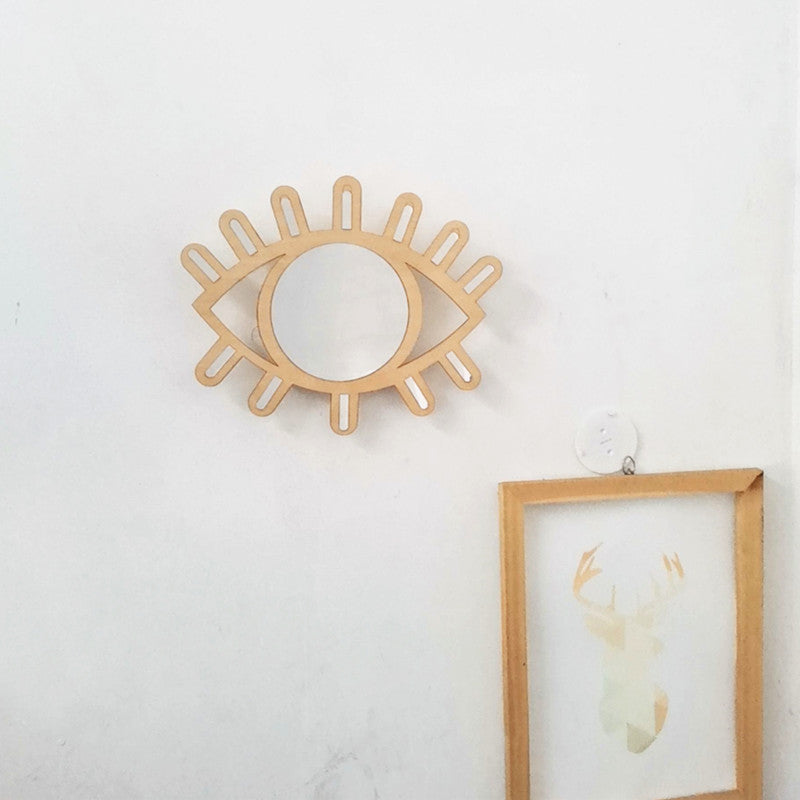
Irregular and sculptural shapes work as decor first and function second. Something like the Nordic Wooden Eye-Shaped Wall Mirror, with a natural plywood frame and an adhesive mount that needs no nails or drilling, is chosen for the silhouette it adds to a wall rather than for checking your reflection. Pieces like this suit gallery walls, a spot above a console, or a rented home where drilling is not an option.
Frame finish should pick up something already in the room. A slim gold metal frame such as the Nordic Gold Wall Mirror warms up a scheme with brass or timber tones and works well in an entryway or bedroom. A black frame grounds a room that already has black window frames or dark hardware. A natural timber frame suits linen, jute and plants.
The same two-finish discipline that applies to lighting applies here: keep to two metal finishes in one room, and the space will look considered rather than accidental.
Frameless mirrors disappear into the wall and maximise the reflective surface for the space they take up. They are the right choice when the mirror is there to do a job rather than to be looked at.
Hanging It Safely: Weight, Fixings and When to Get Help
This is the part worth slowing down on, because a mirror that comes off a wall is a far bigger problem than a picture frame that does the same.
Know the weight before you choose the fixing. Lightweight acrylic mirrors with an adhesive mount hold themselves on a clean, flat, sound surface with no hardware at all. Framed glass mirrors are a different proposition entirely, and glass gets heavy quickly as it gets larger.
Plasterboard on its own carries almost nothing. A screw driven straight into plasterboard with no anchor will pull out. For anything with real weight you need either a rated plasterboard anchor or, better, a fixing into a stud. In most Australian homes, studs sit at 450 mm or 600 mm centres. A stud finder is the fastest way to locate them, and it is worth the few minutes.
Match the anchor rating to the mirror, with room to spare. Read the weight rating on the fixing packet and choose one rated comfortably above the mirror's actual weight, not just level with it. Where a mirror has two hanging points, the load is shared, but do not assume both are carrying equally.
Use two fixing points wherever possible. Two points stop the mirror rotating out of level and halve the load on each fixing. D-rings with a rated hanging wire, or two keyhole plates, both work.
Get help with anything heavy or oversized. A large framed mirror or a full-length piece is awkward as well as heavy, and getting it level while supporting the weight is genuinely a two-person job. For a very large or very heavy mirror, or for masonry and brick walls where you need the right fixings for the substrate, engaging a professional installer is the sensible call.
Leaning a floor mirror still needs securing. A tall mirror propped against a wall looks relaxed but can tip, particularly in a home with children or pets. Anchor the top of the frame to the wall with a safety strap or bracket.
For the general principles of getting things onto a wall without wrecking the plasterboard, our guide on how to hang wall art without damaging walls covers the no-stud options and how to patch small holes afterwards.
One note on lit mirrors: any mirror with integrated lighting that connects to fixed wiring is electrical work. Have it installed by a licensed electrician, and never attempt the wiring yourself.
Wall Mirror Choices at a Glance
| Where it is going | Size guide | What to prioritise |
|---|---|---|
| Above a console or hall table | 2/3 to 3/4 the furniture width, 15-20 cm gap | Reflecting the entry sightline or a light source |
| Narrow hallway | Long wall, generous width | Visually widening the space |
| Above a dresser | 2/3 to 3/4 the dresser width | Usable at both standing and seated height |
| Empty feature wall | About 60% of the usable wall span | Clear wall on both sides |
| Bedroom, full-length | 120 cm minimum height, 150 cm+ better | Head-to-toe view without stepping back |
| Gallery wall | Small, shaped, lightweight | Silhouette and frame finish over function |
| Rented home | Lightweight acrylic, adhesive mount | No nails, no drilling, no repairs on exit |
| Bathroom | Sized to the vanity, not wider | Moisture tolerance and ventilation |
Ready to Find Yours?
Measure the furniture the mirror will sit above, work out two-thirds to three-quarters of that width, then check what the spot actually reflects before you buy. When you have those numbers, browse the full Pattan Australia range and match a shape and finish to the room.
Frequently asked questions
What size mirror should I hang above a console table?
Choose a mirror roughly two-thirds to three-quarters the width of the console. A 120 cm console suits a mirror of about 80 cm to 90 cm wide. Leave a gap of 15 cm to 20 cm between the top of the console and the bottom of the mirror.
How high should a wall mirror be hung?
Aim for the centre of the mirror at around 145 cm to 155 cm from the floor, which puts it at natural eye level. If furniture sits underneath, position from the furniture instead, keeping a 15 cm to 20 cm gap above it.
Where should you place a mirror to make a room brighter?
Hang it on a wall perpendicular to a window so it catches daylight and throws it deeper into the room. A mirror directly opposite a window tends to reflect light straight back out and can create glare at certain times of day.
How do you hang a heavy mirror without it falling?
Fix into wall studs where you can, since studs in Australian homes are usually at 450 mm or 600 mm centres. Otherwise use plasterboard anchors rated comfortably above the mirror's weight, and use two fixing points rather than one. For very large or heavy mirrors, use a professional installer.
What shape wall mirror should I choose?
Round mirrors soften rooms full of straight lines and pair well above rectangular furniture. Rectangular or arched mirrors hung vertically add a sense of height. Irregular or sculptural shapes suit a decorative role on a gallery wall or above a console.
Can you hang a mirror without drilling holes?
Yes, if the mirror is light enough. Lightweight acrylic mirrors with an adhesive mount attach to a clean, flat, sound wall with no hardware, which suits rented homes. Framed glass mirrors are too heavy for adhesive mounting and need rated anchors or stud fixings.