Cart
0
TL;DR: Knowing how to choose a chandelier for a living room comes down to four decisions: diameter matched to the size of the room, total fitting height matched to your ceiling, enough clearance underneath that nobody walks into it, and a style and finish that connects to the furniture already in the space. A useful sizing shortcut is to add the room's length and width in metres, multiply by 8, and treat the result as a starting diameter in centimetres, so a 5 m x 4 m lounge lands around 72 cm. Unlike a dining chandelier, a living room fitting has no table to anchor it, so it is sized to the room and planned as the ambient layer alongside floor and table lamps. Every hardwired fixture must be installed by a licensed electrician.
A chandelier in a dining room has an easy job: there is a table underneath it, and the table sets the size, the position and the height. A living room gives you none of that. The room is usually larger, the seating is spread out, people walk through it, and the ceiling point was often placed by a builder who was thinking about a plain batten fitting rather than a 70 cm decorative piece. That is why so many living room chandeliers end up looking either lost in the space or awkwardly low over a walkway.
This guide works through the four decisions in order: size to the room, height to the ceiling, position to the seating, and style to the furniture. It also covers globe bases, dimming, and why a chandelier on its own almost never lights a lounge room properly.
Size the Chandelier to the Room, Not to a Piece of Furniture
In a dining room you size the fitting to the table. In a living room you size it to the floor area, because there is no single object it needs to relate to.
The simplest starting point: add the room's length and width in metres, then multiply by 8. Use that number as a diameter in centimetres.
| Room size | Length + width | Starting diameter |
|---|---|---|
| 3.5 m x 3 m (small lounge) | 6.5 | approx. 52 cm |
| 4.5 m x 3.5 m (typical lounge) | 8 | approx. 64 cm |
| 5 m x 4 m (large lounge) | 9 | approx. 72 cm |
| 6 m x 5 m (open-plan living) | 11 | approx. 88 cm |
Treat that figure as a centre point rather than a rule. Go a little larger if the room has high ceilings, a strong feature wall, or very little other decoration competing for attention. Go a little smaller if the ceiling is low, the room is busy with artwork and shelving, or the fitting sits close to a doorway.
Two practical adjustments worth knowing:
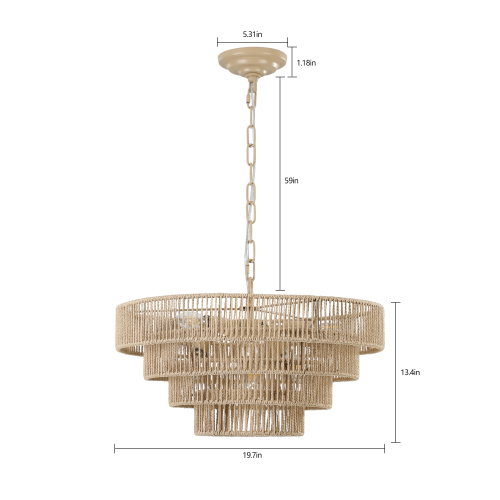
- A wide, shallow fitting reads bigger than its diameter suggests. A four-tier woven shade such as the Bohemian Woven Rattan Chandelier, at roughly 50 cm wide and 34 cm high, has more visual weight than an open metal frame of the same diameter because the shade is solid rather than see-through.
- An open frame can go larger than the formula. A geometric iron-and-wood fitting like the Farmhouse 5-Light Chandelier lets you see straight through it, so it fills a room visually without blocking sightlines or making the ceiling feel lower.
If your living room and dining area share one open-plan space, size each fitting to its own zone rather than to the combined floor area, and keep the two in the same family of finish. Our guide on how high to hang a chandelier over a dining table covers the dining half of that pairing in detail.
Ceiling Height Sets the Drop, and Sometimes Rules a Chandelier Out
Most newer Australian homes have a 2.4 m ceiling in the living areas. Older homes, Federation cottages and Queenslanders often run 2.7 m to 3.3 m. That difference changes what is actually wearable.
A workable guide to total fitting height (canopy to the lowest point, including chain or cable):
- 2.4 m ceiling: keep the whole fitting to roughly 30 cm to 40 cm. A semi-flush or compact fitting usually makes more sense than a long-drop chandelier.
- 2.7 m ceiling: roughly 45 cm to 55 cm of total height works comfortably.
- 3 m and above: 60 cm or more, and a longer drop stops the fitting looking stranded up near the ceiling.
The number that matters more than any of these is clearance underneath. Anywhere people walk, aim for at least 2.1 m from the floor to the lowest point of the fitting. On a 2.4 m ceiling that leaves you about 30 cm of total fitting height before someone tall starts ducking, which is exactly why long-drop chandeliers and low ceilings rarely get along.
You get more room to play if the fitting hangs over something rather than over open floor. Directly above a coffee table, where nobody stands, you can drop lower, because the table itself keeps foot traffic away.
If a 2.4 m ceiling rules out the drop you wanted, the answer is usually a different mounting style rather than a smaller chandelier. Our comparison of ceiling rose vs flush mount light explains which mounting types suit which ceiling heights, and what changing between them involves.
Where It Goes: Room Centre, Seating Centre, or Neither
The existing ceiling point is rarely in the ideal spot, so it is worth deciding what you actually want before assuming you have to work around it.
- Centre of the room is the default and the safest choice in a square or near-square lounge with seating arranged around the edges. It keeps the ceiling looking balanced from every doorway.
- Centre of the seating zone works better in a long or open-plan room where the lounge suite occupies one end. Hanging over the conversation area makes the fitting feel intentional rather than arbitrary.
- Over the coffee table is the strongest option visually, because the table gives the fitting an anchor the way a dining table does, and it lets you hang lower without creating a head-height hazard.
In an open-plan living and dining space, resist centring the living room fitting on the whole room. Split the space into its two functional zones and centre each fitting on its own zone. A room reads as deliberately planned when each light has an obvious reason to be where it is.
Moving a ceiling point is electrical work. It is entirely doable, but it involves relocating the wiring and patching the ceiling, and it must be carried out by a licensed electrician.
Match the Style and Finish to What Is Already in the Room
A chandelier is one of the few things in a living room that everyone looks up at, so it sets the tone for the whole space. The most reliable approach is to pick up a material or finish that already exists in the room rather than introducing a fifth new one.
Natural and textured fittings, such as woven rattan or timber-toned frames, suit rooms with linen upholstery, jute rugs, timber floors and plants. They soften a room and read as relaxed rather than formal, which suits the way most Australian living rooms are actually used.
Iron and wood farmhouse frames suit rooms with a mix of black metal and timber already present: black window frames, a timber coffee table with dark legs, black curtain rods. The white-and-black finish on a piece like the Farmhouse 5-Light Chandelier gives you a foot in both camps.
Fabric drum shades are the quietest option. A fitting such as the Silk Drum Chandelier, available from 50 cm through to 100 cm in diameter, diffuses light evenly and disappears into a scheme rather than dominating it. This is the safer choice in a room that already has a bold rug, patterned cushions or a gallery wall.
Sculptural and modern pieces do the opposite: they become the focal point. That works well in a pared-back room with plain walls and simple furniture, where there is space for one strong object.
A useful discipline on finishes: keep to two metal finishes maximum in one room. If your door handles, curtain rods and coffee table legs are already black, a black or dark chandelier will look considered. Add brass to that mix and you have three, at which point the room starts to feel accidental.
Globes, Light Output and Dimming
A chandelier's fitting type determines which globes you can buy, so check it before you commit rather than after delivery.
- E27 is the standard large screw base common across Australian fittings.
- E26 is the slightly narrower screw base used on some imported fittings, including the Farmhouse 5-Light Chandelier, which takes 5 x E26 globes at a maximum of 60 W each.
- E14 and E12 are the small candelabra screw bases used on multi-arm and tiered fittings. The Bohemian Woven Rattan Chandelier takes 6 x E12.
- Integrated LED fittings have no replaceable globe at all. The light source is built in, which means fewer decisions up front but no option to change the colour temperature later.
For a living room, warm white in the 2700 K to 3000 K range is almost always the right call. Cooler light suits a kitchen bench or a laundry, but in a lounge it makes the room feel clinical at night. If you are weighing this up across the whole house, our guide to warm white vs cool white light breaks down where each belongs.
Dimming is worth planning for rather than adding later. A chandelier that runs at full brightness for a family dinner and at a quarter for a movie earns its place in a way a fixed-output fitting never quite does. Not every fitting and not every globe dims, and dimmable LED globes need a compatible dimmer, so confirm both before buying.
A Chandelier Is One Light Source, Not a Lighting Plan
This is the mistake that undoes an otherwise well-chosen fitting. A single ceiling light, however good, throws light downward from one point. It leaves the corners of the room dim, puts shadows under people's eyes, and gives you exactly one brightness setting for every activity in the room.
A living room generally wants three layers:
- Ambient: the chandelier, providing the overall wash of light.
- Task: a floor lamp beside the reading chair, or a table lamp on a side table next to the lounge. Our guide on how to choose a floor lamp covers sizing and placement for this layer.
- Accent: a lamp on a console or sideboard, or lighting that picks out artwork or shelving, adding depth once the main light is dimmed.
Plan the chandelier as the first of those three, not the only one. In practice, a lounge with a well-sized chandelier plus two lamps will feel better at night than the same lounge with a larger, more expensive chandelier on its own.
Living Room Chandelier Choices at a Glance
| Your situation | What to look for | Why |
|---|---|---|
| 2.4 m ceiling | Semi-flush or compact, 30-40 cm total height | Preserves the 2.1 m walking clearance |
| 2.7 m or higher ceiling | Longer drop, 45 cm or more | Stops the fitting looking stranded near the ceiling |
| Small lounge, 3.5 m x 3 m | Around 50 cm diameter | Scales to the room without crowding it |
| Large or open-plan living | 80 cm or more, or one fitting per zone | Fills the volume and defines each zone |
| Busy room, patterned rug and cushions | Plain fabric drum shade | Adds light without competing for attention |
| Pared-back room, plain walls | Sculptural or open frame | Gives the room a single deliberate focal point |
| Relaxed, natural interior | Woven rattan or timber tone | Picks up existing linen, jute and timber |
| Above a coffee table | Lower drop is fine | The table keeps foot traffic clear |
Installation Is a Licensed Electrician's Job
Chandeliers are hardwired fixtures. In Australia, connecting or altering fixed wiring must be carried out by a licensed electrician, and that is not a formality: a heavy fitting also needs to be mounted to something structurally capable of holding it, which frequently means fitting a proper mounting bracket or brace rather than relying on the existing ceiling box.
Have your electrician confirm the ceiling can take the weight, install any bracing required, set the drop to the height you have measured for, and check dimmer compatibility while they are there. Do not attempt to wire a chandelier yourself.
Ready to Choose Yours?
Measure your room, work out your starting diameter, then check the drop against your ceiling height before anything else. When you have those two numbers, browse the chandelier and modern lighting range and filter by what actually fits your space.
Frequently asked questions
What size chandelier do I need for a living room?
Add the room's length and width in metres and multiply by 8 to get a starting diameter in centimetres. A 4.5 m x 3.5 m lounge gives 8 x 8, or roughly 64 cm. Adjust up for high ceilings and plain walls, down for low ceilings and a busy room.
How low can a chandelier hang in a living room?
Keep at least 2.1 m between the floor and the lowest point of the fitting anywhere people walk. Directly above a coffee table you can hang lower, because foot traffic is already kept clear by the table itself.
Can you put a chandelier in a room with 2.4 m ceilings?
Yes, but keep the total fitting height to roughly 30 cm to 40 cm, or choose a semi-flush mount instead of a long-drop design. On a 2.4 m ceiling, anything with a long chain will sit below comfortable head height.
Where should a living room chandelier be positioned?
Centre it on the room in a square lounge, on the seating zone in a long or open-plan room, or directly over the coffee table if you want the strongest visual anchor. In open-plan spaces, centre each fitting on its own zone rather than on the whole room.
Do I need other lights if I have a chandelier?
Yes. A chandelier provides ambient light from a single point, which leaves corners dim and gives you one brightness setting. Add a floor lamp or table lamp for reading, plus an accent lamp, so the room works for different activities and times of day.
Can I install a living room chandelier myself?
No. Chandeliers are hardwired fixtures and must be installed by a licensed electrician in Australia. Heavy fittings also need suitable ceiling bracing, which your electrician can assess and fit at the same time.