Cart
0
Quick answer: Run it at or below −18°C, freeze things flat rather than in blocks, and label everything with contents and date — because the freezer's real problem is not space, it is that you cannot identify anything after two months.
TL;DR: Almost nothing is thrown out of a freezer because it spoiled. It is thrown out because nobody could tell what it was or how long it had been there. That makes labelling the highest-value habit, not containers. The second lever is flat-freezing: portions frozen flat in bags stack vertically like files, thaw far faster, and use a fraction of the space that a rigid container does. Beyond that it is straightforward — hold −18°C, zone by category so things have a home, and accept that a freezer works best moderately full rather than either empty or packed solid. Freezer burn is not spoilage; it is dehydration from air contact, and it is almost entirely preventable by removing air before sealing.
Key facts
- Run a freezer at or below −18°C.
- Freezer burn is dehydration from air contact, not spoilage — it is a quality loss, not a safety issue.
- Flat-frozen portions thaw considerably faster and stack far more efficiently than blocks.
- A moderately full freezer holds temperature better than an empty one.
- Label with contents and date; frost makes packaging unreadable within weeks.
- Never refreeze food that has fully thawed at room temperature.
Get the Temperature Right
At or below −18°C. That is the standard, and it is what stops enzymatic and microbial activity.
Do not trust the dial. Freezer dials are frequently marked 1 to 5 with no temperatures. A cheap thermometer left inside overnight tells you what is actually happening.
A moderately full freezer holds temperature better than an empty one, because frozen mass acts as a thermal buffer. It does not follow that packing it solid is better — air still needs to circulate, and a freezer stuffed to the door develops warm pockets exactly like an over-packed fridge.
Keep the door closed during a blackout. Our guide on storm season and blackout prep covers the rest, and the rule that matters is temperature rather than elapsed time.
Flat-Freezing Changes Everything
This is the single biggest space improvement available.
Freeze liquids and mince in bags laid flat, not in tubs. Once solid, a flat pack stands upright and files like a book. A tub of the same volume occupies several times the usable space and cannot be stacked reliably.
Flat also thaws far faster, because the surface-area-to-volume ratio is much higher. That is a safety benefit too — faster thawing in the fridge means less time in the temperature range where bacteria multiply.
Portion before freezing, not after. Freezing a family-sized block and chipping pieces off it is how most freezer food goes unused. Freeze in the portions you will actually cook.
Remove air before sealing. Air contact is what causes freezer burn.
Zone It
Give categories a home so things stop migrating.
| Zone | Contents | Notes |
|---|---|---|
| Bottom / coldest | Raw meat and fish | Coldest and lowest, so drips cannot contaminate |
| Middle | Cooked and prepared meals | Ready-to-eat above raw, same as a fridge |
| Top / door | Bread, frozen vegetables, ice | Most accessed, most temperature-variable |
| Dedicated bin | Anything nearing its date | The "use next" zone |
Raw below cooked, exactly as in a fridge — our guide on how to organise a fridge covers why that ordering matters and the 5°C danger-zone threshold.
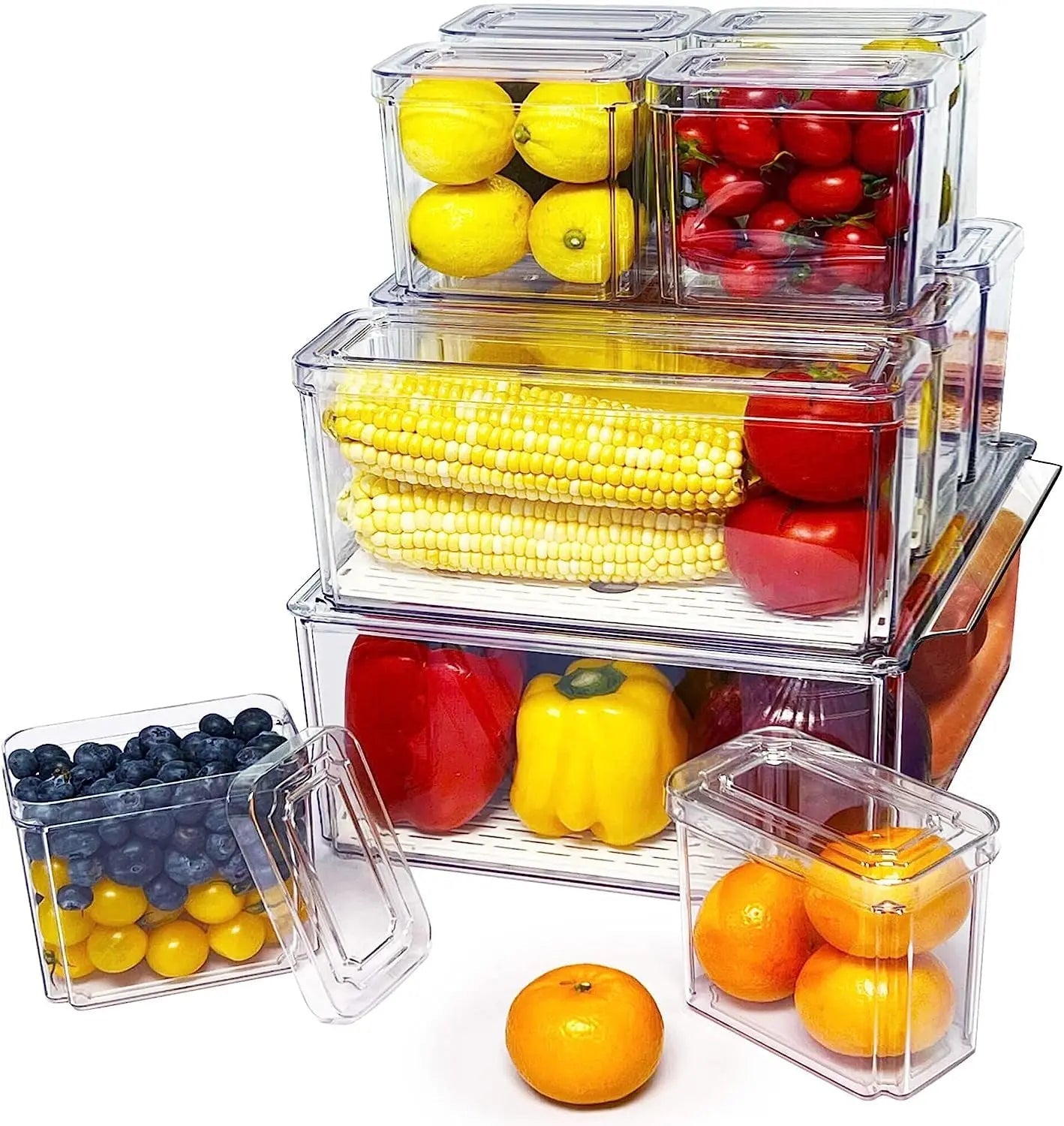
Bins turn a chest or a deep drawer into something usable. A stackable set with lids includes a large bin at 30 × 30 × 14.5 cm holding 9.8 L. A 9-piece set in three widths, all 33 cm long tiles a shelf edge to edge — three wide at 23 cm, three medium at 15 cm, three narrow at 7 cm.
A chest freezer needs bins more than an upright does, because without them everything sinks to the bottom and the lower half becomes archaeology.
Label Everything
This is the habit that saves the most food.
Contents and date, on every item. Not one or the other.
Write on the bag before filling it. Writing on a frosted, full bag rarely works.
Frost makes original packaging unreadable within weeks, which is why "I'll recognise it" fails reliably.
Keep a list on the door if you use the freezer heavily. It sounds excessive and it removes most of the digging.
How Long Things Keep
Frozen food stays safe indefinitely at −18°C — quality is what degrades, not safety.
| Item | Best quality within |
|---|---|
| Mince and sausages | 3 to 4 months |
| Whole cuts of beef and lamb | 6 to 12 months |
| Chicken pieces | 9 months |
| Fish (oily) | 3 months |
| Bread | 3 months |
| Cooked meals and soups | 2 to 3 months |
| Vegetables (blanched) | 8 to 12 months |
These are quality windows, not safety cliffs. Food held continuously at −18°C past these times is safe; it just will not taste as good.
Freezer Burn and Thawing
Freezer burn is dehydration, caused by air reaching the food surface. It looks like greyish-white dry patches. It is unappealing but not unsafe — cut it away and the rest is fine.
Prevent it by removing air before sealing and by not repeatedly part-thawing and refreezing.
Thaw in the fridge, not on the bench. Bench thawing puts the outside of the item into the 5°C to 60°C danger zone while the centre is still frozen.
Never refreeze anything that has fully thawed at room temperature. Food thawed in the fridge and still cold can generally be refrozen, with some quality loss.
Maintenance
Defrost when ice buildup reaches about 5 mm, if your freezer is not frost-free. Ice takes space and forces the unit to work harder.
Check the door seal. A perished seal is a continuous energy cost and a common cause of frost buildup — our guide on reducing energy bills covers why an old second freezer in a hot garage is often one of the largest continuous loads in a household.
Do a stocktake before each big shop. Five minutes, and it stops you buying what you already have three of.
Ready to Sort It Out?
Check the temperature first, then switch to flat-freezing in real portions — that alone transforms the usable space. Label contents and date on everything before filling, and give categories a home so nothing has to be excavated. Browse the kitchen storage collection for freezer bins and containers.
Frequently asked questions
What temperature should a freezer be in Australia?
At or below −18°C. That is the point at which enzymatic and microbial activity effectively stops. Do not rely on a dial marked 1 to 5 — leave an inexpensive thermometer inside overnight to see what the freezer is actually holding.
How long does frozen food last?
Indefinitely from a safety perspective at a constant −18°C — it is quality that degrades. As quality windows: mince 3 to 4 months, whole cuts 6 to 12 months, chicken pieces around 9 months, oily fish 3 months, cooked meals 2 to 3 months, blanched vegetables 8 to 12 months.
What causes freezer burn?
Air reaching the surface of the food, which dehydrates it and leaves greyish-white dry patches. It is a quality problem rather than a safety one — cut the affected area away and the rest is fine. Prevent it by removing air before sealing and avoiding repeated part-thawing.
Why should you freeze food flat?
Flat packs stand upright and file like books, using a fraction of the space a rigid tub of the same volume needs. They also thaw considerably faster because of the higher surface-area-to-volume ratio, which reduces the time food spends in the temperature range where bacteria multiply.
Can you refreeze thawed food?
Food thawed in the fridge and still cold can generally be refrozen, with some quality loss. Never refreeze anything that has fully thawed at room temperature, since the outside will have spent time in the 5°C to 60°C danger zone while the centre was still frozen.
Is a full freezer more efficient?
A moderately full freezer holds temperature better than an empty one, because frozen mass acts as a thermal buffer. Packing it solid is not better though — air still needs to circulate, and an over-stuffed freezer develops warm pockets in the same way an over-packed fridge does.