Cart
0
TL;DR: A fridge is not one temperature. It is a set of zones, and organising it properly means matching each food to the zone that suits it. Run the appliance at or below 5°C, because the food safety danger zone in Australia is 5°C to 60°C. Put raw meat and fish on the bottom shelf, both because it is coldest and because anything that drips there cannot contaminate food below it. Keep ready-to-eat food and leftovers up high. Treat the door as the warmest, most variable zone and reserve it for condiments, not milk or eggs. Then use bins to group things by category rather than stacking them by size, leave the rear vent clear so cold air can circulate, and accept that a fridge packed solid runs warmer than one with room to breathe.
Most fridges are organised by accident. Things go wherever there is a gap, the back fills up with jars nobody can identify, and half a bag of spinach turns to liquid behind the milk. The cost is not just annoyance. It is food thrown out, and it is a genuine food safety issue when raw meat sits above ready-to-eat food.
The good news is that fixing it is a one-hour job and it stays fixed, because a zoned fridge is easier to put away into than a random one.
First, Get the Temperature Right
Everything else is secondary to this.
Run the fridge at or below 5°C. In Australia, the food safety danger zone is 5°C to 60°C, the range in which bacteria multiply fastest. A fridge sitting at 8°C looks and feels cold, but it is inside that zone.
Run the freezer at or below −18°C.
Do not trust the dial. Fridge dials are frequently marked 1 to 5 with no temperatures at all, and the actual internal temperature depends on how full the fridge is, how warm the kitchen is and how often the door opens. A cheap fridge thermometer left on the middle shelf overnight tells you what is really happening. Check it in the morning before the door has been opened.
Give it time after any change. A fridge takes several hours to stabilise after you change the setting or restock it heavily. Do not adjust, check after ten minutes and adjust again.
Do not overfill it. This is the most common cause of a fridge running warm. Cold air has to circulate to work, and a fridge packed wall to wall blocks that circulation. The rear vent in particular must stay clear.
The Five Zones
Cold air sinks, the compressor and vent sit at the back, and the door swings out into a warm kitchen many times a day. Those three facts create the zones.
Bottom Shelf: The Coldest, and the Safest Place for Raw
The bottom shelf, immediately above the crisper drawers, is normally the coldest part of the fridge.
Raw meat, poultry and fish belong here, and nowhere else. Two reasons, and the second matters more than the first. It is the coldest zone, which is what raw protein wants. And it is the lowest zone, so if a package leaks, nothing it drips onto is food you plan to eat without cooking. Raw chicken juice on a bag of salad two shelves down is the single most avoidable cross-contamination event in a home kitchen.
Keep raw items contained as well as low. A tray or a dedicated bin under the packaging catches leaks before they reach the shelf. A wipeable clear stackable bin with a removable drain tray does this job and can be lifted out and washed, which a glass shelf cannot. The large size in that set measures 30 x 30 x 14.5 cm and holds 9.8 L, so it takes a family-sized pack comfortably.
Middle Shelves: Dairy and Eggs
Dairy goes in the middle, where the temperature is cold and reasonably stable.
Eggs belong inside the fridge, not in the door. Egg cartons in the door were a design habit, not good practice. The door is the warmest and most temperature-variable zone in the whole appliance, and eggs prefer stability. An auto-rolling egg holder solves the shelf-space problem that pushes people to use the door in the first place. It uses a 7-degree slope so the next egg rolls down when you take one, the layers hold 18, 36 or 54 eggs depending on configuration, and the transparent body means you can see how many are left without opening anything.
Top Shelf: Ready-to-Eat and Leftovers
The top shelf is slightly warmer than the bottom and, critically, it is above everything else.
Leftovers, cooked food, ready-to-eat items and drinks belong up here. Nothing raw should ever sit above cooked or ready-to-eat food.
Put leftovers in clear containers and put them at the front. The reason leftovers get wasted is that they become invisible. Opaque containers at the back of a shelf are food you have already thrown away, you just have not admitted it yet.
Cool food before it goes in, but do not leave it out too long. Steaming hot food in a sealed container raises the temperature of everything near it. Australian guidance uses a two-hour and four-hour rule for food left at room temperature: under two hours it can go back in the fridge, between two and four hours it should be eaten, and beyond four hours it should be thrown out.
Crisper Drawers: Fruit and Vegetables, Separated
The drawers are humidity-controlled, which is what produce needs, and they are the zone people misuse most.
Separate ethylene producers from ethylene-sensitive produce. Apples, bananas, avocados, tomatoes, stone fruit and rockmelon release ethylene gas as they ripen. Leafy greens, broccoli, cucumbers, carrots and herbs are sensitive to it and deteriorate faster in its presence. Two drawers, or two bins within one drawer, solves this entirely and costs nothing.
Wet greens rot. Wash produce when you are about to use it, not when you put it away. If greens are already damp, a paper towel in the container absorbs the excess.
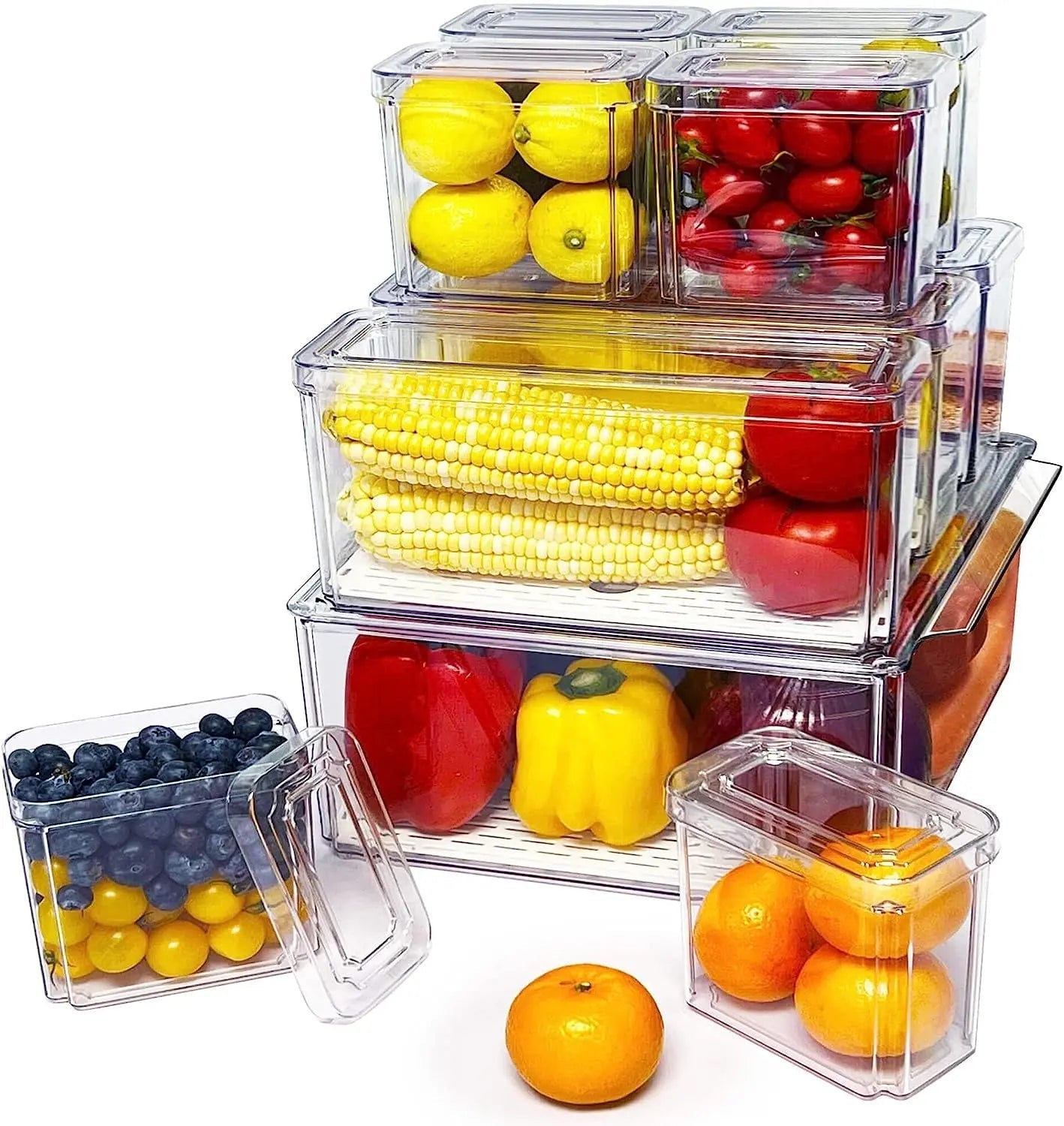
Use bins inside the drawers. A crisper drawer is a large open box, so smaller items sink to the bottom and are forgotten. Dividing it into categories with a set of clear fridge organiser bins keeps them visible. Those measure 25 x 15 x 7.6 cm each, which suits a drawer subdivision, and they stack when not in use.
A colander-style container earns its place for berries and salad. A set with a built-in colander insert lets moisture drain away from the produce instead of pooling under it, which is what turns strawberries to mush. The set runs from extra-large down to small, so the small size handles grapes, strawberries and cherries.
The Door: Condiments Only
The door is the warmest zone and it fluctuates every time you open it.
Suitable for the door: sauces, condiments, jams, pickles, most things with high salt, sugar or vinegar content that are stable at variable temperatures.
Not suitable for the door: milk, eggs, cream, anything raw. The traditional milk shelf in the door is the worst place in the fridge for milk.
Zone Summary
| Zone | Relative temperature | Put here | Keep out |
|---|---|---|---|
| Bottom shelf | Coldest | Raw meat, poultry, fish | Ready-to-eat food |
| Middle shelves | Cold, stable | Dairy, eggs, cheese | Raw protein |
| Top shelf | Slightly warmer | Leftovers, cooked food, drinks | Anything raw |
| Crisper drawers | Cold, humid | Fruit and vegetables, separated | Ethylene mixes |
| Door | Warmest, variable | Condiments, sauces, jams | Milk, eggs, cream |
Drinks, Cans and Bottles
Drinks are bulky, roll around and waste more space than anything else in a fridge.
Cans stack badly and fall over. A 2-tier rolling can dispenser holds up to 12 standard 330 ml cans in a double layer and auto-rolls the next one forward as you take one from the bottom, so the footprint stays fixed rather than spreading across a shelf.
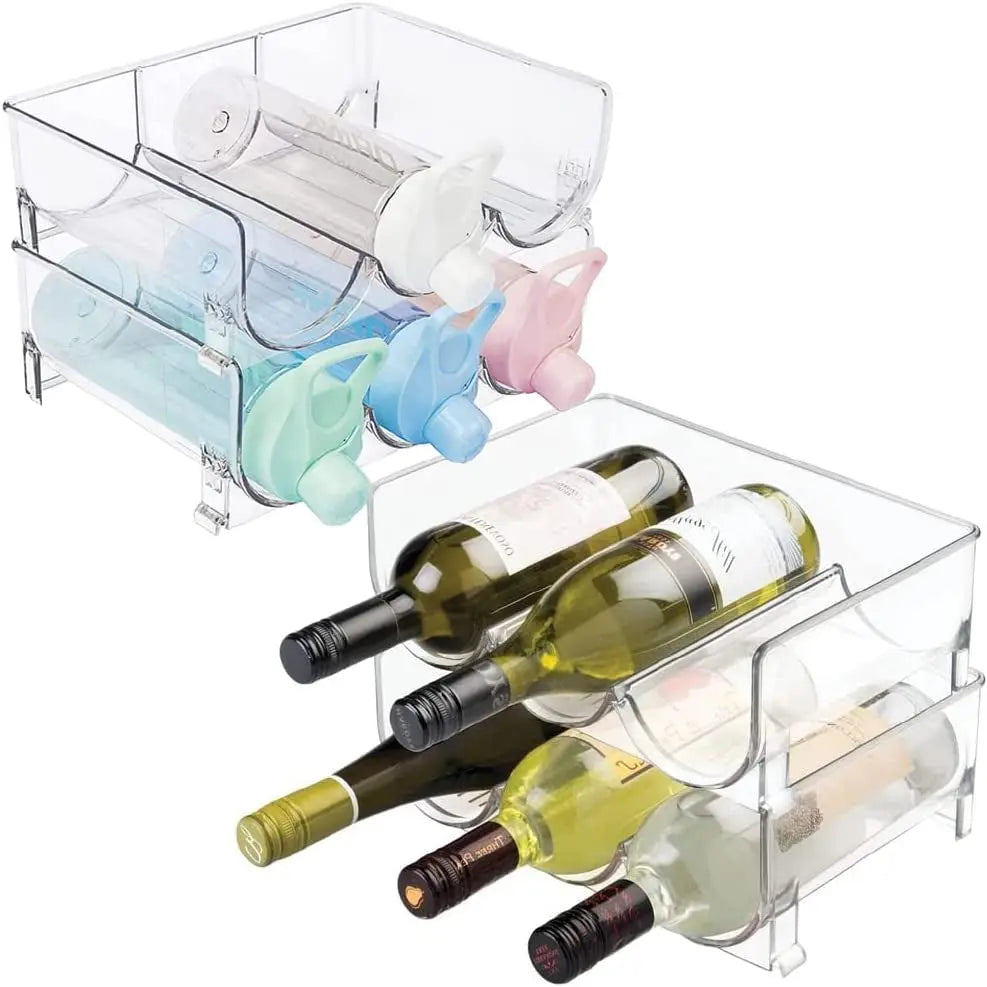
Bottles lying loose are the worst offenders. A stackable water bottle and wine organiser holds six bottles across two stacked racks and stops them rolling every time the door shuts. Our guide on choosing a water bottle and wine storage rack goes into sizing.
Bins: Group by Category, Not by Size
This is the principle that makes a fridge stay organised rather than reverting within a fortnight.
Group by how you use food, not by how things fit. Breakfast items together. Lunchbox items together. Sauces together. Snacks together. When a category has a home, putting the shopping away requires no decisions, and that is what makes it durable.
Match the bin to the shelf depth. Australian fridge shelves are commonly around 30 cm to 35 cm deep. A bin much shorter than the shelf leaves dead space behind it where things get lost. A 9-piece set with three widths is built around this: all nine are 33 cm long to use the full shelf depth, with three wide bins at 23 cm, three medium at 15 cm and three narrow at 7 cm, so you can tile a shelf edge to edge.
Clear beats opaque, every time. You cannot manage what you cannot see.
Handles matter more than they sound. A deep bin at the back of a shelf needs to come out to be useful. Side handles are what make that a one-handed job.
Do not bin everything. Bins add a wall, and a wall slightly restricts airflow. Use them where grouping helps and leave open space where it does not.
Foods That Should Not Be in the Fridge
Space is the scarce resource, and several common items are actively worse for being refrigerated.
- Potatoes, onions, garlic. Cool, dark, dry and ventilated, not cold. Refrigeration turns potato starch to sugar.
- Bananas. Cold damages the skin and halts ripening.
- Whole tomatoes. Refrigeration costs them flavour and turns the texture mealy. Keep them on the bench until cut.
- Bread. The fridge is the fastest way to make bread stale. The freezer is fine; the fridge is not.
- Honey. It crystallises. The pantry is correct.
- Unripe stone fruit and avocados. Bench until ripe, then fridge to hold them.
Moving these to the pantry frees real fridge space. Our guide on how to organise a pantry covers where they should go instead, and small kitchen storage ideas covers finding that space in a kitchen that does not have much.
The One-Hour Reset
Do this once and the maintenance is minutes a week.
- Empty it, one shelf at a time. A whole-fridge empty leaves food out too long.
- Throw out honestly. Anything unidentifiable, anything past date, anything you have moved twice without using.
- Wipe the shelves and drawers. Removable bins are much easier to wash at the sink than fixed shelves are to scrub in place.
- Move the pantry items out of the fridge entirely.
- Assign zones using the table above. Raw at the bottom, ready-to-eat at the top, condiments in the door.
- Set the bins by category and give each one a home.
- Put a thermometer on the middle shelf and check it the next morning.
- Keep a small front-and-centre "eat me first" bin for things approaching their use-by. This one habit removes most household food waste.
Weekly upkeep is then a five-minute pass before the shop: pull anything nearing its date into the eat-first bin, wipe any spills, and check the rear vent is not blocked.
Ready to Reset Yours?
Start with a thermometer and the 5°C target, then zone it: raw at the bottom, ready-to-eat at the top, produce separated in the drawers, condiments in the door. Add bins by category once the zones are set, not before. Browse the kitchen storage collection for the fridge bins, egg holders, can dispensers and bottle racks that make the layout stick, or the full Pattan Australia range if you are fitting out a kitchen from scratch.
Frequently asked questions
What temperature should a fridge be in Australia?
At or below 5°C. The Australian food safety danger zone is 5°C to 60°C, so a fridge running warmer than 5°C sits inside the range where bacteria multiply fastest. The freezer should be at or below −18°C. Check with a thermometer on the middle shelf overnight rather than trusting the dial.
Which shelf should raw meat go on?
The bottom shelf, above the crisper drawers. It is the coldest zone, and because it is the lowest, anything that leaks cannot drip onto ready-to-eat food below. Keeping raw meat in a washable tray or bin adds a second layer of protection.
Should eggs be stored in the fridge door?
No. The door is the warmest part of the fridge and its temperature swings every time it opens, while eggs keep best at a stable temperature. Store them inside on a middle shelf. A dedicated egg holder recovers the shelf space that pushes people to use the door.
Why does my fridge food spoil quickly even though it feels cold?
The two usual causes are a fridge running above 5°C, and overfilling. Cold air has to circulate to keep the whole cabinet at temperature, so a fridge packed wall to wall, or one with the rear vent blocked, develops warm pockets even while feeling cold at the front.
Which fruit and vegetables should be kept apart?
Separate ethylene producers from ethylene-sensitive produce. Apples, bananas, avocados, tomatoes and stone fruit release ethylene as they ripen. Leafy greens, broccoli, cucumbers, carrots and herbs deteriorate faster when exposed to it. Two drawers, or two bins in one drawer, is enough.
What should not be stored in the fridge?
Potatoes, onions, garlic, bananas, whole tomatoes, bread and honey all do better outside it. Cold turns potato starch to sugar, makes tomatoes mealy, stales bread quickly and crystallises honey. Moving them to the pantry also frees genuine fridge space.