Cart
0
TL;DR: There is one calculation, and it takes ten seconds. Multiply the target lux level for the room by its floor area in square metres, and the answer is the total lumens you need. A 20 m² living room at 150 lux needs about 3,000 lumens. A 12 m² kitchen at 300 lux needs about 3,600 lumens, which is why kitchens so often feel dim on a single ceiling fitting. Then adjust upward for high ceilings, dark walls, heavy shades and older eyes. Lumens measure light output; watts measure electricity consumed, and since LED replaced incandescent the two have no fixed relationship. Buy on lumens, then choose colour temperature and colour rendering separately, because a bright light of the wrong colour still feels wrong.
Ask how bright a bulb should be and most people answer in watts, because for a century watts were a reliable proxy. A 60 W bulb was a 60 W bulb. LED broke that relationship permanently: two bulbs drawing the same wattage can differ in output by a factor of two, and a modern LED can produce more light from 10 W than an old incandescent managed from 100 W.
The number that matters now is printed on every box. It is just not the one most people read.
Lumens, Watts and Lux
Three terms, and confusing them causes most bad lighting decisions.
Lumens (lm) measure total light output. This is brightness. It is the number to buy on.
Watts (W) measure electricity consumed. This is running cost, not brightness. Efficiency is expressed as lumens per watt, and modern LED bulbs commonly land somewhere between 80 and 140 lm/W.
Lux (lx) measures light landing on a surface. One lux is one lumen spread over one square metre. This is the number lighting design actually works in, because what matters is not how much light a bulb emits but how much reaches the bench, the book or the floor.
That last definition contains the whole method. If lux is lumens per square metre, then lumens equals lux times square metres.
Total lumens needed = target lux × floor area in m²
Worked example. A living room 4 m × 5 m is 20 m². Aiming for a comfortable ambient 150 lux: 150 × 20 = 3,000 lumens total.
Second example. A kitchen 3 m × 4 m is 12 m². Kitchens are working rooms and want around 300 lux: 300 × 12 = 3,600 lumens. That is more light in a smaller room, and it is why a kitchen lit by one bulb that would suit a bedroom always feels gloomy.
Room-by-Room Targets
These are the design targets commonly used for residential interiors. Australia does have a formal interior lighting standard, AS/NZS 1680, but it is written for workplaces rather than homes, so treat the figures below as practical guidance rather than a compliance requirement.
| Room | Target lux (ambient) | Task areas | Lumens for a 12 m² room |
|---|---|---|---|
| Living room | 100 to 300 | 300+ for reading | 1,200 to 3,600 |
| Kitchen | 200 to 300 | 300 to 500 on the bench | 2,400 to 3,600 |
| Bathroom | 150 to 200 | 300 to 500 at the mirror | 1,800 to 2,400 |
| Bedroom | 100 to 150 | 300+ for reading in bed | 1,200 to 1,800 |
| Home office | 300 to 500 | 500 at the desk | 3,600 to 6,000 |
| Dining room | 150 to 200 | Feature light over the table | 1,800 to 2,400 |
| Hallway and stairs | 100 to 150 | Even coverage matters more | 1,200 to 1,800 |
| Laundry | 200 to 300 | 300 at the bench | 2,400 to 3,600 |
| Garage or workshop | 300+ | 500+ at the bench | 3,600+ |
Two patterns are worth noticing. Working rooms want roughly twice the light of relaxing rooms. And every room has a range, not a single number, because the right answer depends on what you do in it and who is doing it.
Four Adjustments to the Base Number
The calculation gives a starting point. Four factors move it.
Ceiling height. The standard assumes roughly a 2.4 m ceiling, which is the common Australian residential height. Light falls off with distance, so a 3 m or raked ceiling puts the source further from the floor and needs more output, commonly 10% to 20% more. A high-ceilinged room lit to a flat calculation will feel dim.
Wall and ceiling colour. Bounced light is real light. White or pale walls reflect a large proportion of what hits them, while charcoal walls, dark timber and deep feature colours absorb most of it. Dark rooms can need 20% to 30% more output to feel the same brightness.
Shades and diffusers. A bare bulb delivers nearly all its lumens into the room. A fabric drum shade, a frosted diffuser or a heavy pendant absorbs part of that, so a fitting's usable output is lower than the bulb's rating. Add roughly 20% to 30% when the light passes through anything.
Age and eyesight. Visual acuity declines with age and the amount of light needed rises with it. A room that suits someone in their twenties can be genuinely inadequate for someone in their seventies. If you are lighting for older occupants, plan for the top of each range rather than the middle.
Watt Equivalents, If You Still Think in Watts
Most people have a feel for what a 60 W bulb looked like. This is that intuition translated.
| Old incandescent | Approximate lumens | Typical LED wattage |
|---|---|---|
| 25 W | 250 lm | 3 W to 4 W |
| 40 W | 450 lm | 5 W to 6 W |
| 60 W | 800 lm | 8 W to 10 W |
| 75 W | 1,050 lm | 11 W to 13 W |
| 100 W | 1,500 lm | 15 W to 18 W |
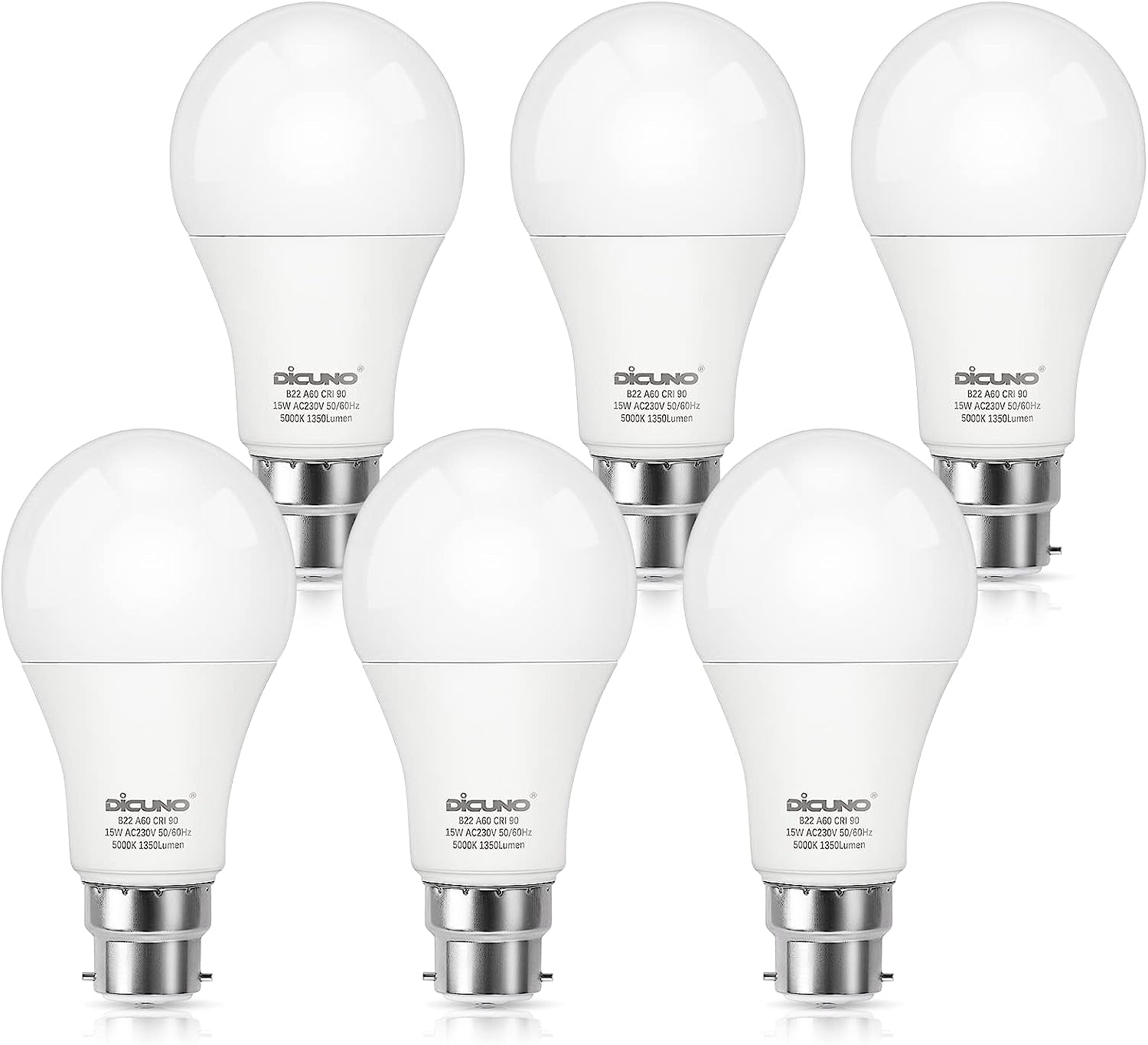
Manufacturers state their own equivalence, and it varies. A B22 bayonet LED rated at 15 W and 1,350 lm is marketed as a 100 W replacement, which is about 90 lm/W and in the normal band for a frosted A60. An E27 Edison screw bulb rated 10 W and 1,400 lm is a corn-style lamp with the LED beads exposed rather than behind a diffuser, which is why the figure per watt is higher. Both are 230 V, which is Australia's nominal mains voltage.
The practical lesson: read the lumen figure, not the equivalence claim. Two bulbs both advertised as "100 W equivalent" can differ by several hundred lumens.
Do Not Put It All in One Fitting
A single ceiling light that hits the total lumen target still lights a room badly. It produces flat overhead light, hard shadows under cupboards and on faces, and nothing you can adjust.
Split the total across three layers.
Ambient is general fill, and typically carries 50% to 60% of the total. Ceiling fittings, pendants, flush mounts.
Task is directed light where you do something specific, carrying 20% to 30%. A benchtop, a desk, a reading chair, a mirror. Task light is why a 300 lux room can support a 500 lux desk without lighting the entire space to 500 lux, which would be both uncomfortable and wasteful. A floor lamp with an E27 fitting and three brightness levels does this job in a living room or bedroom, and its three shelves, drawer and 5 V/2 A USB port mean it earns its floor space twice over. Overall size is 26 x 26 x 159.5 cm with a 2.6 m cord, so it reaches a wall socket from beside a chair.
Accent is the remaining 10% to 20% and shapes how the room feels rather than how well you can see. Lamps, strip lighting, feature fittings.
Multiple modest sources beat one bright one. Three 800 lm sources spread around a room produce far better light than one 2,400 lm fitting in the centre of the ceiling, despite the identical total.
For a workshop or garage, where evenness matters more than atmosphere, a portable option like a rechargeable 30 W, 1,500 lm LED work light covers the case where the light needs to go to the job rather than the job to the light. It is IP65 rated with high, low and strobe modes.
Colour Temperature and Colour Rendering
Getting the lumens right and the colour wrong produces a room that is bright and still unpleasant.
Colour temperature, in kelvin, sets the warmth. Roughly 2700 K is warm white, 4000 K is neutral, and 5000 K to 6500 K is daylight white. Warm suits bedrooms and living rooms; neutral and daylight suit kitchens, laundries, bathrooms and workspaces. Our guide on warm white versus cool white covers the choice room by room.
Keep colour temperature consistent within a room. Mixing 2700 K and 5000 K bulbs in one space reads as a fault. Different rooms can legitimately differ; one room should not argue with itself.
Colour rendering index (CRI) describes colour accuracy on a scale to 100. Most household LEDs sit around 80, which is fine for a hallway. CRI 90 and above shows colour much more faithfully, which matters where you judge colour: kitchens, wardrobes, bathrooms and anywhere you apply makeup or match clothing. The B22 bulb above is rated CRI 90 for that reason.
Dimming needs to be designed in, not added later. A non-dimmable LED on a dimmer circuit flickers, buzzes or fails early. If you want dimming, buy dimmable bulbs and a compatible LED dimmer. A WiFi smart dimmable E27 bulb is the route that avoids touching the wiring altogether, since the dimming happens in the bulb and is controlled from a phone or a voice assistant. Our guide on how to dim a lamp without rewiring covers the other options.
Getting the Fitting Right
Lumens are wasted if the bulb does not fit or the fitting does not suit the room.
Check the cap before you buy. Australian homes overwhelmingly use B22 bayonet and E27 Edison screw for general lighting, plus smaller caps in decorative and downlight fittings. Our light bulb fitting types guide covers identifying what you have.
Match the fitting to the room's proportions, not only its lux target. A pendant over a dining table has a correct height range, and our guide on how high to hang a chandelier over a dining table covers it. For living rooms, how to choose a chandelier for a living room covers scale, and how to choose a floor lamp covers the task layer.
Check the fitting's maximum wattage before fitting a high-output bulb. LEDs run far cooler than incandescent, so this is rarely a constraint now, but enclosed fittings do trap heat and heat shortens LED life.
One safety note. Changing a bulb and plugging in a lamp are household jobs. Installing or altering a hardwired fitting, adding downlights, moving a ceiling point or fitting a wall dimmer is electrical work, and in Australia that must be done by a licensed electrician.
Ready to Work Out Your Rooms?
Measure the floor area, pick the lux target from the table, multiply, then adjust for ceiling height, wall colour and shades. Split the total across ambient, task and accent rather than loading one fitting, and match colour temperature to the room's purpose. Once you know your numbers, browse the LED lights collection to match bulbs to the output you need, or the modern lighting and chandelier collection for the fittings themselves.
Frequently asked questions
How many lumens do I need for a living room?
Multiply the floor area by a target of 100 to 300 lux. A 20 m² living room therefore needs roughly 2,000 to 6,000 lumens in total, with about 3,000 lumens a comfortable middle for general use. Split that across a ceiling fitting and two or three lamps rather than a single source, and add a brighter task light beside a reading chair.
How many lumens is a 60 watt bulb?
Around 800 lumens. A 40 W incandescent produced roughly 450 lumens, a 75 W about 1,050, and a 100 W about 1,500. A modern LED reaches 800 lumens on roughly 8 W to 10 W, which is why wattage is no longer a useful guide to brightness.
What is the difference between lumens and lux?
Lumens measure the total light a source emits. Lux measures how much of that light lands on a surface, defined as one lumen per square metre. Lux is what determines whether a room feels bright, which is why the calculation is target lux multiplied by floor area in square metres.
Is 3000 lumens enough for a kitchen?
For a kitchen up to about 12 m², yes, provided it is well distributed and supplemented at the bench. Kitchens want 200 to 300 lux ambient and 300 to 500 lux on work surfaces, so a 12 m² kitchen needs roughly 2,400 to 3,600 lumens overall plus dedicated under-cabinet or benchtop task lighting.
Should every room have the same colour temperature?
Not necessarily, but each individual room should be consistent. Warm white around 2700 K suits bedrooms and living rooms, while neutral to daylight white from 4000 K to 6500 K suits kitchens, bathrooms, laundries and workspaces. Mixing colour temperatures within a single room reads as a mistake.
Do high ceilings need more lumens?
Yes. The common targets assume a ceiling around 2.4 m. Raising the source further from the floor reduces the light reaching it, so a 3 m or raked ceiling typically needs 10% to 20% more output. Dark walls and heavy shades each add further to the requirement.