Cart
0
Quick answer: Target heating and cooling first, because it is the single largest share of a typical Australian household bill — then lighting and standby power, which cost little to fix and keep paying back every day.
TL;DR: Most energy advice fails because it treats every saving as equal. They are not. Heating and cooling dominate a typical Australian household bill, so a one-degree change on a thermostat outweighs almost anything you do elsewhere. After that, the wins are the cheap permanent ones: replacing halogen downlights with LED cuts that load by around 80% for the same light, and switching off standby loads removes a draw that runs 24 hours a day for zero benefit. The pattern worth internalising is that permanent changes beat habits — a habit needs re-deciding every day, while an LED globe or a switched-off power board keeps saving without anyone remembering to do anything.
Key facts
- Heating and cooling is the largest single share of a typical Australian household energy bill.
- Every degree of extra heating or cooling adds roughly 5 to 10 per cent to that appliance's running cost.
- LED lighting uses roughly 80% less energy than halogen for equivalent light output.
- Standby power draws continuously, 24 hours a day, whether or not the device is used.
- 24°C to 25°C in summer and 18°C to 20°C in winter are the efficient thermostat ranges.
- A ceiling fan typically draws a small fraction of what air conditioning draws.
Start Where the Money Actually Is
Heating and cooling first. It is the biggest share of a typical bill, so a small percentage change there beats a large percentage change on something small.
The thermostat is the highest-leverage control in the house. Every degree you push it further from the outside temperature costs roughly 5 to 10 per cent more on that appliance.
- Summer: 24°C to 25°C. Setting 19°C does not cool the room faster — thermostats set a target, not a rate. It just runs the unit longer and further.
- Winter: 18°C to 20°C. Same logic in reverse.
Run a ceiling fan alongside the air conditioner rather than instead of it. The fan lets you sit comfortably at a higher summer setting, which is where the saving comes from. A ceiling fan draws a small fraction of what an air conditioner draws — the 69 cm low profile ceiling fan lists a 10 W fan motor against 50 W for its own lighting, which puts the scale in perspective.
Reversible fans work in both seasons. A reversible DC motor ceiling fan at 65 cm suits rooms of 8 to 20 m² and runs counterclockwise in summer to push air down, clockwise in winter to circulate warm air without a draught. Most people never touch that switch.
Heat and cool the room you are in, not the house. Close doors to rooms you are not using.
Our guides on keeping a house cool in summer and keeping a house warm in winter cover the free structural measures — shading, draught sealing and ventilation timing — which cost nothing and compound with everything above.
Lighting: The Cheapest Permanent Win
Replacing halogen with LED cuts lighting energy by roughly 80% for the same light output. It is permanent, it needs no behaviour change, and halogens also throw heat into the room, which your cooling then has to remove.
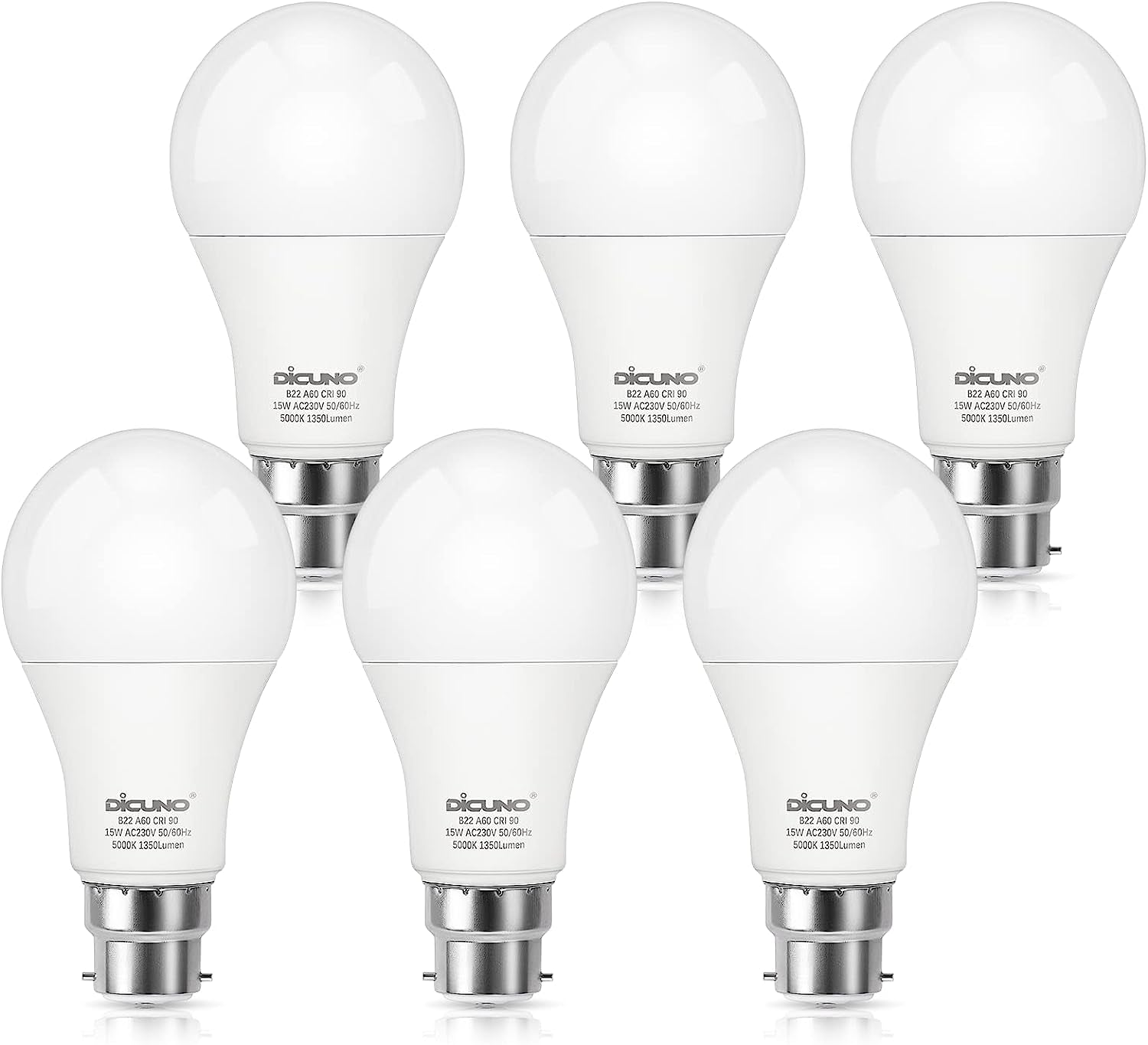
Buy on lumens, not watts. Wattage measures consumption; lumens measure light. A B22 bayonet LED rated 15 W and 1,350 lm is marketed as a 100 W replacement at CRI 90. An E27 10 W globe producing 1,400 lm is the screw-cap equivalent. Both run at 230 V, Australia's nominal mains voltage.
Check the cap before buying. Australian homes mostly use B22 bayonet and E27 Edison screw — our light bulb fitting types guide covers identification, and how many lumens you need per room covers sizing output so you do not over-light a room and pay for it.
Do not over-light. Lighting a room brighter than it needs is a permanent cost. Task lighting beats flooding a whole room — a floor lamp with three brightness levels lets you light the corner you are using rather than the whole ceiling.
Clean the fittings. A dusty globe and a soiled shade measurably reduce light output, which tempts people to add more lighting. Our guide on cleaning light fittings safely covers the power-off-first rule.
Changing a globe is a household job. Anything hardwired is not — installing fittings, downlights or new circuits is electrical work and in Australia must be done by a licensed electrician.
Standby Power: Small, Constant, Invisible
Standby power runs 24 hours a day for no benefit. Individually each device is small; collectively they are a continuous baseline load you are paying for around the clock.
The usual offenders: entertainment units, game consoles left in rest mode, chargers left plugged in, second fridges in the garage, and anything with a clock or a standby light.
Use switchable power boards for clusters that are genuinely off overnight. One switch beats unplugging six things.
The second fridge deserves scrutiny. An old fridge running in a garage to hold drinks can be one of the larger continuous loads in a household, and it runs harder in a hot garage than it would indoors.
Do not switch off things that should stay on — modems you rely on, medical equipment, or anything on a timer that matters.
Hot Water, Laundry and the Kitchen
Wash in cold where the fabric allows. Heating water is the energy cost in a wash cycle, not the machine turning.
Line dry rather than tumble dry. Australian sun is free and gentler on fabric. Our guide on choosing a clothes drying rack covers indoor options for wet weeks — and note that drying indoors adds moisture, which our condensation guide explains.
Run full loads. A half-full dishwasher or washing machine uses nearly the same energy as a full one.
Keep the fridge between the right temperatures and do not overfill it. A fridge that cannot circulate air works harder. Our how to organise a fridge guide covers the 5°C target and airflow.
Boil only the water you need, and cover pots — an uncovered pot loses heat continuously.
Ranked by Payback
| Rank | Change | Effort | Why it ranks here |
|---|---|---|---|
| 1 | Thermostat by 1–2 degrees | None | Largest load, immediate effect |
| 2 | Halogen → LED | One-off | ~80% cut, permanent, no behaviour change |
| 3 | Draught sealing and shading | Low | Reduces the biggest load structurally |
| 4 | Standby power boards | One-off | Removes a 24-hour baseline draw |
| 5 | Ceiling fan with air con | One-off | Lets you hold a higher thermostat setting |
| 6 | Cold washes, full loads, line drying | Habit | Real but smaller; needs repeating |
Permanent changes outrank habits. A habit has to be re-decided daily; a globe or a power board keeps working whether anyone remembers or not.
Ready to Start?
Do the thermostat today, because it is free and it is the biggest load. Then replace the halogens, because that saving is permanent and needs no behaviour change. Standby power is the third, and the second fridge is worth a hard look. Browse the LED lights collection or the full Pattan Australia range.
Frequently asked questions
What uses the most electricity in an Australian home?
Heating and cooling is the largest single share of a typical household bill, which is why the thermostat is the highest-leverage control in the house. Hot water and refrigeration follow. Lighting and standby power are smaller shares but among the cheapest to fix permanently.
How much does changing the thermostat by one degree save?
Roughly 5 to 10 per cent of that appliance's running cost per degree. Setting a much lower summer temperature does not cool a room faster, because a thermostat sets the target rather than the rate — it simply runs the unit longer and further than needed.
Do LED bulbs really save money?
Yes. LED uses roughly 80% less energy than halogen for equivalent light output, and the saving is permanent with no behaviour change required. Halogens also emit significant heat into the room, which cooling then has to remove, so the saving compounds in summer.
Is it cheaper to run a fan or air conditioning?
A ceiling fan draws a small fraction of what air conditioning draws. The most efficient approach is running both together, since air movement lets you sit comfortably at a higher thermostat setting — the saving comes from the higher setting rather than from the fan itself.
Does standby power actually cost much?
Individually each device is small, but standby draws continuously for 24 hours a day and collectively forms a baseline load you pay for constantly. Switchable power boards for clusters that are genuinely off overnight remove it with one switch rather than unplugging each device.
What is the fastest way to lower an energy bill?
Adjust the thermostat, since it is free, immediate, and affects the largest load. After that, replace halogen lighting with LED — a one-off change that cuts lighting energy by around 80% permanently and requires no ongoing effort to maintain.