Cart
0
Quick answer: Buy one system rather than several — a single range that stacks and shares lids — and size it to your shelf depth rather than to the food, because mismatched containers are what turn a cupboard into a jumble.
TL;DR: Most container frustration comes from owning three incompatible sets. Lids do not interchange, nothing stacks cleanly, and the collection expands until a whole cupboard is dedicated to storing empty boxes. One system solves it. After that the decisions are straightforward: square and rectangular containers use roughly 20% more of a shelf than round ones because circles waste the corners; glass is better for reheating and staining but heavier and breakable; plastic is lighter and safer around children but scratches and holds odours. And check the number that decides everything — Australian kitchen shelves are commonly 30 cm to 35 cm deep, so a container that does not use that depth wastes space you have already paid for.
Key facts
- Square and rectangular containers use shelf space roughly 20% more efficiently than round ones.
- Australian kitchen shelves are commonly 30 cm to 35 cm deep.
- One matching system beats several sets, because shared lids remove the main source of clutter.
- Nesting saves space when empty; stacking saves space when full. Most kitchens need both.
- Look for BPA-free plastic and check whether the lid, not just the base, is dishwasher safe.
- Produce containers need drainage, since sitting in pooled water is what spoils berries and greens.
Rule One: One System, Not Several
The single biggest improvement is owning one range. Shared lids, consistent footprints, predictable stacking.
Three half-sets is the normal state of a kitchen and it is why the cupboard never stays tidy. Lids that fit nothing accumulate, nothing stacks squarely, and every retrieval becomes a search.
Replace rather than add. Adding a fourth set to fix the problem created by three is the most common mistake.
Count what you actually need. Most households need fewer, larger containers than they own, plus a few small ones. The middle sizes are where duplication hides.
Glass or Plastic
Neither is universally better. They fail differently.
| Glass | Plastic | |
|---|---|---|
| Weight | Heavy | Light |
| Breakage | Breaks | Survives drops |
| Staining | Resists | Stains, especially tomato |
| Odours | Does not hold | Holds over time |
| Reheating | Generally microwave and oven safe | Microwave only, check the grade |
| Freezer | Risk of thermal shock | Generally fine |
| Children | Not ideal | Better |
| Cost | Higher | Lower |
Choose glass for reheating, for anything oily or tomato-based, and where you want containers to last a decade.
Choose plastic for lunchboxes, for children, for the freezer, and for anything carried out of the house.
Most kitchens want both — glass for the fridge and reheating, plastic for transport and freezing.
If you buy plastic, check it is BPA-free and food grade. A large stackable kitchen container at 27.5 × 18.5 × 9.5 cm is BPA-free and designed to stack, so cupboard, fridge and bench all work.
Shape: Why Square Wins
Square and rectangular containers use roughly 20% more of a shelf than round ones, because round containers waste the corners between them.
Round has one genuine advantage: no corners to clean, and liquids pour more cleanly.
For a fridge or pantry where space is tight, square is the better default. For soups and liquids, round is easier to live with.
Match the footprint to the shelf depth. Australian shelves are commonly 30 cm to 35 cm deep. A container 33 cm long uses that depth; one 20 cm long leaves dead space behind it that fills with forgotten items. A 9-piece set with three widths, all 33 cm long is built on exactly this logic — three wide at 23 cm, three medium at 15 cm and three narrow at 7 cm, so a shelf tiles edge to edge.
Nesting or Stacking
Nesting saves space when empty. Containers sit inside each other, which suits a small kitchen where most containers are unused most of the time.
Stacking saves space when full. Containers sit squarely on top of each other in the fridge or pantry.
Most kitchens need both, which is another argument for a single system designed to do both.
Lid storage is the hidden problem. Lids that store flat, clip to the base, or nest separately in a dedicated bin are worth choosing for. A set of foldable storage bins at 25 × 25 × 25 cm works as a lid corral inside a deep cupboard.
Special Cases Worth Buying For
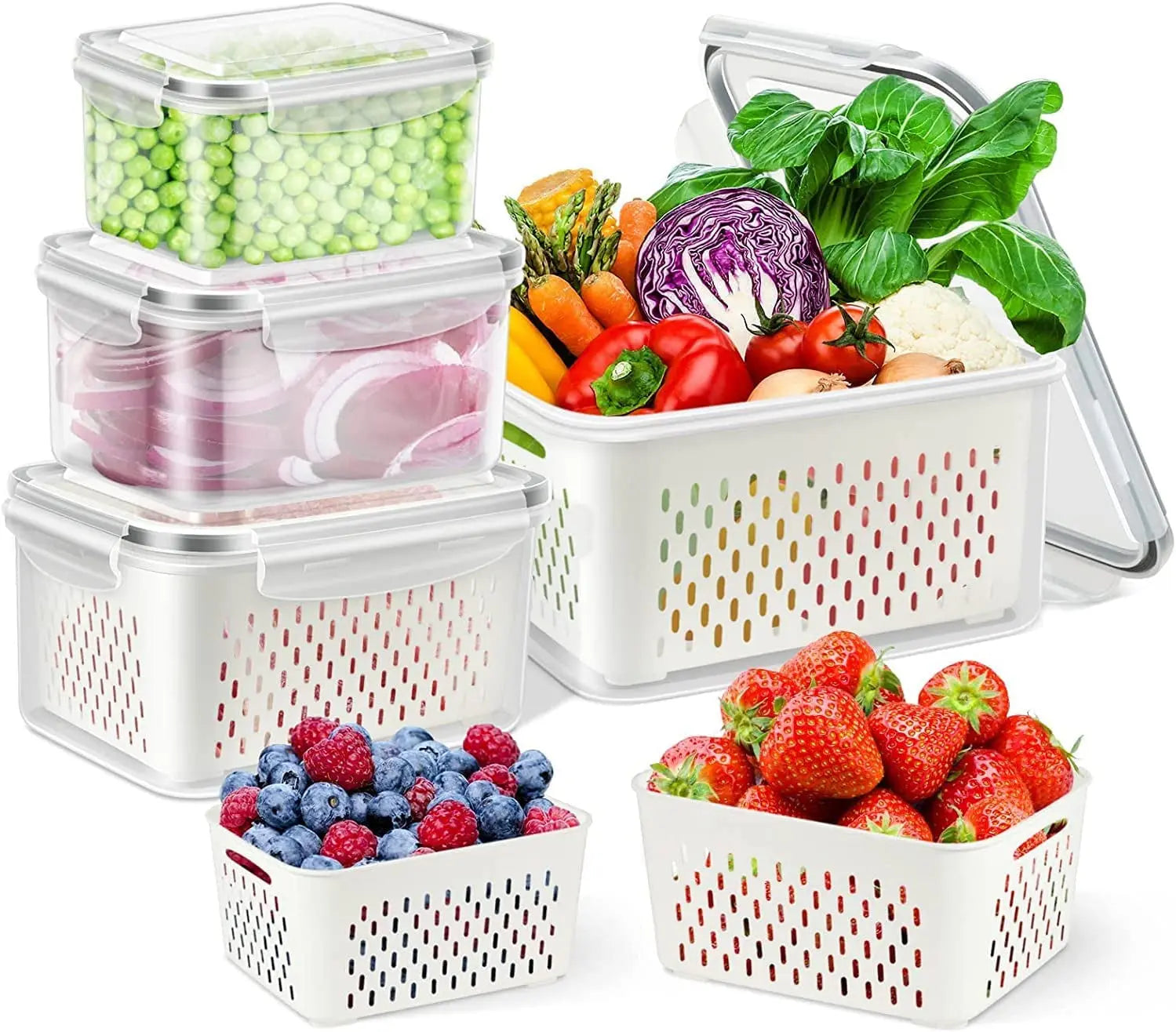
Produce needs drainage, not a seal. Berries and greens spoil because they sit in their own moisture. A container set with a built-in colander insert lifts produce clear of pooled water, and runs from extra-large down to small — the small size suits grapes, strawberries and cherries.
Fridge bins are containers for containers. A set of clear fridge organiser bins at 25 × 15 × 7.6 cm each groups loose items so they stop migrating. Our guide on how to organise a fridge covers zones, and how to store fruit and vegetables covers the ethylene rule that decides what goes where.
Bins with drain trays suit anything washed before storing. A stackable set with removable drain trays includes a large bin at 30 × 30 × 14.5 cm holding 9.8 L.
Care: What Actually Kills Containers
Check whether the lid is dishwasher safe, not just the base. Lids warp in a hot dishwasher far more often than bases, and a warped lid no longer seals — which retires an otherwise fine container.
Hand wash anything the label says to hand wash. Several clear plastics are explicitly not dishwasher safe, and heat clouds them permanently.
Staining is mostly preventable. Rinse tomato-based residue immediately rather than letting it sit.
Odours mean the plastic has absorbed them. Sun exposure helps; often it is simply time to replace that container.
Store lids with their bases where you can. A lid separated from its base is the first step to a lid that belongs to nothing.
Our guides on how to organise a pantry and small kitchen storage ideas cover where the containers then live.
Ready to Replace the Jumble?
Pick one system and replace rather than add. Size it to your shelf depth, favour square for space efficiency, and split glass for reheating from plastic for transport. Then check that the lids — not just the bases — survive your dishwasher. Browse the kitchen storage collection.
Frequently asked questions
Are glass or plastic food containers better?
Neither universally — they fail differently. Glass resists staining and odours and handles reheating, but is heavy and breakable. Plastic is light, survives drops and suits the freezer and lunchboxes, but stains and absorbs odours over time. Most kitchens benefit from both.
What size food containers should you buy?
Size them to your shelf depth rather than to the food. Australian kitchen shelves are commonly 30 cm to 35 cm deep, so containers that use that full depth avoid dead space behind them. Most households need fewer large containers and a few small ones, with the middle sizes being where duplication hides.
Are square or round containers better?
Square and rectangular use shelf space roughly 20% more efficiently, because round containers waste the corners between them. Round containers are easier to clean and pour from, which suits liquids and soups, so the right answer depends on whether space or handling matters more.
How do you stop food containers staining?
Rinse tomato-based and oily residue immediately rather than letting it sit, since that is when staining sets. Glass resists staining almost entirely, so if it is a recurring problem in your kitchen the practical fix is using glass for those foods rather than trying to prevent it in plastic.
Why do container lids stop sealing?
Usually heat. Lids warp in a hot dishwasher far more often than bases do, and a warped lid no longer seals properly. Check whether the lid specifically is dishwasher safe, not just the container, and hand wash anything the label says to.
How do you store food container lids?
Keep lids with their bases wherever possible, since a separated lid is the first step towards one that belongs to nothing. Where that is impractical, corral them in a dedicated bin inside the cupboard rather than letting them lie loose, and favour systems where lids stack flat or clip on.