Cart
0
Quick answer: Only three categories earn permanent bench space — things used daily, things too heavy to lift out, and things that are genuinely decorative — and everything else goes in a cupboard or on a wall.
TL;DR: A cluttered benchtop is almost never a storage problem. It is a decision problem: nobody has decided what is allowed to live there, so everything does. Apply one test — used daily, too heavy to move, or deliberately decorative — and most benchtops empty out immediately. After that it is about protecting the work triangle, keeping one completely clear preparation zone, and moving upward rather than outward, because vertical storage costs no bench area. The rotating and wall-mounted options matter most in small Australian kitchens, where bench depth is typically only about 60 cm and the usable strip in front of the splashback is narrower than people assume.
Key facts
- Standard Australian benchtop depth is around 60 cm, leaving a usable working strip of roughly 40 cm.
- Only three categories earn permanent bench space: daily-use, too-heavy-to-lift, and decorative.
- Keep at least one preparation zone completely clear at all times.
- Vertical and rotating storage costs no bench area for the same capacity.
- Appliances used less than weekly belong in a cupboard, not on the bench.
The Three-Category Test
Everything currently on your benchtop falls into one of four groups. Three stay, one goes.
1. Used daily. The kettle, if you use it every morning. The knife you actually reach for. Not the appliance you use on weekends.
2. Too heavy to lift out. A stand mixer that weighs 10 kg is not going into a low cupboard and back out again — it earns its space by physics. A small appliance you can lift one-handed does not.
3. Genuinely decorative. A bowl of fruit, a plant. One or two items, chosen, not accumulated.
4. Everything else. This is the group that is actually causing the problem, and almost all of it fits somewhere else.
Be honest about the "daily" test. Most people overestimate it substantially. If you cannot remember using it this week, it is not daily.
Protect One Clear Zone
Keep at least one preparation area completely empty. Not tidy — empty.
Australian benchtops are typically about 60 cm deep, and once you allow for the splashback and anything pushed to the back, the genuinely usable working strip is closer to 40 cm. That is not much, and it disappears fast.
Work out where you actually prepare food — usually between the sink and the cooktop — and defend that stretch. Everything else can be negotiated.
Corners are the least valuable bench real estate and the right home for anything that must stay out but is not used constantly.
Go Vertical and Rotating
This is where small kitchens win, because height is free and bench area is not.
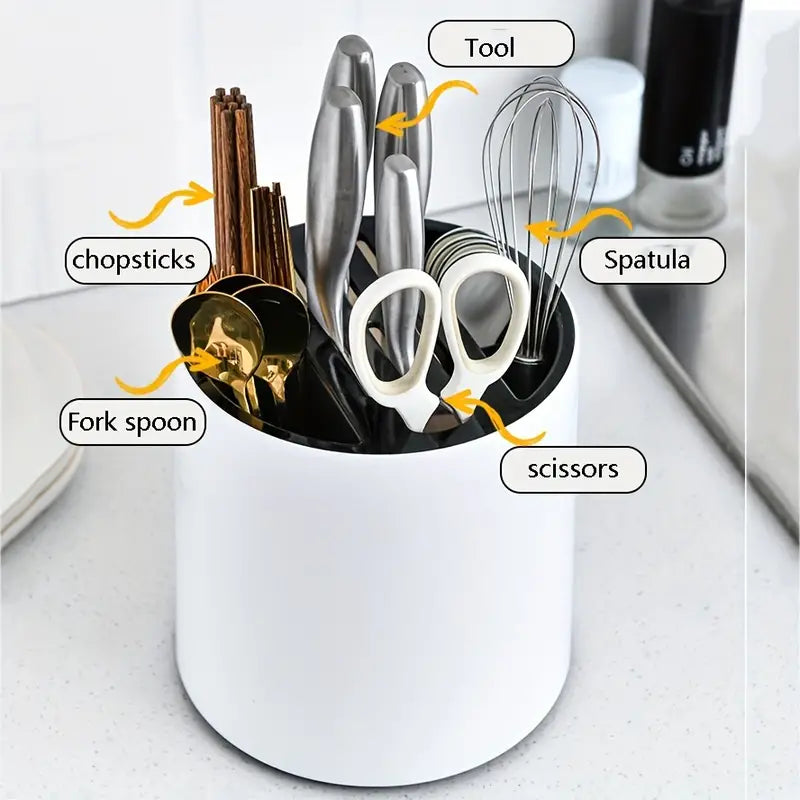
Rotating storage holds more in the same footprint. A rotating knife and utensil rack combines a knife holder with utensil storage in one unit that spins, so you reach what you need without a drawer or a wide spread of containers. It weighs 0.61 kg, so it moves easily when you need the space, and comes in white, grey or green.
Knives especially benefit from getting off the bench and out of drawers. Our guide on how to store kitchen knives safely covers block, magnetic and in-drawer options and the safety trade-offs.
Stackable containers use height instead of width. A large stackable kitchen container at 27.5 × 18.5 × 9.5 cm is BPA-free and moves between bench, cupboard and fridge, which means it is not single-purpose.
Spices are the classic bench-clutter category. Our guide on how to organise a spice rack covers getting them into one system rather than three half-systems.
Where the Displaced Items Go
Clearing the bench only works if there is somewhere for things to land.
Drawers, properly divided. An undivided drawer is where bench clutter goes to become drawer clutter. Our guide on organising a kitchen drawer with dividers covers it.
Cupboards, zoned by task. Baking together, everyday together. Our how to organise a pantry guide covers zoning.
The fridge, for anything that should have been in there anyway. A set of clear fridge organiser bins at 25 × 15 × 7.6 cm each subdivides a shelf so things stop migrating out to the bench. Our how to organise a fridge guide covers the zones.
Food that has been sitting in packets on the bench usually belongs in sealed containers. A container set with a colander insert runs extra-large down to small.
If nothing has anywhere to go, the problem is upstream. Our small kitchen storage ideas guide covers finding capacity in a kitchen that has none.
The Habits That Keep It Clear
Reset the bench at the end of each day. Five minutes, every night. This single habit does more than any container.
Nothing new gets bench space without something leaving. A strict swap keeps the count stable.
Deal with the paper immediately. Mail, receipts and school notes are the most common non-kitchen items on a kitchen bench, and they belong nowhere near it. Our guide on organising a small entryway covers intercepting paper before it reaches the kitchen.
Charge phones somewhere else. A charging point on the bench turns it into a desk.
If you stand at the bench for long stretches, comfort matters as much as tidiness — our guide on anti-fatigue kitchen mats covers whether one is worth it.
Do It in This Order
- Clear the entire bench. Everything off, no exceptions. Organising around what is there just rearranges it.
- Clean the empty surface. You will not get another chance this easily.
- Apply the three-category test to each item as you consider putting it back.
- Return only what passes, placing daily-use items nearest where you use them.
- Rehome the rest into drawers, cupboards or the fridge — not into a pile elsewhere.
- Defend one clear preparation zone and keep it that way.
Ready to Clear Yours?
Take everything off, then let only three categories back on: daily use, too heavy to lift, deliberately decorative. Go vertical for anything that must stay out, and keep one preparation zone genuinely empty. Browse the kitchen storage collection for the racks and containers that hold it in place.
Frequently asked questions
What should be kept on a kitchen benchtop?
Only three categories: items used daily, items too heavy to lift in and out of a cupboard, and one or two deliberately decorative pieces. Everything else belongs in a drawer, cupboard or fridge. Most people overestimate what qualifies as daily use.
How do you organise a small kitchen bench?
Go vertical and rotating rather than spreading outward, since height costs no bench area. Australian benchtops are typically about 60 cm deep with only around 40 cm genuinely usable, so protect one clear preparation zone and push anything that must stay out into a corner.
How do you stop a kitchen bench getting cluttered again?
Reset it completely at the end of each day, and apply a strict swap rule where nothing new earns bench space unless something leaves. Deal with mail and paper immediately and charge phones elsewhere, since those are the two most common non-kitchen invaders.
Should small appliances be stored on the bench?
Only if you use them daily or they are too heavy to lift comfortably. A stand mixer earns its place through weight; a sandwich press used on weekends does not. Anything you can lift one-handed and use less than weekly belongs in a cupboard.
Where should knives be stored in a small kitchen?
Off the benchtop and out of an undivided drawer. A rotating rack, a block or a magnetic strip all keep blades protected and accessible while using less surface area than knives spread across the bench, and all are safer than loose knives in a drawer.
What is the first step to decluttering a benchtop?
Remove everything, then clean the empty surface before anything goes back. Organising around items already in place only rearranges the problem, and an empty bench is the only time you can genuinely assess what deserves to return.